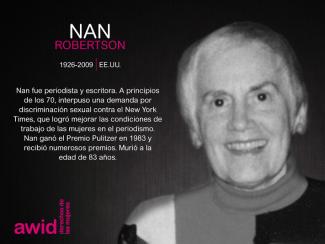
Nan Robertson
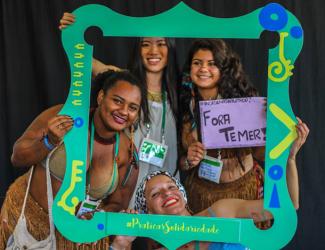
Young feminist activists play a critical role in women’s rights organizations and movements worldwide by bringing up new issues that feminists face today. Their strength, creativity and adaptability are vital to the sustainability of feminist organizing.
At the same time, they face specific impediments to their activism such as limited access to funding and support, lack of capacity-building opportunities, and a significant increase of attacks on young women human rights defenders. This creates a lack of visibility that makes more difficult their inclusion and effective participation within women’s rights movements.
AWID’s young feminist activism program was created to make sure the voices of young women are heard and reflected in feminist discourse. We want to ensure that young feminists have better access to funding, capacity-building opportunities and international processes. In addition to supporting young feminists directly, we are also working with women’s rights activists of all ages on practical models and strategies for effective multigenerational organizing.
We want young feminist activists to play a role in decision-making affecting their rights by:
Fostering community and sharing information through the Young Feminist Wire. Recognizing the importance of online media for the work of young feminists, our team launched the Young Feminist Wire in May 2010 to share information, build capacity through online webinars and e-discussions, and encourage community building.
Researching and building knowledge on young feminist activism, to increase the visibility and impact of young feminist activism within and across women’s rights movements and other key actors such as donors.
Promoting more effective multigenerational organizing, exploring better ways to work together.
Supporting young feminists to engage in global development processes such as those within the United Nations
Collaboration across all of AWID’s priority areas, including the Forum, to ensure young feminists’ key contributions, perspectives, needs and activism are reflected in debates, policies and programs affecting them.
Nous Sommes la Solution uplifts and grows the leadership of rural women working towards African solutions for food sovereignty.
(avec des invités spéciaux!)
📅Mardi 12 mars
🕒18 h - 21 h 30 HNE
🏢 Blue Gallery, 222 E 46th St, New York
Entrée par RSVP uniquement
Merci de votre visite sur le site d'AWID. Pour plus d'informations sur AWID rendez-vous sur https://www.awid.org/fr
En 2021, l’AWID, comme beaucoup d’autres organisations, a dû faire face aux répercussions de la pandémie mondiale en cours sur notre façon de travailler et notre rôle en ces temps particuliers. L’année nous a appris trois leçons essentielles sur la façon de traverser cette période en tant qu’organisation mondiale de soutien au mouvement féministe.
Téléchargez le rapport annuel 2021
Notre expérience en 2021 nous a permis de constater que l’AWID jouait un rôle important et quelque peu unique dans la création et le maintien d’une communauté féministe mondiale transcendant les identités et les thèmes.

Cooperativa Textil Nadia Echazú
The WITM survey is focused on the feminist resourcing realities of the last 3 years (2021 to 2023), and has five key sections:
It consists of mandatory* and optional questions, most of which are multiple-choice. You will have a chance to share more on issues that are important to you by responding to the open question(s) at the end of the survey.

To respond to the questions quickly and easily, we advise that you have your key financial information at hand (e.g., your annual budgets from 2021 to 2023). However, if you wish to save your responses and come back to the survey later, you are able to do this whenever needed.
Building Feminist Economies is about creating a world with clean air to breath and water to drink, with meaningful labour and care for ourselves and our communities, where we can all enjoy our economic, sexual and political autonomy.
In the world we live in today, the economy continues to rely on women’s unpaid and undervalued care work for the profit of others. The pursuit of “growth” only expands extractivism - a model of development based on massive extraction and exploitation of natural resources that keeps destroying people and planet while concentrating wealth in the hands of global elites. Meanwhile, access to healthcare, education, a decent wage and social security is becoming a privilege to few. This economic model sits upon white supremacy, colonialism and patriarchy.
Adopting solely a “women’s economic empowerment approach” is merely to integrate women deeper into this system. It may be a temporary means of survival. We need to plant the seeds to make another world possible while we tear down the walls of the existing one.
We believe in the ability of feminist movements to work for change with broad alliances across social movements. By amplifying feminist proposals and visions, we aim to build new paradigms of just economies.
Our approach must be interconnected and intersectional, because sexual and bodily autonomy will not be possible until each and every one of us enjoys economic rights and independence. We aim to work with those who resist and counter the global rise of the conservative right and religious fundamentalisms as no just economy is possible until we shake the foundations of the current system.
Advance feminist agendas: We counter corporate power and impunity for human rights abuses by working with allies to ensure that we put forward feminist, women’s rights and gender justice perspectives in policy spaces. For example, learn more about our work on the future international legally binding instrument on “transnational corporations and other business enterprises with respect to human rights” at the United Nations Human Rights Council.
Mobilize solidarity actions: We work to strengthen the links between feminist and tax justice movements, including reclaiming the public resources lost through illicit financial flows (IFFs) to ensure social and gender justice.
Build knowledge: We provide women human rights defenders (WHRDs) with strategic information vital to challenge corporate power and extractivism. We will contribute to build the knowledge about local and global financing and investment mechanisms fuelling extractivism.
Create and amplify alternatives: We engage and mobilize our members and movements in visioning feminist economies and sharing feminist knowledges, practices and agendas for economic justice.
“The corporate revolution will collapse if we refuse to buy what they are selling – their ideas, their version of history, their wars, their weapons, their notion of inevitability. Another world is not only possible, she is on her way. On a quiet day, I can hear her breathing”.
Arundhati Roy, War Talk
Con más de 10 años de experiencia en finanzas, Lucy ha dedicado su carrera a misiones con y sin fines de lucro. También ha prestado trabajo voluntario para organizaciones sin fines de lucro. Desde el acelerado mundo de las finanzas, Lucy siente pasión por estar al día con las competencias tecnológicas asociadas con este ámbito. Lucy se incorporó a AWID en 2014. En su tiempo libre disfruta de la música, de viajar y de practicar una variedad de deportes.
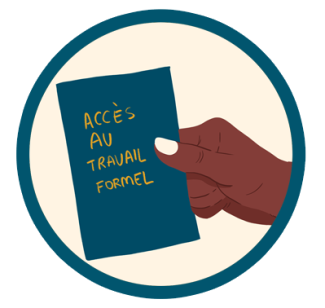
Seul·es 18 % des trans et travestis en Argentine ont accès à un emploi formel.
To make the complexity of resourcing diverse forms of feminist organizing visible
Kasia soutient le travail des mouvements féministes et de justice sociale depuis 15 ans. Avant de rejoindre l'AWID, Kasia dirigeait les politiques et le plaidoyer d’ActionAid et d’Amnesty International, tout en se mobilisant avec des féministes et des groupes de justice sociale en Pologne pour l'accès à l'avortement et la lutte contre les violences aux frontières européennes. Kasia est passionnée par le ressourcement des organisations féministes dans tout leur courage, leur richesse et leur diversité. Elle partage son temps entre Varsovie et son village communautaire de bricolage dans la forêt. Elle adore les saunas et aime follement son chien Wooly.
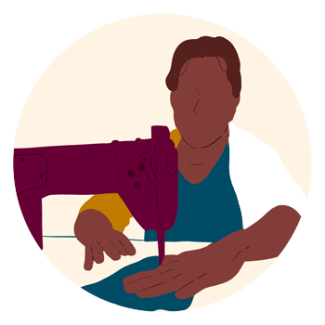
THE TRANS EMPLOYMENT QUOTA
sanctioned by law is not being respected by companies and employers
 Le financement des mouvements féministes est indispensable à la mise en place d’une présence plus juste et pacifique et d’un avenir libéré. Au cours de la dernière décennie, les bailleurs de fonds se sont engagés à verser bien plus d’argent en faveur de l’égalité des genres, mais 1 % seulement des financements philanthropiques et de développement a réellement été destiné à financer directement les changements sociaux menés par des féministes (ressource en anglais).
Pour viser l’abondance, et rompre ce cycle d’insuffisance chronique, l’enquête WITM est une invitation pour les activistes féministes et défenseur·ses de la justice de genre à se lancer dans l’aventure de la collecte de données probantes et d’arguments en faveur de la mobilisation de davantage d’argent, de meilleure qualité, et de réappropriation du pouvoir au sein de l’écosystème actuel du financement. En solidarité avec les mouvements qui continuent à être invisibilisés, marginalisés et empêchés d’accéder à des financements de base, à long terme, flexibles et reposant sur la confiance, l’enquête WITM souligne l’état actuel de la mobilisation de ressources, remet en question les fausses solutions, et identifie les changements à opérer au sein des modèles de financement afin que les mouvements s’épanouissent et relèvent les défis complexes de notre époque.