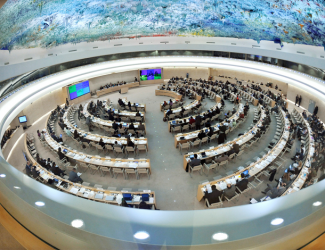
Jean-Marc Ferré | Flickr (CC BY-NC-ND 2.0)
A general view of participants at the 16th session of the Human Rights Council in Geneva, Switzerland.

Análisis Especiales

AWID es un organización feminista internacional de membresía, que brinda apoyo a los movimientos que trabajan para lograr la justicia de género y los derechos de las mujeres en todo el mundo.

Consejo de Derechos Humanos (CDH)

El Consejo de Derechos Humanos (CDH) es el cuerpo intergubernamental del sistema de las Naciones Unidas responsable de la promoción y protección de todos los derechos humanos en todo el mundo. El HRC se reúne en sesión ordinaria tres veces al año, en marzo, junio y septiembre.  La La Oficina del Alto Comisionado para los Derechos Humanos (ACNUDH) es la secretaría del Consejo de Derechos Humanos.

El CDH  trabaja de la siguiente forma:

  • Debate y aprueba resoluciones sobre cuestiones mundiales de derechos humanos y el estado de los derechos humanos en determinados países

  • Examina las denuncias de víctimas de violaciones a los derechos humanos o las de organizaciones activistas, quienes interponen estas denuncias representando a lxs víctimas.

  • Nombra a expertos independientes que ejecutarán los «Procedimientos Especiales» revisando y presentado informes sobre las  violaciones a los derechos humanos desde una perspectiva temática o en relación a un país específico

  • Participa en discusiones con expertos y  gobiernos respecto a cuestiones de derechos humanos.

  • A través del Examen Periódico Universal, cada cuatro años y medio, se evalúan los  expedientes de derechos humanos de todos los Estados Miembro de las Naciones Unidas

Aprende más sobre el CDH


La Sesión actual - CDH44

Se está llevarando a cabo en Ginebra, Suiza del 30 de junio al 17 de julio de 2020.

AWID trabaja con socios feministas, progresistas y de derechos humanos para compartir conocimientos clave, convocar diálogos y eventos de la sociedad civil, e influir en las negociaciones y los resultados de la sesión.

Con nuestrxs socixs, nuestro trabajo será:


◾️ Monitorear, rastrear y analizar actores, discursos y estrategias anti-derechos y su impacto en las resoluciones

◾️ Desarrollar conjuntamente una labor de promoción conjunta para contrarrestar a los actores anti-derechos y debatir más a fondo las conclusiones del Informe de Tendencias de OUR de 2017

◾️ Apoyar, coordinar y desarrollar de manera colaborativa el Caucus feminista emergente en el CDH


Contenido relacionado

Snippet - CSW69 - Feminist Solidarity Space 12 - EN

Feminist Solidarity Space

✉️ By registration for larger groups. Drop-ins for smaller groups. Register here

📅 Wednesday, March 12, 2025
🕒 2.00-4.00pm EST

🏢 Chef's Kitchen Loft with Terrace, 216 East 45th St 13th Floor New York 

Organizer: AWID

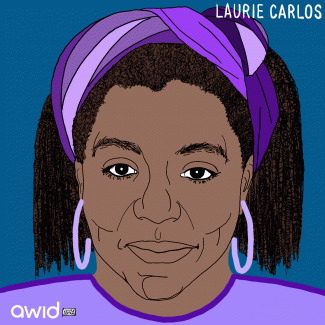
Laurie Carlos

Laurie Carlos was an actor, director, dancer, playwright, and poet in the United States. An extraordinary artist and visionary with powerful ways of bringing the art out in others. 

“Laurie walked in the room (any room/every room) with swirling clairvoyance, artistic genius, embodied rigor, fierce realness—and a determination to be free...and to free others. A Magic Maker. A Seer. A Shape Shifter. Laurie told me once that she went inside people’s bodies to find what they needed.” - Sharon Bridgforth 

She combined performance styles such as rhythmic gestures and text. Laurie mentored new actors, performers, writers and helped amplify their work through Naked Stages, a fellowship for emerging artists. She was an artistic fellow at Penumbra Theater and supported with identifying scripts to produce, with a goal of “bringing more feminine voices into the theater”. Laurie was also a member of Urban Bush Women, a renowned contemporary dance company telling stories of women of the African diaspora.

In 1976, as Lady in Blue, she made her Broadway debut in Ntozake Shange’s original and award-winning production of the poetic drama For colored girls who have considered suicide / when the rainbow is enuf. Laurie’s own works include White Chocolate, The Cooking Show, and Organdy Falsetto

“I tell the stories in the movement—the inside dances that occur spontaneously, as in life—the music and the text. If I write a line, it doesn’t necessarily have to be a line that is spoken; it can be a line that’s moved. A line from which music is created. The gesture becomes the sentence. So much of who we are as women, as people, has to do with how we gesture to one another all the time, and particularly through emotional moments. Gesture becomes a sentence or a state of fact. If I put on a script ‘four gestures,’ that doesn’t mean I’m not saying anything; that means I have opened it up for something to be said physically.” Laurie Carlos

Laurie was born and grew up in New York City, worked and lived in Twin Cities. She passed away on 29 December 2016, at the age of 67, after a battle with colon cancer.


Tributes:  

“I believe that that was exactly Laurie’s intention. To save us. From mediocrity. From ego. From laziness. From half-realized art making. From being paralyzed by fear.
Laurie wanted to help us Shine fully.
In our artistry.
In our Lives.” - Sharon Bridgforth for Pillsbury House Theatre

“There’s no one that knew Laurie that wouldn’t call her a singular individual. She was her own person. She was her own person, her own artist; she put the world as she knew it on stage with real style and understanding, and she lived her art.” - Lou Bellamy, Founder of Penumbra Theater Company, for Star Tribune 
Read a full Tribute by Sharon Bridgforth

Snippet FEA ASOM Challenges Story 1 (ES)

DESAFÍOS

  • Cambio Climático
  • Acesso a créditos
  • Intermediários

Fatima Qureshi

Biography

A nomad of cultures, born in Hong Kong, rooted in Turkish-Pakistani heritage, Fatima’s love for narratives - both in reading and co-creating them - fueled her passion for communications activism. Supported by her education in journalism, Fatima has worked for 7 years in digital and media communications fields with NGOs that provide education opportunities and legal aid to refugee and asylum seekers, as well as with the Muslim feminist movement which applies feminist and rights-based lenses in understanding and searching for equality and justice within Muslim legal tradition. She is a regular op-ed writer on feminist issues in the Global South.

Through storytelling in this hyper-digital age of social media, Fatima continues to collaborate with community organizers and grassroots activists to create audiovisual content with the aim to cultivate bridges of understanding towards collective liberation and decolonization. On days when she’s not working, she intently watches independent feminist films coming from Iran, Morocco and Pakistan and on other days, she performs spoken word poetry with her comrades in Kuala Lumpur.

Position
ICM Digital Communications and Partnerships Lead
Add to stories
Off

Snippet - WCFM Airtable iFrame - EN

Explore the Database now!

Don't know where to start? Let's try understanding the filters.


Fadila M.

Fadila M. fue una activista tribal soulaliyate de Azrú, en la región Ifrane de  Marruecos. Luchó contra una forma específica de discriminación territorial dirigida a  las mujeres tribales.

Como parte del Movimiento de Mujeres Soulaliyate por el Derecho a la Tierra, trabajó para reformar el marco legislativo relacionado con la administración de la propiedad comunitaria, a través de la adopción, en 2019, de tres proyectos de ley que garantizan la igualdad de mujeres y varones.

Según las leyes consuetudinarias vigentes, las mujeres no tenían derecho a beneficiarse de la tierra, en especial aquellas que eran solteras, viudas o divorciadas. En Marruecos, los derechos a las tierras colectivas eran transmitidos tradicionalmente entre los varones de la familia mayores de 16 años. Desde 2007, Fadila M. ha sido parte del movimiento de mujeres, la primera movilización nacional de base por los derechos a la tierra. Una de sus conquistas ha sido que, en 2012, las mujeres soulaliyate pudieron registrarse por primera vez en las listas de beneficiarixs, y recibir compensaciones relacionadas con la cesión de tierras. El movimiento también logró la enmienda del dahir (decreto del Rey de Marruecos) de 1919, para garantizar el derecho a la igualdad de las mujeres.

Fadila M. falleció el 27 de septiembre de 2018. Las circunstancias de su muerte no son claras. Participó en una marcha de protesta relacionada con el tema de las tierras colectivas y, si bien las autoridades informaron que su muerte fue accidental y que tuvo un paro cardíaco camino al hospital, la sección local de la Asociación de Derechos Humanos de Marruecos (AMDH) señaló que Fadila fue sofocada por un miembro de la fuerza policial utilizando una bandera marroquí. Su familia solicitó una investigación, pero los resultados de la autopsia no fueron dados a conocer.

Más información sobre el Movimiento de Mujeres Soulaliyate por el Derecho a la Tierra (en inglés)


Nota: Como no ninguna fotografía/imagen de Fadila M. disponible, la obra de arte (en lugar de un retrato) pretende representar por lo que luchó y trabajó: la tierra y los derechos a vivir y tener acceso a esa tierra y lo que crece en ella.

Snippet FEA Barcelona, Spain (FR)

Barcelone, Espagne

Metzineres


Les Gens se Droguent.

ET ALORS?

Nana Abuelsoud

Biography

Nana es una organizadora feminista e investigadora en derechos reproductivos y políticas demográficas que reside en Egipto. Es miembro de RESURJ (organización feminista por la justicia sexual y reproductiva), del Órgano Asesor del Proyecto A del Líbano y de la Comisión de la Comunidad de Mama Cash. Nana tiene una maestría en Salud Pública del Instituto KIT y la Universidad Vrije de Ámsterdam. En su trabajo, da seguimiento y contextualiza las políticas demográficas nacionales, al tiempo que reúne información para abordar la eugenesia moderna, las ayudas internacionales de carácter regresivo y el autoritarismo. Anteriormente, formó parte de la Fundación de Ginebra para la Educación y la Investigación Médica, la Iniciativa Egipcia para los Derechos Personales y el Colectivo Feminista Ikhtyar de El Cairo.

Add to stories
Off

Snippet - WCFM Contact us- En

Contact Us

If your funding institution is already a part of the Database and you would like to contact us to update your record, or if you would like to leave some feedback for us, please use the form above.

Rosa Candida Mayorga Muñoz

Rosa Candida Mayorga Muñoz était une travailleuse sociale, leader syndicale et défenseure des droits humains du Guatemala. On la surnommait affectueusement Rosita. 

Dans les années 1980, Rosa devient la première femme à siéger au comité exécutif du syndicat de l’Institut d’électrification nationale (STINDE), syndicat qu’elle avait rejoint en premier lieu pour défendre les droits des femmes au travail. Cela signifiait, à ses yeux, de lutter pour l’égalité des chances dans une entreprise où de nombreuses femmes affrontaient un système discriminatoire et violent mis en place par la direction de l’entreprise. Rosa avait également subi du harcèlement sexuel sur son lieu de travail, tant de la part de collègues que de responsables. Elle n’entendait cependant pas rester silencieuse. 

Rosa a continué à se battre et fait partie des efforts pour façonner la lutte afin qu’elle prenne la forme du « Pacte collectif pour les conditions de travail du INDE-STINDE ». Ce pacte était le premier du genre et le premier au Guatemala à caractériser le concept de harcèlement (sexuel). Il fait désormais référence dans la loi guatémaltèque pour les questions de travail, et sert d’encouragement aux autres syndicats.

« Elle n’avait d’autres outils pour se battre que ses propres idéaux... Elle a été intimidée à plusieurs reprises, harcelée pour abandonner la lutte, mais son courage a fait naître l’espoir chez les syndicalistes de la base. Rosita a créé une image de respect non seulement au sein de son syndicat mais également face aux autorités de l’institution et au sein du mouvement des femmes. Elle a été reconnue comme une pionnière du mouvement des femmes du syndicat, dans un espace qui avait davantage été dominé par les hommes. » - Maritza Velasquez, ATRAHDOM

Rosa est décédée le 4 avril 2018, elle avait 77 ans.

Snippet FEA Care as the foundation (EN)

Care as the foundation of economies

The COVID-19 pandemic put the global crisis of care into sharp focus and demonstrated the failures of the dominant economic model that is decimating essential public services, social infrastructures and systems of care around the world.

Cozinha Ocupação 9 Julho, the Association of Afro-Descendant Women of the Northern Cauca (ASOM) and Metzineres are only some examples of caring economies that center the needs of marginalized people and nature, as well as the reproductive, invisibilized, and unpaid care work required to ensure the sustainability of our lives, societies and eco-systems.

¿Cómo se inició AWID?

AWID surgió en 1982 y se ha ido transformando con el paso de los años en una verdadera organización mundial.

Saber más de nuestra historia

Leer «From “WID” to “GAD” to Women’s Rights: The First Twenty Years of AWID» (en inglés)

Clone of Snippet - WITM About the survey - FR

In 2023, feminist and 
women's rights organizations 
had a median annual budget of $22,000

In contrast, over $1 billion went to three anti-rights groups 2021-2022, with funding for anti-gender networks still rising.1

1 Global Philanthropy Project, 2024

Esther Mwikali

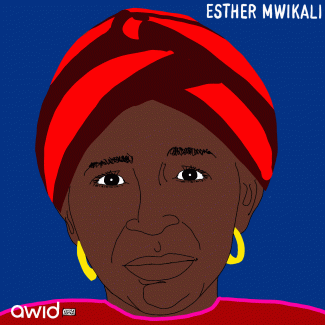
Esther Mwikali’s home was in Mithini village, Murang’a County, Kenya. A prominent and valued land rights activist, she looked into abuses against squatters who are living on land claimed by tycoons. The investigation Esther was part of also involved land rights’ violations in Makuyu by powerful individuals.

After failing to attend a village meeting, a search party went looking for Esther. On 27 August 2019, two days after her disappearance, her body was found on a farm near her homestead, displaying signs of torture. She was brutally murdered. 

“Esther was renowned for her work to prevent community members being evicted from land claimed by tycoons. Local activists had no doubt her murder was related to the area’s ongoing land struggles, a tragic reminder of the alarming regularity with which extra-judicial killings are routinely carried out in Kenya,” - Global Witness Report, July 2020

“We associate Mwikali’s death with land struggles around here. We are asking the Government to investigate the matter without delay.” - James Mburu, spokesperson for the squatters

“Action should be taken on individuals who are alleged to have threatened the squatters including Mwikali's family.” - Alice Karanja, National Coalition of Human Rights Defenders

“The impact of her work and tenacity will remain alive in Kenya for decades. CJGEA consoles with the bereaved and it calls for justice.” - Center for Justice and Governmental Action (CJGEA) Press Release, 13 September 2019

Snippets FEA EoS The Cover (EN)

Illustration of a pink house with a yellow background

The Cover
Care and healing environment

Quels sont les enjeux sur lesquels travaille l’AWID ?

L’AWID œuvre à renforcer la justice de genre et les droits humains des femmes.

Nous travaillons à renforcer les voix et l'impact des défenseuses des droits humains, des organisations et des mouvements.

Nos Domaines prioritaires sont étroitement liés aux réalités internationales. Ils sont le reflet de situations de plus en plus précaires qui sapent les droits des femmes à l’échelle mondiale.

  • La justice économique 
  • Les ressources pour les droits des femmes
  • S'opposer aux fondamentalismes religieux
  • Les défenseuses des droits humains
  • L'activisme des jeunes féministes

Découvrir les domaines prioritaires de l’AWID