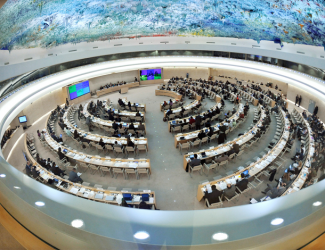
Jean-Marc Ferré | Flickr (CC BY-NC-ND 2.0)
A general view of participants at the 16th session of the Human Rights Council in Geneva, Switzerland.

Análisis Especiales

AWID es un organización feminista internacional de membresía, que brinda apoyo a los movimientos que trabajan para lograr la justicia de género y los derechos de las mujeres en todo el mundo.

Consejo de Derechos Humanos (CDH)

El Consejo de Derechos Humanos (CDH) es el cuerpo intergubernamental del sistema de las Naciones Unidas responsable de la promoción y protección de todos los derechos humanos en todo el mundo. El HRC se reúne en sesión ordinaria tres veces al año, en marzo, junio y septiembre.  La La Oficina del Alto Comisionado para los Derechos Humanos (ACNUDH) es la secretaría del Consejo de Derechos Humanos.

El CDH  trabaja de la siguiente forma:

  • Debate y aprueba resoluciones sobre cuestiones mundiales de derechos humanos y el estado de los derechos humanos en determinados países

  • Examina las denuncias de víctimas de violaciones a los derechos humanos o las de organizaciones activistas, quienes interponen estas denuncias representando a lxs víctimas.

  • Nombra a expertos independientes que ejecutarán los «Procedimientos Especiales» revisando y presentado informes sobre las  violaciones a los derechos humanos desde una perspectiva temática o en relación a un país específico

  • Participa en discusiones con expertos y  gobiernos respecto a cuestiones de derechos humanos.

  • A través del Examen Periódico Universal, cada cuatro años y medio, se evalúan los  expedientes de derechos humanos de todos los Estados Miembro de las Naciones Unidas

Aprende más sobre el CDH


La Sesión actual - CDH44

Se está llevarando a cabo en Ginebra, Suiza del 30 de junio al 17 de julio de 2020.

AWID trabaja con socios feministas, progresistas y de derechos humanos para compartir conocimientos clave, convocar diálogos y eventos de la sociedad civil, e influir en las negociaciones y los resultados de la sesión.

Con nuestrxs socixs, nuestro trabajo será:


◾️ Monitorear, rastrear y analizar actores, discursos y estrategias anti-derechos y su impacto en las resoluciones

◾️ Desarrollar conjuntamente una labor de promoción conjunta para contrarrestar a los actores anti-derechos y debatir más a fondo las conclusiones del Informe de Tendencias de OUR de 2017

◾️ Apoyar, coordinar y desarrollar de manera colaborativa el Caucus feminista emergente en el CDH


Contenido relacionado

2002: Discussions on the Financing for Development agenda begin

The Monterrey Conference on Financing for Development marked the beginning of discussions on the Financing for Development agenda.

  • The Monterrey Consensus was adopted at this first international conference on Financing for Development. It was the first United Nations hosted summit-level meeting to address key financial and related issues on global development.
  • The Conference and its preparatory process saw unprecedented cooperation between the United Nations and the World Bank (WB), the International Monetary Fund (IMF) and the World Trade Organization (WTO) as part of efforts to promote greater coherence and consistency among the international monetary, trade and financial systems and institutions.
  • Monterrey also marked the first time that financing for development debates took place between governments, representatives of civil society and the business sector. These actors moved the discussion beyond a ‘technical’ focus, to look at how to mobilize and channel financial resources to fulfill the internationally agreed development goals of previous UN conferences and summits of the 1990s, including the Millennium Development Goals (MDGs).
  • The Women’s Caucus noted the historical significance of the conference stating that it had the potential to address structural challenges that continue to hamper development but also raised concern over the effects of increased militarisation and fundamentalism on women, despite the fact that the Monterrey Consensus assumed that the global economic and financial system worked for all.
  • Learn more about the six Monterrey themes and the conference follow up mechanisms: Gender Issues and Concerns in Financing for Development by Maria Floro, Nilufer Çagatay, John Willoughby and Korkut Ertürk (INSTRAW, 2004) 

Snippet SM CTA_Fest (EN)

Follow us on social media and share about your favorite moments from our festival:

Facebook: @AWIDWomensRights
Instagram: @awidwomensrights
Twitter ENG@awid
LinkedIn: Association for Women's Rights in Development (AWID)

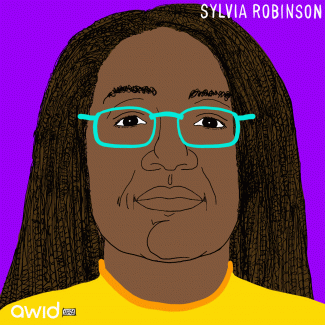
Sylvia Robinson

"Life is...about living in joy - waking up with purpose, feeling our creative energy, answering your calling." - Sylvia Robinson

Sylvia Robinson, a tireless community organizer and leader, was the founder and Executive Director of The Emergence Community Arts Collective (ECAC) in Washington DC.

This hub and performance space combine education, civic engagement, arts, social and spiritual services, and sustainable environmental practices. Sylvia envisioned it as a home where “there was a balance and synergy with the activities that people needed in order to sustain life.” 

She was also one of the founding members of the Georgia Avenue Community Development Taskforce, a neighborhood group that works on social justice and organizing in Northwest DC  to make sure the community has a voice in redevelopment and gentrification in the area. 

“We're asking for affordable housing. We're asking that the small businesses that have been here for a long time don't get wiped out by new retail. We're asking for green space and space for people to get together to socialize. We're asking for streetscape improvements—better roads and lighting in the corridor.” - Sylvia Robinson about the Taskforce

Prior to becoming an organizer and after receiving a degree in computer science, Sylvia worked in air traffic control systems for over a decade. She then moved into drug and alcohol counselling, becoming increasingly engaged in community work.

“It was my call to be involved in community.”  - Sylvia Robinson

Born in Washington D.C. on 14 August 1961, Sylvia passed away on 18 September 2017 after a battle with cancer.

“Sylvia's spirit and legacy will continue to inspire this community for many years to come.” - ECAC
ฉันเสนอกิจกรรมไปในฟอรัมที่ผ่านมา ฉันยังจำเป็นต้องสมัครใหม่อีกครั้งหรือไม่

กรุณาสมัครใหม่อีกครั้ง โลกได้เปลี่ยนไปจากปี 2564 และเราขอเชิญชวนให้คุณเสนอกิจกรรมที่ถ่ายทอดความจริงและสิ่งที่คุณให้ความสำคัญในปัจจุบัน

2009: la ONU celebra una Conferencia sobre el impacto de la crisis económica

Conferencia de la ONU sobre la crisis financiera y económica mundial y sus efectos sobre el desarrollo

  • Esta conferencia de 2009 fue un producto de la Conferencia de Doha realizada en 2008. La Declaración de Doha le había encargado a la ONU que el Presidente de su Asamblea General organizara una conferencia sobre la crisis financiera y económica mundial y su impacto sobre el desarrollo.
  • En esta conferencia los grupos de mujeres, a través del WWG, destacaron el impacto de la crisis financiera mundial sobre los grupos en situación de vulnerabilidad. En su declaración ante los Estados Miembros, el WWG les propuso acciones que consideraba necesarias para remediar los efectos de la crisis sobre las mujeres. También observó que otros grupos sociales afectados por la crisis son clave para una respuesta que esté en consonancia con los estándares y compromisos internacionales en materia de igualdad de género, derechos de las mujeres, derechos humanos y empoderamiento.

Snippet Video C&H (ES)

Maritza Quiroz Leiva

Maritza Quiroz Leiva fue una activista social afrocolombiana, líder comunitaria y defensora de los derechos humanos de las mujeres. Como una de las 7,7 millones de colombianxs desplazadxs internamente por 50 años de conflicto armado, Maritza dedicó su trabajo de incidencia a apoyar los derechos de otras personas, en particular dentro de la comunidad afrocolombiana, que sufrían similares desplazamientos y violaciones de derechos.

Maritza era líder adjunta del Comité de Víctimas de Santa Marta, y una voz importante para quienes buscaban justicia en su comunidad, exigiendo reparaciones por las torturas, los secuestros, los desplazamientos y la violencia sexual que experimentaban las víctimas durante el conflicto armado. También trabajó activamente en el movimiento nacional por la redistribución de la tierra y la justicia agraria.

El 5 de enero de 2019 Maritza fue asesinada por dos individuos armados que irrumpieron en su casa. Tenía 60 años.

Maritza se sumó así a lxs otrxs cinco activistas y líderes sociales colombianxs que fueron asesinadxs durante la primera semana de 2019. En Colombia, ese año fueron asesinadxs un total de 107 defensorxs de derechos humanos.
 

CFA FAQ - Accessibility and Health - Thai

สุขภาพและการช่วยในการเข้าถึง

Janvier 2015: 1ère session de rédaction du document final de la 3ème Conférence sur le FdD

La première session de rédaction du document final de la troisième Conférence sur le financement du développement

  • À partir de janvier 2015, les sessions de rédaction du document final se sont succédé au siège de l’ONU à New York.
  • Avant la première de ces sessions, les co-facilitateurs du processus préparatoire de la Conférence d’Addis Abeba ont présenté un document récapitulatif (en anglais) en vue de la rédaction de la dite « version zéro » du document final. Ce document avait vocation à servir de base aux négociations intergouvernementales relatives au contenu du document final.
  • Pendant les sessions, des organisations de défense des droits des femmes ont mis l’accent sur la nécessité, au cours des processus relatifs à l’après-2015, d’aborder séparément le FdD et les modalités de mise en œuvre. À leurs yeux, le FdD offre une occasion unique aux États de s’attaquer aux causes structurelles des inégalités.  

Snippet FEA FIGHT LIKE SOMEONE WHO CARES (FR)

São Paulo, Brésil

COZINHA OCUPAÇÃO 9 DE JULHO

Lutte comme quelqu'un·e qui

PREND SOIN

Roxana Reyes Rivas

Roxana Reyes Rivas, était une philosophe, féministe, lesbienne, poétesse, politicienne et activiste pour les droits des personnes LGBT et des femmes du Costa Rica. Auteure à la plume acérée et à l’humour incisif, elle était irrésistiblement drôle. Née en 1960 et élevée à San Ramón dans la province d’Alajuela, qui était encore une localité rurale à l’époque, elle a toute sa vie refusé d’adhérer aux attentes envers « les femmes ».   

Avec le groupe de lesbiennes costariciennes El Reguero, Roxana a organisé pendant plus de dix ans des festivals lesbiens, de joyeux espaces de formation où se rassembler à une époque où le gouvernement du Costa Rica et la société persécutaient et pénalisaient l’existence des lesbiennes. Ces festivals lesbiens étaient, pour des centaines de femmes, le seul endroit où elles pouvaient être elles-mêmes et se regrouper avec leurs semblables.

Roxana aimait répéter que la formation de partis politiques comptait parmi ses passe-temps. « Il est important que les gens comprennent qu’il y a d’autres manières de faire de la politique, et que de nombreuses questions doivent être résolues collectivement. » Elle fut également l’une des fondatrices des partis Nueva Liga Feminista et VAMOS, centrés sur les droits humains.

« La philosophie est faite pour bousculer, pour aider les gens à se poser des questions. Une philosophe qui n’irrite personne ne fait pas son travail. » Pendant 30 ans, Roxana a enseigné la philosophie dans plusieurs universités publiques du Costa Rica. Des générations d’étudiant·e·ss ont suivi ses directives et réfléchi aux dilemmes éthiques que posent la science et les technologies.  

L’outil de prédilection de Roxana était l’humour. Elle a créé le prix de l’ignorance La Citrouille étincelante, qu’elle décernait à des personnalités publiques sur ses réseaux sociaux, tournant en dérision leurs expressions et déclarations anti-droits.  

Roxana a été emportée par un cancer agressif fin 2019, avant qu’elle ne puisse publier son recueil de poèmes, qu’elle aurait voulu être le cadeau de départ de l’esprit créatif d’une féministe qui a toujours élevé sa voix contre l’injustice.

CFA 2023 - breadcrumbs Menu _ FAQ-ar

What is the United Nations Financing For Development Process?

The United Nations (UN) Financing for Development (FfD) process seeks to address different forms of development financing and cooperation. As per the Monterrey Consensus it focuses on six key areas:

  • Mobilizing domestic financial resources for development
  • Mobilizing international resources for development: foreign direct investment and other private flows
  • International trade as an engine for development
  • Increasing international financial and technical cooperation for development
  • External debt
  • Addressing systemic issues: enhancing the coherence and consistency of the international monetary, financial and trading systems in support of development. 

Snippet FEA Introducing Carmen Silva Ferreira (EN)

We have the pleasure to introduce you to Carmen Silva Ferreira.

She was born in Bahia, the Northeastern part of Brazil. She is an immigrant, a social activist and a mother of 8 children.

Carmen experienced homelessness at the age of 35, after migrating to Sao Paulo on her own. This led her to become a fierce advocate for vulnerable, marginalized and invisibilized communities most affected by the housing crisis. She eventually became one of the founders of MSTC in 2000.

As a visionary political organizer and the current leader of the MSTC, Carmen’s work has laid bare the city's housing crisis and provided inspiration to others on different ways to organize and manage occupations. She stood strong on the forefront of several occupations. One of them is the 9 de Julho Occupation, which now serves as a stage for direct democracy, and a space where everyone can be heard, seen, appreciated and work together.

Carmen has been long celebrated for her boldness in giving life back to abandoned buildings in the heart of São Paulo.

To know more about her life, you can follow her on Instagram!

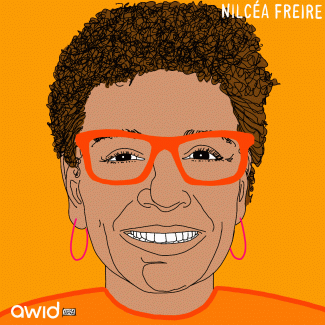
Nilcéa Freire

Nilcéa Freire was a Brazilian feminist activist, politician and academic. A persevering advocate for women’s rights and those of underrepresented minorities in the country, her life and work carried a long history of struggles and victories.

"While resisting we have to keep pushing for progress, and what we can achieve at this time, in my view, will be through the stupendous organization of young white women, and especially black women, in all of the state capitals and large cities of Brazil." - Nilcéa Freire

In 1999 she became the first woman to occupy the position of Dean at the State University of Rio de Janeiro. Here, she spearheaded the implementation of the first affirmative action policy for students graduating from public schools, requiring reserved places specifically for low-income black students in a public university. This system was adopted in dozens of other public universities. 

Some years later, Nilcéa headed the Special Secretariat of Policies for Women in the government of former president Luiz Inácio Lula da Silva. In this capacity, she led the first National Women’s Conference. Over 12,000 women from across the country participated and the result of this collective work was embodied in the National Plan for Policies for Women. 

Her commitment to women, Afro-Brazilians and indigenous peoples was also strongly reflected in her work to promote their rights through initiatives of the Brazil Ford Foundation office where she was a regional director. 

The feminist activist Manoela Miklos recounted Nilcéa to be "a woman without equal"

At the age of 66, Nilcéa passed away in Rio de Janeiro on 29 December 2019 of cancer.


"Without words for the news of the death of dear Nilcea Freire. It is too sad to know that she left so early. She was always part of the ranks of those who do not settle for the injustices of the world. She was the Minister of Women, an activist, always active in the feminist cause. Much missed!” - Jandira Feghali, Federal Deputy

Watch Brazilian feminist Nilcea Freire on why we need to show solidarity with Brazil