L´AWID est une organisation féministe mondiale qui consacre ses efforts à la justice de genre, au développement durable et aux droits humains des femmes
Les défenseuses des droits humains s’auto-identifient comme des femmes ou des personnes lesbiennes, bisexuelles, transgenres, queer, intersexes (LBT*QI) ou autres qui défendent les droits. Elles sont exposées à des risques et à des menaces de nature genrée à cause du travail qu’elles accomplissent en faveur des droits humains et/ou en conséquence directe de leur identité de genre ou de leur orientation sexuelle.
Les défenseuses des droits humains subissent une violence et une discrimination systématique du fait de leur identité, mais aussi à cause de la lutte indéfectible qu’elles mènent en faveur des droits, de l’égalité et de la justice.
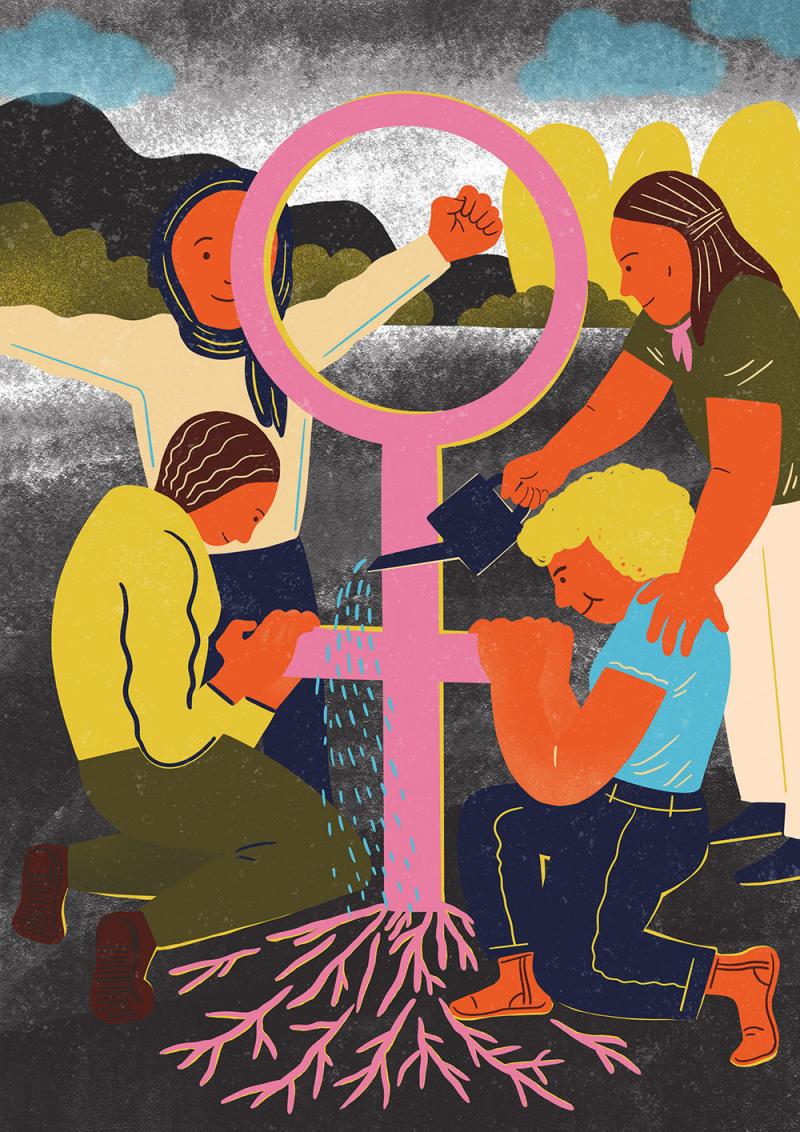
Le programme Défenseuses des droits humains collabore avec des partenaires internationaux et régionaux ainsi qu’avec les membres de l’AWID pour éveiller les consciences à propos de ces risques et menaces, pour plaider en faveur de mesures féministes et holistiques de protection et de sécurité et enfin pour promouvoir activement une culture du souci de soi et du bien-être collectif au sein de nos mouvements.
Les risques et menaces qui planent sur les défenseuses
Les défenseuses des droits humains sont exposées aux mêmes types de risques que toutes les autres personnes qui défendent les droits humains, les communautés et l’environnement. Mais elles se heurtent également à des violences fondées sur le genre et à des risques spécifiques de nature genrée parce qu’elles remettent en cause les normes de genre en vigueur au sein de leur culture et de leur société.
En défendant les droits, les défenseuses des droits humains sont exposées aux risques suivants :
les agressions physiques et la mort
les tentatives d’intimidation et le harcèlement, y compris dans les espaces en ligne
le harcèlement judiciaire et la criminalisation
l’épuisement
Une approche holistique et collaborative de la sécurité
Nous travaillons en collaboration avec des réseaux internationaux et régionaux ainsi qu’avec nos membres pour :
éveiller les consciences à propos des violations des droits humains et abus dont sont victimes les défenseuses des droits humains ainsi que de la violence systémique et de la discrimination qu’elles subissent ;
renforcer les mécanismes de protection et faire en sorte que des réactions plus efficaces et plus rapides s’organisent quand des défenseuses sont en danger.
Nous travaillons à la promotion d’une approche holistique de la protection des défenseuses, qui suppose notamment :
de mettre l’accent sur l’importance du souci de soi et du bien-être collectif, et de reconnaître le fait que ces notions peuvent revêtir une signification différente dans chaque culture ;
de documenter les violations dont sont victimes les défenseuses des droits humains dans une perspective féministe intersectionnelle ;
de promouvoir la reconnaissance et la célébration du travail et de la résilience des défenseuses des droits humains dans la société ; et
de construire des espaces civiques propices au démantèlement des inégalités structurelles, sans restrictions ni obstacles.
Nos actions
Nous souhaitons contribuer à l’avènement d’un monde plus sûr pour les défenseuses des droits humains, leurs familles et leurs communautés. Nous pensons que le fait que les défenseuses œuvrent en faveur des droits et de la justice ne devrait pas leur faire courir de risques ; leur action devrait être appréciée et célébrée.
Promouvoir la collaboration et la coordination entre organisations de défense des droits humains et des droits des femmes au niveau international, et ce dans le but de d’apporter des réponses plus efficaces dans le domaine de la sureté et du bien-être des défenseuses des droits humains ;
Soutenir les réseaux régionaux de défenseur-es et les organisations, parmi lesquels l’Initiative mésoaméricaine des défenseuses des droits humains et la Coalition des défenseuses des droits humains du Moyen-Orient et d’Afrique du Nord, dans leur travail de promotion et de renforcement de l’action collective en faveur de la protection des défenseuses – en mettant en avant l’importance de la création de réseaux de solidarité et de protection, de la promotion du souci de soi ainsi que du plaidoyer et de la mobilisation en faveur de la sécurité des défenseuses ;
Faire en sorte que les défenseur-e-s des droits humains et les risques qui les menacent soient plus visibles et mieux reconnus, en rassemblant des informations sur les agressions dont elles sont victimes et en produisant et diffusant des documents sur leurs luttes, leurs stratégies et les difficultés qu’elles rencontrent ;
Organiser des réponses urgentes fondées sur la solidarité internationale dès que des défenseuses des droits humains sont en danger, par le biais de nos réseaux internationaux et régionaux mais aussi grâce à nos membres.
Every three to four years, AWID hosts its flagship international event. It is the world’s largest event that wholeheartedly centers feminist and gender justice movements in all their diversity. It is a global gathering of feminist activists, allied movements, scholars, funders and policymakers. The Forums rotate between different regions and countries in the global South.
Crear Resistar Snippet
Crear | Résister | Transform
Crear | Résister | Transform es para ti y para todxs lxs increíbles activistas feministas y por la justicia social que conozcas. Reunámonos para compartir nuestras estrategias de resistencia, para crear conjuntamente algo de magia feminista, y para transformar juntxs este mundo.
“Je n’adhère pas au concept de ‘tiers-monde’. Je fais des films pour que les gens puissent les comprendre indépendamment de leur race ou de leur couleur. Pour moi, il n’y a que des exploiteurs et des exploités, c’est tout. Faire un film, c’est prendre position.” - Sarah Maldoror
Sarah Maldoror, cinéaste française d’origine antillaise, fut une pionnière du cinéma panafricain. Elle plaça ses préoccupations politiques et son engagement de longue date dans les mouvements de décolonisation au coeur de son oeuvre.
Son film révolutionnaire Sambizanga (1972), avec son “image révolutionnaire”, retrace la lutte de libération anticoloniale des activistes angolais et retranscrit le point de vue d’une femme qui se trouve dans ce moment historique.
“Pour beaucoup de cinéastes africains, le cinéma est un outil de la révolution, une éducation politique pour transformer les consciences. Il s’inscrivait dans l’émergence d’un cinéma du Tiers-Monde cherchant à décoloniser la pensée pour favoriser des changements radicaux dans la société.” - Sarah Maldoror
Au cours de sa carrière, Sarah a fondé, aux côtés d’un certain nombre d’artistes africain·e·s et caribéen·ne·s, la première compagnie de théâtre noire en France (1956). Elle a réalisé une quarantaine de films, y compris d’importants documentaires qui mettent en valeur les vies et l’oeuvre d’artistes noir·e·s, notamment celles de son ami et poète Aimé Césaire qui lui écrivit ceci:
“À Sarah Maldoror qui, caméra au poing,
combat l’oppression, l’aliénation
et défie la connerie humaine”.
Sarah a également voulu permettre aux femmes africaines de s'approprier davantage le processus de réalisation des films. Dans une interview, elle faisait remarquer :
"La femme africaine doit être partout. Elle doit être à l'image, derrière la caméra, au montage, à toutes les étapes de la fabrication d'un film. C'est elle qui doit parler de ses problèmes…”
Sarah a laissé un héritage incroyablement puissant qui doit être transmis.
Née le 19 juillet 1929, Sarah est décédée le 13 avril 2020 des suites de complications liées au coronavirus.
The menstrual cycle usually lasts between 27 and 30 days. During this time, the period itself would only go on for five to seven days. During the period, fatigue, mood swings, and cramps are the result of inflammation.
In traditional Javanese culture, this is the moment for women to rest and take care of themselves. During this moment, a woman would take Kunyit Asam, a jamu or herbal drink to soothe the inflammation. This elixir consists of turmeric and tamarind boiled together in a pot.
I still remember my first period - it was one day before graduation day in elementary school. I remember pedaling my bike feeling something warm running between my thighs. When I arrived home I did all I could to clean myself and then put on a menstrual pad. My mother came home from work about four hours later. I told her what had happened. She looked me in the eye and asked how I felt. I told her that it was painful, that my body was swollen in every place. Then she asked me to go with her to the backyard. I followed her to our little jungle, my mother sat down on the soil and smiled.
“See this slender leaf? This is the leaf of Kunyit, *empon-empon that leaves the yellow stain on your fingers. What’s most important is not the leaf, but the roots. You dig the soil and slowly grab the roots.”, my mother showed me how to pick Kunyit or Turmeric roots. Then we went to the kitchen where she boiled water along with some tamarind. While waiting for it to boil, she showed me how to wash and grate the orangey-yellow root. Then, we put the grated turmeric into the boiling tamarind water. “Tomorrow, you can make it for yourself. This will help you to feel better!”.
I remember the first time I tasted it - a slightly bitter taste but also sour. My mother always served it warm. She would also put some in a big bottle which I would place on my stomach or lower back for further relief. For days after, my mother’s hands and mine were yellow. My friends could always tell every time I got period because my hands would be yellow.
A year after my first period, I found out that you could get the bottled version in convenience stores. Still, I made my own Kunyit Asam every time I had my period because the one in the convenience stores was cold. It did not smell of wet soil and warm kitchen.
Fast forward, I am a 26 year old woman who casually makes this drink for friends when they have their periods. I’ve made some for my housemates and I’ve delivered some for friends who live in different towns. I do not grow turmeric roots in my garden, but I have grown and shared the love from my mom. What was once from garden to cup is now from *pasar to cup.
A couple of days ago, I asked my mother who taught her how to make the jamu.
“Who else? Yang Ti*! Your grandmother was not just a teacher”, said my mom. I was never close to my grandmother. She passed away when I was eight. All I knew from my mom was that she was a math teacher who had to teach courses after work. I had this image of my grandmother as a hard worker who was kind of distant with her children. My mom did not disagree with that but explained it came from her survival instinct as a mother. “She tried to make time. She tried. She taught me how to make jamu so I could take care of myself and my sisters”.
My mother is the second child out of seven, six of whom are girls. The reason my grandmother taught her is so that all of her children could take care of each other. While my mother was taught how to make the drink, my mother’s older sister was taught how to plant turmeric. Yang Ti knew which one loved the smell of soil more and which one loved the smell of the kitchen. My mother was the latter. She learned how to plant from my aunt, her older sister.
My grandfather worked in a bank but he got laid off when he was in his 40s. So, my grandmother had to do a side-hustle to support their children. My mother was in high school at that time when Yang Ti woke her and her older sister up at dawn. “Would you help me to pick some roots?”. Of course nobody said no. Especially if it was your mother, especially if you were born in Javanese culture where saying “no” sounded like a bad word. Together, the three of them went to the backyard, and they harvested empon - empon, rhizome, that was buried inside the soil. She grew many kinds of rhizome; temu lawak, temu putih, ginger, galangal, kunci, kencur, and kunyit. That was the day where my mother realized that her mother was never far away from her.
That was the day where she could spend more time with her mother. There, in the garden. There, in the kitchen.
“We’re sending these for Ibu Darti, the lady who lives across the river. Kunyit Asam for her and her daughters.”, said my grandmother to my mother and my aunt that day. They poured the Turmeric-Tamarind warm drink into a tall thermos and later my grandmother would deliver it on the way to school.
Over time, my grandmother got more orders for jamu. Everybody in the family helped her to make and deliver her jamu. The small business lasted only a few years, but that was what paid for my mother and her siblings’ education.
Today, my mother, who got laid off just a few days before I wrote this piece, harvested Turmeric and other roots. She’s making her Turmeric Tamarind drink from her kitchen.
My phone rang in the middle of this afternoon, a couple minutes after I boiled the rest of my grated turmeric. Today is one day after my period.
“Ingka, have you washed your pot after boiling those turmeric? It would forever be yellow if you don’t wash it right away!”
*empon-empon = roots like ginger, turmeric, etc. coming from the Javanese word “Empu” which means, something or someone that has deep knowledge.
*jamu = Indonesia’s traditional elixir made of roots, barks, flowers, seeds, leaves, and fruits.
*Yang Ti = Javanese term for grandmother, taken from the term “Eyang Putri” the female you look up to.
*pasar = the word for traditional market in Indonesian.
Con una asistencia de hasta 2500 participantes presenciales y 3,000 conectadxs de manera virtual, este será el Foro de AWID más grande hasta ahora. Vislumbramos múltiples espacios para establecer conexiones significativas, aprender, intercambiar ideas, tener conversaciones estratégicas, sanar y celebrar. Es la primera vez que nos reunimos en este espacio desde la pandemia, y estamos muy deseosxs de hacerlo.
ours chapter 3
Chapter 3
Anti-Rights Discourses
Anti-rights discourses continue to evolve. As well as using arguments related to religion, culture, and tradition, anti-rights actors co-opt the language of social justice and human rights to conceal their true agendas and gain legitimacy.
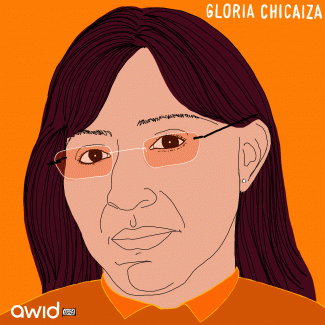
Gloria Chicaiza, an Ecuadorian social and environmental activist, was a fervent defender of land and water. She defied the status quo, fighting against a model of development based on extraction and worked tirelessly for ecological justice and the rights of communities affected by mining.
In diverse areas of Ecuador, Gloria was part of resistance actions in favour of protecting the ecosystem. With passion and dedication, Gloria supported the indigenous and environmental movement, its communities and organizations who oppose mining projects and protect their territories and collective life projects. She spoke out, in local and international foras, against the criminalization of dissent and resistance, the pressure and violence being enacted against community activists, in particular, women human rights defenders and in support of community led efforts for food sovereignty and sustainability.
She was the Mining Justice Coordinator at Acción Ecológica, member of the Latin American Network of Women Defenders of the Social and Environmental Rights and a Board member at the Observatory of Mining Conflicts of Latin America.
In 2014, Gloria supported the coordination of a delegation to the UN COP 20 Dialogue on Climate Change. The group consisted of 25 Indigenous women from Latin America.
Gloria passed away due to complications from a lung transplant on December 28, 2019. She is remembered for her resistance and tireless work.
"The fastest way to achieve sustainability is still resistance." - Gloria Chicaiza (2010 interview)
Tributes:
“Para GLORIA. GLORIA Agua. GLORIA Tierra. GLORIA Madre. GLORIA Revolución. GLORIA Hermana. GLORIA Cielo. GLORIAmiga. GLORIAstral. Thank you for weaving us together.” -Liliana Gutierrez
“Thank you Glorita, for sustaining hope, for keeping the fabric strong, for connecting the community, for the united hands, for solidarity, thank you Glorita for standing with us in the most difficult moments. Thank you for teaching us that throughout life, nobody gets tired.” (Chakana News)
“Gloria Chicaiza cherished and flourished in being one of many. And as humble as she was, she had an uncanny ability to lead and maintain a steady and thunderous beat, a life-affirming pulse that guided, mobilized, and inspired communities and networks in the protection of Mother Earth. She denounced all forms of violence against cuerpos-territorios. She endorsed el buen vivir.” - Gabriela Jiménez, Latin America Partnerships Coordinator, KAIROS
“Thank you Gloria Chicaiza from infinity we are sure that you will continue to support our struggle. You who continued to struggle with us despite your failing health. You will live on in the forests and the water that you defended with such courage. You will live on in our hearts.”- The community of Intag in Ecuador
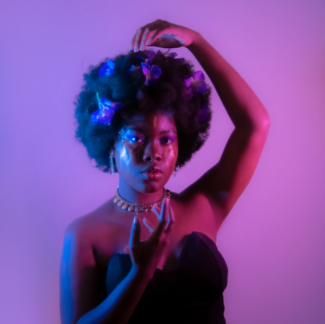
The artwork is a photography and illustration collaboration between Siphumeze and Katia during lockdown. The work looks at black queer sex and plesure narratives, bondage, safe sex, toys, mental health and sex and many more. It was created to accompany the Anthology Touch.
Mental HealthSex and SpirtualityOrgasm
About the Artists:
Siphumeze Khundayi is an art-maker, photographer and facilitator interested in creative ways of bringing together dialogue and artistic practice in relation to African Queer identity.
She is creative director of HOLAAfrica! a pan-Africanist womanist online collective.
Her solo and collaborative performance work has been featured in a number of festivals and theatre spaces such as Ricca Ricca Festival in Japan
She directed two Naledi nominated productions in 2017 and 2018. She directed a show that won a Standard Bank Ovation award in 2020.
As a photographer she was part of a group exhibition titled Flowers of my Soul in Italy organised by the Misfit Project. Produced three publications for HOLAAfrica and was published in and provided the cover for volume two: As You Like of the Gerald Kraak Anthologies.
Katia Herrera is a 21-year-old Digital visual artist from the noisy city of Santo Domingo in the Dominican Republic. Despite Herrera being a self-proclaimed introvert, her artwork is remarkably loud in a world trying to quiet black voices. With titles like Black Woman, You Own the Moon, Earth Goddess, Forever, and Universe Protector, Herrera’s legacy will be marked by her passion for highlighting the endurance and perseverance of black folks of old and present to contrast the narrative that black skin should only be associated with slavery.
One of her most lovely and vivaciously titled works, Universe Protector, portrays the black soul as a divine entity full of strength, power, and greatness. In her youth, her love of graphic design was stimulated by her parents’ artistry and the Photoshop they had downloaded on their computer for their professional photography.
If your funding institution is already a part of the Database and you would like to contact us to update your record, or if you would like to leave some feedback for us, please use the form above.
Comment puis-je financer ma participation au Forum de l'AWID ?
Si votre groupe ou votre organisation est récipiendaire de fonds, vous feriez bien de vous entretenir dès maintenant avec votre organisme de financement pour savoir si ce dernier est en mesure de prendre en charge votre voyage et votre participation au Forum. De nombreuses institutions planifient leur budget pour l'année prochaine dès le début de l'année 2023, aussi vaudrait-il mieux ne pas reporter cette discussion à l'année prochaine.
Primer: Spot key groups and debunk their narratives
Cartilla:
Cómo identificar a los principales grupos y refutar sus narrativas
¿Es usted una persona que diseña políticas en la ONU y quiere saber quiénes son los principales grupos anti-derechos y frente a qué discursos mantenerse alerta? ¿O unx feminista que busca argumentos para refutar esos discursos rápidamente? Esta cartilla de 8 páginas le ofrece información importante de un vistazo.
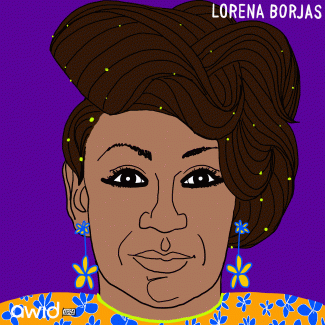
Lorena Borjas, una mujer trans latina y activista, vivía y trabajaba en el barrio de Jackson Heights de Queens, en la ciudad de Nueva York. En esas calles, cuidó de su comunidad durante años, defendiendo los derechos de las personas trans e inmigrantes, apoyando a lxs sobrevivientes del tráfico humano y del abuso, y haciendo campaña por los derechos de lxs trabajadorxs sexuales y de las personas que viven con VIH y SIDA.
Lorena era fuerte e incansable en su lucha por apoyar, defender y proteger a quienes son más marginalizadxs y discriminadxs por la transfobia, la misoginia y el racismo.
«Ella nos empujaba a brillar auténticamente, a convertirnos en un grito de subversión que dice “Aquí estoy, y merezco felicidad también”.» - Cecilia Gentili, activista trans amiga de Lorena
Luego de haber enfrentado ella misma numerosos traumas y dificultades como mujer trans inmigrante y víctima de tráfico humano, recabó conocimientos y memoria emocional de la fuente de sus propias experiencias para ayudar a construir y fortalecer la comunidad de la cual era parte, y que era parte de ella. Algunas de las formas en que llevó esto a cabo fue organizando y movilizando apoyo, que abarcaba desde proveer preservativos y conectar a las mujeres trans con distintos servicios sociales, hasta armar una clínica para el testeo de VIH en su propia casa.
«Era un alma tan bella que ayudaba a otrxs, aun cuando su propio camino era difícil y doloroso como inmigrante, como inmigrante trans. Creía que la comunidad trans necesitaba amor, aceptación, y compasión, y lo daba todo.» - Luchia Dragosh, supervisora de producción de QPTV de un documental sobre Lorena
En sus más de 25 años de activismo, también fundó con Chase Strangio (abogadx y activista por los derechos trans) el Lorena Borjas Community Fund. Este fondo ayuda a lxs diferentes integrantes de su comunidad (y en especial a las personas trans) que lidian con problemas de inmigración, para evitar el ciclo de arresto-cárcel-deportación.
Lorena falleció en marzo de 2020 por complicaciones derivadas del COVID-19.
Su enorme y hermoso legado será llevado adelante a través de las calles de Queens por la red y la comunidad que ella ayudó a crear.
« Continuaremos su trabajo desde donde ella lo dejó, un trabajo que es esencial para el bienestar de “mis pájaras”, como llamaba Lorena a las chicas trans de Queens que protegía bajo su ala.» - Cecilia Gentili
Tributos:
«Lorena nos trajo luz, cuando atravesábamos tiempos muy oscuros aquí en Nueva York. Nos trajo luz cuando tuvimos que enfrentar la epidemia del crack, cuando tuvimos que enfrentar la crisis del SIDA, cuando tuvimos que enfrentar los cambios en las políticas de inmigración.» - Cristina Herrera, fundadora y CEO de Translatina Network y amiga de Lorena
«Lorena ha hecho más que nadie que yo conozca para arrojar luz sobre la epidemia del tráfico en las comunidades transgénero y para ayudar a otras mujeres trans a escapar de la explotación.» - Lynly Egyes, representante de Borjas en nombre del Transgender Law Center
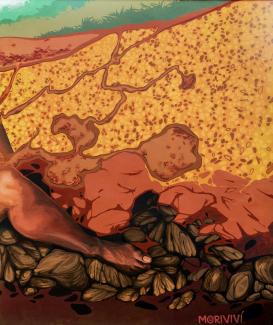
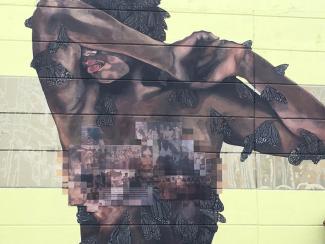
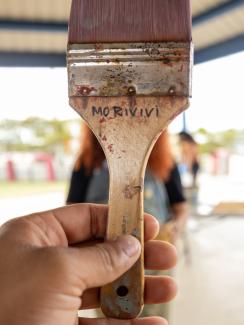
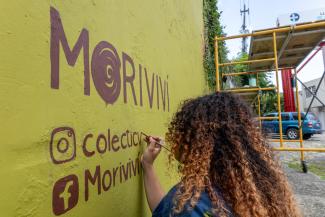
El Colectivo Moriviví es una colectiva de solo mujeres. Nuestra producción artística consiste en muralismo, muralismo comunitario y acciones/performances de protesta. Nuestro trabajo tiene como objetivo democratizar el arte y llevar a la esfera pública las narrativas de las comunidades de Puerto Rico, para generar espacios en donde sean validadas. Creemos que, a través del artivismo, podemos promover conciencia sobre temas sociales y fortalecer nuestra memoria colectiva.
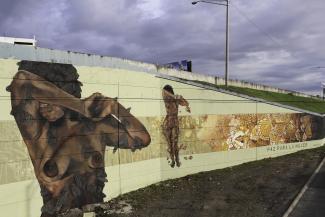
“Cacibajagua” 2017, proyecto de mural, Jiangxi, China“Cacibajagua” 2017, proyecto de mural, Jiangxi, China“Paz para la Mujer” 2015, colaboración con la organización Coordinadora Paz para la Mujer, Santurce, Puerto Rico
“Paz para la Mujer” 2015, colaboración con la organización Coordinadora Paz para la Mujer, Santurce, Puerto Rico
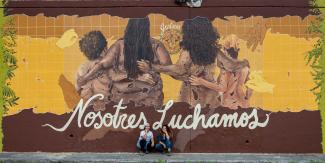
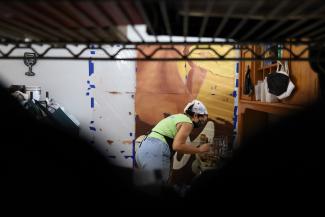
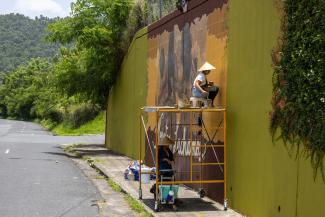
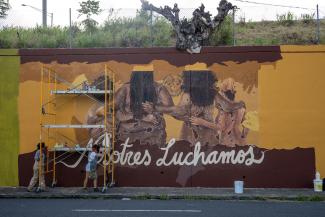
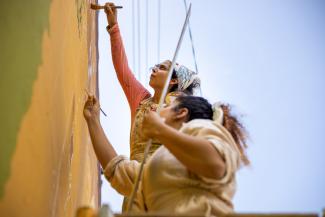
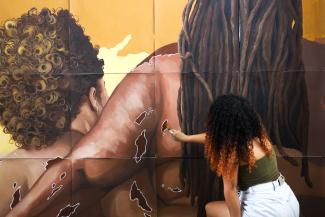
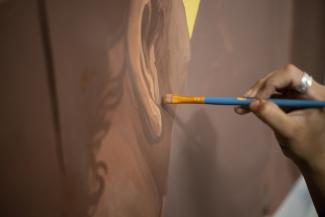
En el marco de su participación en el Grupo de Trabajo Artístico de AWID, el Colectivo Moriviví convocó a un grupo diverso de afiliadxs, asociadxs y personal de AWID y facilitó un proceso colaborativo de imaginación, configuración y decisión sobre el contenido para la creación de un mural comunitario, a través de un proceso de creación conjunta en múltiples etapas. El proyecto comenzó con una conceptualización remota con feministas de diferentes zonas del planeta reunidxs por AWID, y luego evolucionó hacia su recontextualización y realización en Puerto Rico. Nos honra haber contado con la contribución de las artistas locales Las Nietas de Nonó (@lasnietasdenono), la participación de mujeres locales en la Sesión de Pintura Comunitaria, el apoyo logístico de la Municipalidad de Caguas, y el apoyo adicional al colectivo, brindado por FRIDA Young Feminist Fund.
El mural explora la trascendencia de las fronteras, al presentar cuerpos como un mapa en un abrazo que realza la intersección de las distintas manifestaciones, prácticas y realidades feministas.
Agradecemos también a Kelvin Rodríguez, quien documentó y captó las diferentes etapas de este proyecto en Puerto Rico:
Sobre el Colectivo Moriviví
Moriviví es un colectivo de jóvenes artistas mujeres que trabajan en arte público desde abril de 2013. Con sede en Puerto Rico, hemos obtenido reconocimiento por la creación de murales y de arte comunitario.
El grupo se inició en festivales locales de arte urbano. A medida que nuestro trabajo se fue haciendo más conocido, algunas organizaciones y líderes comunitarias comenzaron a contactarnos. Al principio éramos solo ocho estudiantes de secundaria que querían pintar juntas un mural. Y en estos ocho años de duro trabajo hemos enfrentado muchos desafíos. Ahora estamos en un período de transición. Queremos reestructurar internamente el colectivo durante el próximo año. Nuestro objetivo es abrir nuevas oportunidades de colaboración y respaldar nuestro proceso de toma de decisiones con un nuevo sistema de evaluación. Aspiramos, en el largo plazo, a convertirnos en una escuela alternativa para la práctica artística, destinada a aquellas personas interesadas en sumergirse en la producción de arte comunitario.