L´AWID est une organisation féministe mondiale qui consacre ses efforts à la justice de genre, au développement durable et aux droits humains des femmes
Forum de l'AWID : Co-créer nos horizons féministes
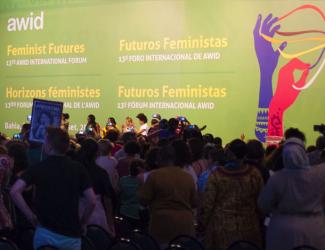
En septembre 2016, 1800 féministes et défenseur-e-s des droits des femmes venu-e-s des quatre coins de nos mouvements se réunissaient sur les côtes de Bahia à l’occasion du 13ème Forum international de l’AWID.
Cette section met l’accent sur les victoires, les enseignements et les ressources qui ont couronné nos conversations. Nous vous invitons à l’explorer, la partager et laisser vos impressions.
L’un des principaux éléments à retenir de ce Forum a été la nécessité d’élargir et d’approfondir notre travail de collaboration entre mouvements pour faire face à une montée des fascismes et des fondamentalismes, une exacerbation de la cupidité des entreprises et un changement climatique en progression.
L’AWID a donc travaillé avec plusieurs allié-e-s pour ériger ces semences de résistance :
Les mouvements peuvent aussi bénéficier d’une nouvelle méthodologie pour envisager nos horizons féministes. (à venir bientôt !)
A travers son prochain plan stratégique et le processus de son Forum, l’AWID s’engage à poursuivre et approfondir les rapports, les apprentissages et les processus amorcés lors du Forum 2016, tout en s’inspirant de l’actualité.
Et maintenant ?
Le monde est bien différent de celui qu’il était l’an dernier et il continuera à changer dans les années à venir.
Le prochain Forum de l’AWID se tiendra dans la région Asie-Pacifique (les dates et le lieu exacts seront annoncés en 2018). Nous attendons avec impatience de vous y retrouver !
A propos du Forum de l’AWID
Les Forums de l’AWID ont vu le jour en 1983, à Washington DC. Depuis, ils revêtent de nombreux aspects et incarnent, selon les personnes, tantôt un processus itératif visant à affiner nos analyses, notre vision et nos actions, un évènement clé galvanisant les féminismes des participant-e-s et leurs organisations ou un espace politique offrant refuge et solidarité aux défenseur-se-s des droits humains.
El Foro es un ejemplo vivo de lo que el más grande NOSOTRXS podemos hacer. Vamos al Foro, somos semillas, luego nos sembramos. Esto lo tenemos que celebrar. - Sara Abu Ghazal, Líbano
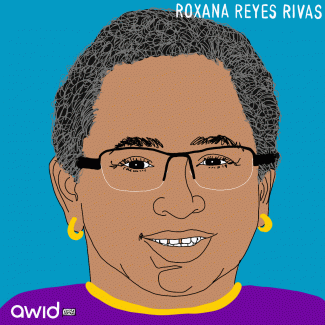
Roxana Reyes Rivas, philosopher, feminist, lesbian, poet, politician and LGBT and women’s rights activist from Costa Rica. Owner of a sharp pen and incisive humour, a laugh a minute. She was born in 1960 and raised in San Ramón of Alajuela, when it was a rural town, and her whole life she would break away from the mandates of what it meant to be a woman.
With El Reguero (Costa Rican lesbian group) she organized lesbian festivals for over a decade, fun-filled formative spaces to come together at a time when the Costa Rican government and society persecuted and criminalized the lesbian existence. For hundreds of women the lesbian festivals where the only place they could be themselves and come together with others like them.
Roxana would often say founding political parties was one of her hobbies. “It’s important for people to understand there are other ways to do politics, that many issues need to be solved collectively”. She was one of the founders of the New Feminist League and VAMOS, a human rights focused political party.
“The philosophical trade is meant to jab, to help people ask themselves questions. A philosopher who doesn’t irritate anyone is not doing her job”. For 30 years Roxana taught philosophy at several Costa Rican public universities. Through her guidance, generations of students reflected about the ethical dilemmas in science and technology.
Roxana’s favourite tool was humour, she created the Glowing Pumpkin award, an acknowledgement to ignorance that she would bestow upon public figures, through her social media channels, mocking their anti-rights expressions and statements.
An aggressive cancer took Roxana at the end of 2019, before she could publish a compilation of her poems, a departing gift from the creative mind of a feminist who always raised her voice against injustice.
Film club - Films from Nuestramérica
Notre programme final du Feminist Film Club est maintenant disponible: « Films from Nuestramérica » est une série de films sur les réalités féministes d'Amérique latine et d'Amérique centrale organisée par Alejandra Laprea (Venezuela).
The space created by this festival has been so necessary. Necessary for the souls of those who are seeking comfort during these bleakest of times. Necessary for those craving community in what feels like an increasingly isolating world and above all, necessary for those fighting against the very systems that have brought many of us to our knees, especially over the past two years.
“Crisis is not new to feminist and social movements, we have a long history of surviving in the face of oppression and building our communities and our own realities.”
Advocating for alternative visions and alternative realities to the one we are currently living in is a fundamental building block of the feminist agenda. So many amazing people are doing the work of exploring different ways for us to exist in this world. These alternatives are people-centred. They are equitable and just. These worlds are filled with love, tenderness and care. The visions outlined are almost too beautiful to imagine, yet we must force ourselves to imagine because this is the only way we can continue.
Over the past 10 months, I have been incredibly fortunate to be working with a feminist collective that is not just imagining an alternative reality but actively living it. We are inspired by the work of so many other feminist movements across the globe who have not let the white supremacist, capitalist patriarchy deter their visions. This collective has held me together when all I wanted to do was fall apart. Much like the story shared by Maria Bonita on Day 4 of the festival, the liberation I have found in feminist movements is far too great to only be experienced by me. This is something we need to share, that we need to shout from the rooftops as we invite others to join.
Day 4 of the festival brought with it a captivating conversation between Felogene Anumo, Dr Dilar Dirik, Nana Akosua Hanson and Vandana Shiva who encouraged festival attendees to believe that not only is an alternative future possible - but that it is indeed urgent. Feminists have been talking about alternative worlds for so many years and hearing about these from the panellists was not just eye-opening but also comforting. Comforting in the sense that it made me feel safe to know that there are indeed strong, global feminist networks working across international and national borders, seeking to decolonise the established frameworks of our current realities.
What does an alternative reality look like?
During the session, Dr Dirik highlighted the fact that belief, sacrifice and patience are most needed to abolish the oppressive systems we currently live in. Collaboration, partnership, creativity, solidarity and autonomy. These are key pillars to building a global feminist society and they should be embraced by all feminist movements around the world.
Practical examples of these realities can be found across the globe, including the Soulaliyate Women's Land-Use Rights Movement. Referring to the tribal women in Morocco who live on collective land, the Soulalyate Women’s Movement is the first grassroots nationwide mobilisation for land rights in Morocco. Whilst initially the movement was quite small, it grew into a nationwide agenda that challenged the gendered nature of laws regulating land in the country. In 2019, the group contributed to overhauling the national framework legislation on the management of community property through the adoption of three sets of laws guaranteeing the equality of women and men.
Knowing about these feminist movements who are doing the work to make alternative futures a reality is incredibly inspiring and just what is needed, especially as I struggle to grapple with the neverending stream of bad news that seems to flow uninterrupted.
“Capitalist patriarchy is like a cancer. It doesn’t know when to stop growing” - Dr Vandana Shiva
AWID has always been a movement inspired by the feminist realities that we can live in. Through their festivals, as well as feminist realities magazine and toolkit, we have been shown a different way of doing things. We can imagine a world where care is prioritised, where feminist economies and gender justice are the norm. Creating alternative futures is how we fight back, it’s how we resist the violence that is perpetrated against our bodies every day.
The Crear | Resister | Transform Festival has allowed me to feel so connected to a global community, many of whom I will never meet. Knowing that we are all working towards and claiming another world has lit a fire in my soul and I cannot wait to see what the next festival will have in store.
If you missed it, make sure to watch the: "She is on her way: Alternatives, feminisms and another world" session from Day 4 of the festival below. And remember, as Dr Shiva said so eloquently: “Women’s energies will continue life on earth. We will not be defeated.”
Snippet - WCFM Content Body - EN
Feminist and gender justice movements continue to be chronically underfunded in the face of global funding cuts and freezes, and rising fascisms. Growing resource scarcity has impacted the most vulnerable communities, particularly in Global South regions with progressively closing civic spaces.
In response to these challenges, we collaborated with Impactmapper to co-create a comprehensive resource that combines two powerful tools to strengthen the funding ecosystem for social justice movements.
Le Forum international de l’AWID est un événement phare que l’association organise tous les trois ou quatre ans. C'est la plus importante manifestation au monde entièrement consacrée aux mouvements féministes et de justice de genre dans toute leur diversité. Il s'agit d'un rassemblement mondial qui réunit activistes féministes, mouvements alliés, universitaires, bailleurs de fonds et décideur·e·s politiques. Les forums se tiennent successivement dans différentes régions et différents pays du sud mondial.
«Yo no planeaba ser una cantante, el canto planeó estar en mí.» - Dorothy Masuka (entrevista de Mail & Guardian)
Dorothy Masuka, nacida en 1935 en Bulawayo (en ese momento Rodesia del Sur, ahora Zimbabue), creció en Sudáfrica, y se convirtió en una reconocida compositora, cantante de jazz, activista, y defensora ferviente de la lucha contra el apartheid. Definida como «una arquitecta del discurso de la música popular africana de liberación», Dorothy a menudo cantaba sobre política en lenguas indígenas africanas y, a través de todo su trabajo, confrontó las políticas racistas del gobierno sudafricano.
Una de estas canciones, titulada «Dr. Malan» (por el político pro-apartheid D.F. Malan) fue prohibida. Luego, en 1961, grabó «Lumumba», una canción sobre el asesinato del líder anticolonial Patrice Lumumba. El trabajo y el activismo de Dorothy atrajeron la atención de la División Especial de la policía sudafricana, y fue forzada a un exilio político que se prolongaría durante tres décadas. Durante ese tiempo, trabajó con grupos independentistas, incluido el Congreso Nacional Africano. En 1992, cuando el apartheid comenzó a desmoronarse y Nelson Mandela fue liberado de prisión, Dorothy regresó a Sudáfrica.
Su trabajo incluye la primera canción que grabó, en 1953, titulada «Hamba Notsokolo», que fue un éxito durante la década de 1950, y hoy es un clásico muy valorado. También escribió «El Yow Phata Phata», una canción que fue adaptada por Miriam Makeba, quien hizo de «Pata, Pata» un hit internacional.
Arraigados en la resistencia, la música y el activismo de Dorothy (popularmente conocida como «Auntie Dot» [«Tía Dot»]) estaban entretejidos, y dejaron un legado magnífico e inspirador.
Dorothy falleció en Johannesburgo el 23 de febrero de 2019 a la edad de 83 años, por problemas de salud.
Check out the AWID Feminist Film Club program “Holding up the Skies” - a film series on Feminist Realities from Africa and the African Diaspora curated by Gabrielle Tesfaye
Llevamos juntxs más de 20 años; el amor y apoyo de ustedes me es muy entrañable. Es interesante pensar que ustedes también tienen una edad similar a la de AWID, que somos contemporáneas, tratando de descubrir cómo comprometernos y apoyar a la comunidad. A las madres del movimiento: sus liderazgos y orientación han sido inigualables. Pienso en Prudence Mabele, Kate Thompson, Darien Taylor, Patricia Pérez, Martha Tholanah, Deloris Dockery, Iris De La Cruise, Doris Peltier, Cecilia Chung y tantxs otras. Aunque no son perfectxs (ya que ningunx de nosotrxs lo es), ustedes siempre ponen a su comunidad en primer lugar y abogan por la inclusión de TODXS lxs mujeres que viven con el VIH en los espacios feministas.
Amo la forma en que me sostuvieron cuando nadie más había podido hacerlo, pero lo más importante es cómo nos sostuvimos mutuamente. Ustedes comprenden el estigma, la discriminación, la violencia y el dolor, y también comprenden la alegría, el amor y el perdón. Como feministas que vivimos con el VIH, somos gloriosas y poderosas en nuestra interseccionalidad. Entendemos que el feminismo incluye y que está liderado por comunidades — las de nuestras hermanas negras, marronas e indígenas, las comunidades trans y de género diverso, lxs trabajadorxs sexuales, lxs queer/lesbianas, lxs que han sido encarceladxs y lxs que usan drogas —, tal y como se establece en los principios de la MPPVS (mayor participación de las personas que viven con el VIH y el sida). Practicamos un feminismo incluyente. Hablamos de los temas difíciles y de las comunidades criminalizadas, porque como personas que vivimos con el VIH, nosotrxs mismxs estamos criminalizadxs.
Sería muy desconsiderada si no le enviara un cariño especial a lxs mujeres jóvenes que viven con el VIH, que son el latido del movimiento. Lxs veo, Kia Lebejia, Keren Dunaway, Liz Onyango, Faith Ona, Sara Thapa Maga, Doreen Moraa, Yana Panfilova y millones de otrxs increíbles activistas que viven con el VIH. Ustedes son la energía que nos seguirá impulsando y que nos permitirá ser consideradxs importantes en los movimientos feministas hegemónicos. Gracias por hacer avanzar cada vez más a nuestro movimiento para incluir SIEMPRE a las personas trans y de género diverso, para hablar de las relaciones entre el cambio climático y la salud y los derechos sexuales y reproductivos.
Lxs quiero, quiero, quiero mucho. Para bien o para mal, avancemos juntxs porque esta es nuestra comunidad, esta es mi comunidad.
When can I register for the Forum? How much does it cost to register? What does Registration Include?
Registration will start early 2024. We will announce the exact registration date and registration fee soon. Registration will include participation in the Forum, plus lunch and snacks (breakfast to be provided at the hotels), and one onsite dinner.
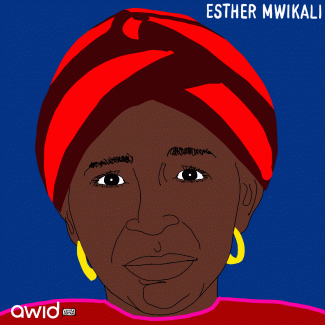
Esther Mwikali habitait dans le village de Mithini, dans le comté de Murang’a au Kenya. Activiste des droits fonciers, importante et appréciée, elle travaillait sur les abus à l’égard de squatters vivant sur des terres revendiquées par des magnats. Esther a participé à une enquête qui comprenait également des violations de droits fonciers à Makaya par de puissants individus.
Suite à l’absence d’Esther lors d’une réunion de village, une équipe de patrouille est partie à sa recherche. Le 27 août 2019, deux jours après sa disparition, on retrouva son corps dans une ferme proche de sa propriété, montrant des signes de torture. Elle fut sauvagement assassinée.
« Esther était reconnue pour son travail auprès des membres de la communauté, empêchant les évictions de terres revendiquées des magnats. Les activistes du coin n’ont aucun doute sur le lien entre son meurtre et les luttes constantes pour les terres dans la région. C’est un tragique rappel de la fréquence alarmante d’assassinats extrajudiciaires régulièrement menés au Kenya » - Global Wittness Report, juillet 2020
« Nous associons la mort de Mwikali aux luttes pour les terres par ici. Nous demandons au gouvernement de mener une enquête sur ce sujet au plus tôt. » - James Mburu, porte-parole des squatters
« Des mesures devraient être prises à l’égard des individus suspectés d’avoir menacé les squatters, et notamment la famille Mwikali. » - Alice Karanja, National Coalition of Human Rights Defenders (coalition nationale des défenseur·e·s des droits humains)
« L’impact de son travail et sa ténacité demeureront encore en vie pour les prochaines décennies au Kenya. CJGEA console avec les personnes endeuillées et appelle à la justice. » - Center for Justice and Governmental Action (Centre pour la justice et l’action gouvernementale, CJGEA) communiqué de presse, 13 septembre 2019
ours chapter 3 fr
Chapitre 3
Les discours antidroits
Les discours antidroits continuent à évoluer. Outre le recours à des arguments religieux, culturels et traditionnels, les acteur·rice·s antidroits s’approprient le langage de la justice sociale et des droits humains pour travestir leurs véritables programmes et gagner ainsi en légitimité.
Comment un mouvement nait-il ?
des fantômes nous expulsent d’une maison, d’une famille ou d’une nation
on arrive éreintées dans un espace (parfois une vraie adresse) mais surtout dans un état d’être
précédées par une étoile déchue
notre arrivée n’est peut-être pas accompagnée par la fatigue,
mais bien par la peur
notre arrivée n’est peut-être pas accompagnée par la peur
mais bien par la colère
de problèmes qui se répètent en boucle :
un coup au cœur (entendez douleur sentimentale)
un coup dans le dos (entendez trahison)
des disparitions forcées
des corps condamnés par le mariage, la défiguration et la fatigue chronique
mais quand on arrive, on se rassemble, on chuchote, on parle et on pleure.
C’est comme ça que naissent nos mouvements lorsque l’on arrive l’une à l’autre
Nous devenons des graines,
C’est comme ça que naissent nos mouvements lorsque l’on se sème l’une l’autre
Devenant des fleurs, parfois juste des épines, parfois des fruits,
nous sommes nos oasis mutuelles
où nous chantons pour le combat
où nous préparons des remèdes
où nous déposons le visage de l’être aimé, la forme de son visage, le son de son rire
le secret qui transforme des silences en un langage
les instructions détaillées des sorcières
notre mouvement est : pour nous toutes
lorsque nous arrivons en tant que graines dans l’objectif de fleurir.