L´AWID est une organisation féministe mondiale qui consacre ses efforts à la justice de genre, au développement durable et aux droits humains des femmes
Forum de l'AWID : Co-créer nos horizons féministes
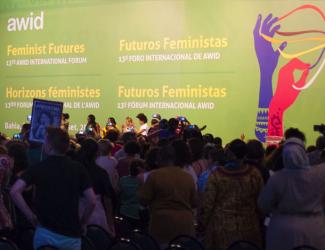
En septembre 2016, 1800 féministes et défenseur-e-s des droits des femmes venu-e-s des quatre coins de nos mouvements se réunissaient sur les côtes de Bahia à l’occasion du 13ème Forum international de l’AWID.
Cette section met l’accent sur les victoires, les enseignements et les ressources qui ont couronné nos conversations. Nous vous invitons à l’explorer, la partager et laisser vos impressions.
L’un des principaux éléments à retenir de ce Forum a été la nécessité d’élargir et d’approfondir notre travail de collaboration entre mouvements pour faire face à une montée des fascismes et des fondamentalismes, une exacerbation de la cupidité des entreprises et un changement climatique en progression.
L’AWID a donc travaillé avec plusieurs allié-e-s pour ériger ces semences de résistance :
Les mouvements peuvent aussi bénéficier d’une nouvelle méthodologie pour envisager nos horizons féministes. (à venir bientôt !)
A travers son prochain plan stratégique et le processus de son Forum, l’AWID s’engage à poursuivre et approfondir les rapports, les apprentissages et les processus amorcés lors du Forum 2016, tout en s’inspirant de l’actualité.
Et maintenant ?
Le monde est bien différent de celui qu’il était l’an dernier et il continuera à changer dans les années à venir.
Le prochain Forum de l’AWID se tiendra dans la région Asie-Pacifique (les dates et le lieu exacts seront annoncés en 2018). Nous attendons avec impatience de vous y retrouver !
A propos du Forum de l’AWID
Les Forums de l’AWID ont vu le jour en 1983, à Washington DC. Depuis, ils revêtent de nombreux aspects et incarnent, selon les personnes, tantôt un processus itératif visant à affiner nos analyses, notre vision et nos actions, un évènement clé galvanisant les féminismes des participant-e-s et leurs organisations ou un espace politique offrant refuge et solidarité aux défenseur-se-s des droits humains.
Linda Porn est une autre héroïne de l'organisation syndicale féministe et de l'activisme des travailleur·euses du sexe au niveau national (en Espagne) et transnational.
Originaire du Mexique, elle vit en Espagne depuis les années 2000. Elle est travailleuse du sexe, militante, mère célibataire et artiste multidisciplinaire.
Puisant dans ces différentes identités, elle utilise la performance, l'art vidéo et le théâtre pour rendre visibles les luttes aux intersections du transféminisme, du travail du sexe, de la migration, du colonialisme et de la maternité. Elle combine l'art et le travail du sexe tout en prenant soin de sa fille en tant que mère célibataire.
Linda appartient également à des groupes de travailleur·euses du sexe qui luttent pour leurs droits, comme le syndicat OTRAS et CATS Murcia. Elle a également cofondé le groupe 'Madrecitas' - qui rend visible et dénonce la violence institutionnelle raciste contre les familles migrantes. Violence à laquelle elle et sa fille ont été soumises en tant que travailleuse du sexe et mère célibataire migrante.
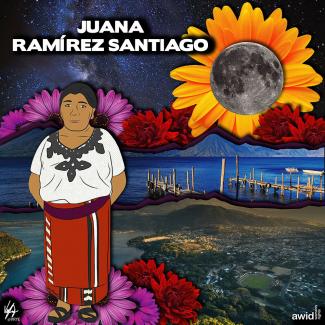
Juana was one of the founders and current Board Member of Red de Mujeres Ixiles de Nebaj, an Indigenous women’s rights organization that is a member of the Mesoamerican Initiative of WHRDs (IM-Defensoras).
She was also a midwife and a mother of 7 children. Juana had received death threats that were reported to the Prosecutor’s office. Juana is the third Indigenous WHRD murdered in the area during 2018. The Guatemala Ombudsman reports that a total of 20 HRDs were killed in the country this year.
Juana Ramírez Santiago was shot dead by unidentified attackers while crossing a bridge in Nebak, Quiché, Guatemala. Investigations to identify the perpetrators are ongoing.
Forum anchors (Forum page)
Points d’ancrage thématiques
Le Forum de l’AWID s’articulera autour de 6 sujets interconnectés. Ces ‘points d’ancrage’ sont centrés sur les réalités féministes.
Freeing the Church, Decolonizing the Bible for West Papuan Women
By Rode Wanimbo (@rodwan986), Jayapura, Papua Province of Indonesia
“Lord, we are unworthy. We are the ones who committed sin for Eve ate the fruit in Eden. We are just women who grow sweet potatoes, look after pigs and give birth to children. We believe you died on the cross to set us free. Thank you, In Jesus’s name Amen.”
This is a typical prayer of women I have heard during my visits to ministries in several villages. Even I said the same prayer for many years.
I was born and grew up in Agamua, the Central Highlands of West Papua. My father belongs to the Lani tribe and my mother comes from Walak.
In Lani and Walak languages - languages spoken in the Central Highlands - tiru means a pillar. There are four tiru (pillars) standing firmly in the middle of the Lani roundhouse (honai), around wun’awe or a furnace. Tiru is always made of the strongest type of wood called a’pe (ironwood tree). The longer the wood gets heated and smoked from the fire in the honai, the stronger it becomes. Without tiru, the honai cannot stand firm. West Papuan women are these tiru.
West Papua is located in the western part of the New Guinea island, containing some of the world’s highest mountains, densest jungle, and richest mineral resources. It is home to over 250 groups and has an incredible biodiversity. Due to its natural wealth, West Papua has, over the centuries, been targeted by foreign occupiers. Until 1963, we were colonized by the Dutch. However in 1969, after a manipulative political act, we were transferred from the Dutch to Indonesia.
The first German missionaries arrived in Mansinam Island, Manokwari, in 1855. Then, in the 1950s, Christianity was brought to the Central Highlands of West Papua by Protestant missionaries of European descent from America, Canada, Australia and New Zealand.
According to Scripture in Genesis 1: 26-27, Man and Woman are created in the image of God. It means all humanity is made with the call and capacity to exercise dominion. Radah, the Hebrew word for dominion, means stewardship. Radah is not a call to exercise imperial power as declared by Pope Nicolas V, granting Catholic nations the right to “discover” and claim dominion over non-Christian lands. To diminish the capacity of humans to exercise dominion, is to diminish the image of God on earth (Lisa Sharon Harper, The Very Good Gospel).
The Evangelical Church of Indonesia (GIDI) was established as an institution in 1963. In the Sunday Service liturgy of GIDI, Women are considered unworthy to take any responsibility except collecting offerings. In 2003, after 40 years, the Department of Women was introduced within the structure of the Synod leadership.
In November 2013, I was entrusted to be a chairperson of the Women’s Department of the GIDI Synod.
Together with several other women leaders, we started a cell group that is committed to “decolonizing the Bible.” We learn together how to reconstruct the interpretation of biblical texts to champion women.
A feminist theologian named Elisabeth S Florenza calls it a feminist hermeneutic theory (Josina Wospakrik, Biblical Interpretation and Marginalization of Woman in the Churches of West Papua).
Besides the cell group, we interview our elderly women to collect our ancestors’ wisdom and values. As Bernard Narakobi in his book The Melanesian Way said: “Our history did not begin with contact with the Western explorers. Our civilization did not start with the coming of the Christian missionaries. Because we have an ancient civilization. It is important for us to give proper dignity and place to our history”.
Yum is a knotted net or woven bag handmade from wood fiber or leaves. Yum is highly valued for it symbolizes life and hope. When women of Lani and Walak get married, our maternal aunts put yum on our heads. It means we bear the responsibility for giving life and for providing food. Yum is used to carry garden produce as well as being used as a container to put a baby to sleep in as it gives warmth and a sense of security.
“West Papuan Women are Yum and Tiru” became the prime references as we contextualized women in the eyes of Jesus Christ in seminar and focus group discussions. From 2013 to 2018, we focused on reconstructing the view of women in GIDI and in gaining a healthy self-image. We are still in the process of understanding who we are to Jesus, rather than who we have been told we are by theologians and the fathers of the early Churches. Josina Wospakrik, a West Papuan Theologian said “The Gospel is incredibly rich but it was impoverished due to human ambitions and agendas.”
Since 2018, the GIDI Women Leadership team and I have formulated four priority programs: Decolonizing the Bible, Storytelling in a circle, Training of trainers for Literacy and Gender. The fourth, supported simple bookkeeping and savings groups workshops facilitated by Yapelin and Yasumat, which are faith based organizations established by GIDI leaders to reach the economic, social and health needs of women in the communities.
Storytelling in a Circle
In this programme we create a safe space for women to talk - each woman has a story. We all sit together and learn how to be good listeners.
“I became Christian and was taught that the government is God’s representative. Why did the government do nothing when the army burnt down my village and killed my relatives?” asked one woman in the storytelling circle. “My aunt was raped.” She stopped for a while. Could not talk. She cried. We all did.
The process of storytelling has driven us into deep conversation. We began to contextualize Biblical texts within our daily realities.
We started asking questions amongst ourselves: Where is God in our toughest times? Does the state government truly represent God on earth? Why does the Creator allow privileged people to destroy His own image in the name of Christianity and Development? During the process, I realized that I have been reading the Bible using somebody else’s glasses.
The church has to be a safe place to share stories and be a place of comfort to be still and rest. As we reflect on the testimonies, those who tell their stories begin the process of recovering from wounds and trauma.
Financial Literacy for Women
Culturally, West Papuans invest in relationships. The concept of saving is understood as an investment in relations, not in a bank account. And while the Indonesian central government has granted special autonomy to respond to West Papuans’ demand for self-determination, many government policies harm the quality of family life and they do not account for women’s lives. High illiteracy rates amongst women mean most women do not have access to a bank account. With no money saved, access to medical services becomes a struggle.
Through the priority programmes, Yapelin, with the active involvement and support of women, created saving groups in Bokondini and Jayapura. The saving groups are chaired by women who have access to a bank.
In coordination with Yayasan Bethany Indonesia (YBI) and Yayasan Suluh, a faith-based organization (FBO) based in Jayapura, we facilitated four literacy workshops. The literacy team facilitated the training of trainers in three different dioceses: Merauke, Sentani, and Benawa. We now have 30 facilitators in different congregations who run literacy programs.
Lack of financial support for our programs will not stop us. Being stigmatized as rebels will not stop us from standing up and speaking in church evaluation meetings and conferences. It is stressful but I am committed together with several women leaders to calling on the power-holders within to free the church.
The Gospel known as Good News should become news that liberates women from a very patriarchal circle of power, liberates women from social stigma and returns women to the original purpose of The Creator.
The Gospel must be a mirror to reflect who we are collectively. As Lisa Sharon Harper, in her book The Very Good Gospel said “The Gospel is not only about an individual’s reconciliation with God, self and communities. But also speaks on systemic justice, peace between people groups and freedom for the oppressed”.
Rode Wanimbo is the chairperson of the Women’s Department of Evangelical Church of Indonesia (GIDI).
“Offerings for Black Life”
By Sokari Ekine (@blacklooks), New Orleans
Coming from a place of healing and self-care is a political act that guides us to be focused and to move as one. In New Orleans, we created and will be creating altars in honour of those murdered by police and white supremacists vigilantes!
The AWID Community is an online social networking platform specifically for AWID. It is a feminist space for connection, resistance and celebration. A space for critical feminist conversations, collective power and solidarity. It is also a space for post-event dialogues, navigating difficult political learnings and community care.
Join AWID membership to be part of the AWID Community today.
Snippet FEA Principles of work Education and Learning (EN)
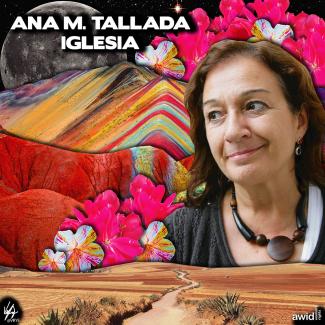
Ana fue una firme defensora de los derechos de las mujeres y trabajó con una amplia diversidad de mujeres, desde aquellas que están redes de base hasta las que son parte del sector privado.
Creía que había que tender puentes entre sectores. Ana fue integrante de la Red Nacional de Promoción de la Mujer (RNPM), y tuvo participación activa en el desarrollo de muchos programas sociales que abordan temas como la salud y los derechos sexuales y reproductivos.
FR Editor's note
Editor's note
Feminist Realities is a warm and caring invitation, a kind of en masse-care (versus self-care) act of preservation, an invitation to archive, to take stock of all the work lest it disappear. (...)
¡Bienvenidxs a Crear | Résister | Transform: un festival para movimientos feministas!
Principios de participación para el Festival
AWID está comprometida con la creación de un espacio virtual que nos invite y desafíe a todxs a funcionar desde un lugar de valentía, curiosidad, generosidad y responsabilidad compartida.
Te invitamos a crear conjuntamente con nosotrxs espacios libres de acoso y violencia, donde todas las personas sean respetadas en su identidad y expresión de género, raza, capacidad, clase, religión, idioma, etnia, edad, ocupación, tipo de educación, sexualidad, tamaño corporal y apariencia física. Espacios donde reconozcamos las desigualdades que prevalecen en nuestro mundo, y nos esforcemos por transformarlas.
Queremos crear un espacio donde:
podamos estar “presentes”:
Esto significa escucharnos, comprendernos y vincularnos. Sentirnos cerca, a pesar de la virtualidad. Para eso, contaremos con interpretación y abriremos canales (como el chat y otras herramientas) para reaccionar y compartir. Para lograr escucharnos mejor, les invitamos a utilizar audífonos o auriculares durante la sesión. Si puedes hacerlo, te sugerimos cerrar tus correos electrónicos y cualquier otra posible distracción mientras estás en la conversación.
todas las formas de conocimiento son valoradas:
Celebremos los distintos saberes y las múltiples formas en que estos se expresan. Nos acercamos al espacio con curiosidad y apertura para aprender de otrxs y permitiéndonos desaprender y reaprender a partir del intercambio, sentando las posibilidades para la construcción colectiva de conocimiento.
todxs nos sintamos bienvenidxs:
Estamos comprometidxs con un enfoque holístico de la accesibilidad, conscientes de las diferentes necesidades físicas, mentales, de idioma y de seguridad. Queremos un espacio que acoja a gente de contextos, creencias, capacidades y experiencias diversas. Seremos proactivxs, pero también te pedimos que nos comuniques tus necesidades, para que, dentro de nuestras posibilidades, nos ocupemos de satisfacerlas.
todxs nos sintamos segurxs y respetadxs:
Asumimos compromisos individuales y colectivos de respetar la privacidad y contar con el consentimiento de otrxs para difundir imágenes o contenido generado durante la conversación.
Crear un ambiente más seguro, respetuoso y disfrutable para las conversaciones es responsabilidad de todxs.
Cómo reportar
Si notas que alguien se está comportando de forma discriminatoria u ofensiva, por favor, contacta a la persona de referencia que se indicará al comienzo de la sesión.
Cualquier participante que se exprese con lenguaje opresivo o imágenes ofensivas será eliminadx de la videoconferencia y no será admitidx nuevamente. No interactuaremos con esa persona de ninguna manera.
Snippet - Blog post Quote_FR
« Poursuivons notre dynamique de solidarité, d’espoir et d’imagination radicale. »
- Beijing+30 et la CSW : adopter une lecture féministe des multiples défis de notre époque
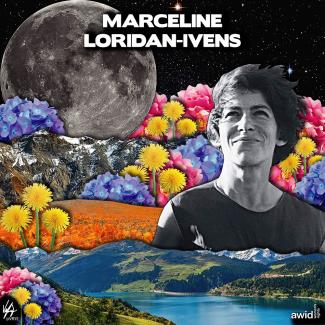
Née en 1928, Marceline était actrice, scénariste et réalisatrice.
En 2003, elle avait réalisé « La petite prairie aux bouleaux », mettant en vedette Anouk Aimée, ainsi que plusieurs autres documentaires. Survivante de l'holocauste, elle n'avait que quinze ans lorsque son père et elle furent arrêtés et envoyés dans des camps de concentration nazis. Les trois kilomètres qui la séparaient de son père à Auschwitz alors qu’elle-même était à Birkenau furent une distance insurmontable, décrite dans l’un de ses romans majeurs « Et tu n’es pas revenu ».
En parlant de son travail, elle a un jour déclaré: « Tout ce que je peux dire c’est que tout ce que je peux écrire, tout ce que je peux dévoiler, c’est à moi de le faire. »
FRMag - My queer Ramadan
Mi ramadán queer
por Amal Amer
Rezo con mi familia por primera vez en seis años envueltx en un keffiyah que recogí de un contenedor de basura. (...)
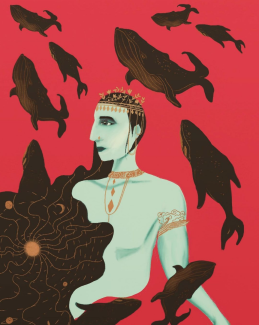
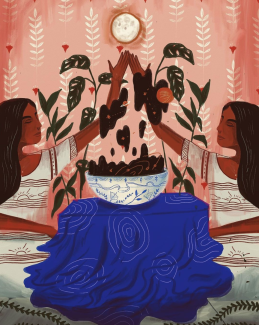
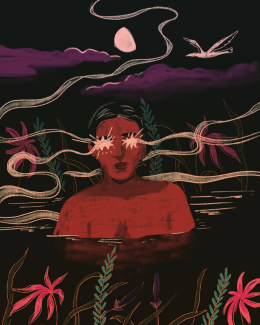
Forgotten Song (Chanson Oubliée)Ode to the Moon (Ode à la Lune)Vapour and Fire (Vapeur et Feu)
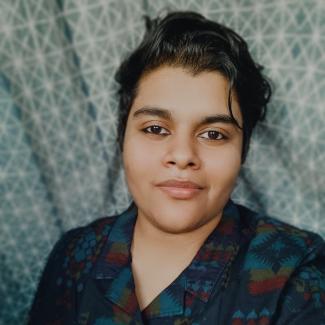
À propos d’Upasana Agarwal
Upasana est un·e illustrateurice et artiste non binaire basé·e à Kolkata, en Inde. Son travail explore l'identité et les récits personnels en partant d’un vestige visuel ou d’une preuve des contextes avec lesquels iel travaille. Iel est particulièrement attiré·e par les motifs qui, selon Upasana, communiquent des vérités complexes sur le passé, le présent et l'avenir. Quand Upasana n'est pas en train de dessiner, iel organise et dirige un centre d'art communautaire queer et trans dans la ville.