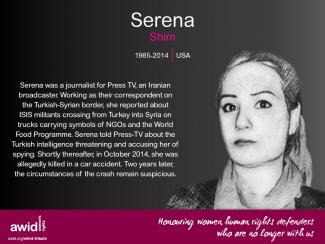
Serena Shim
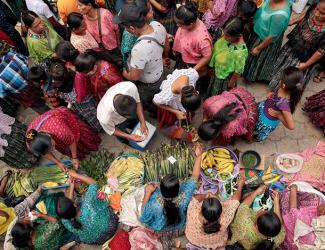
Building Feminist Economies is about creating a world with clean air to breath and water to drink, with meaningful labour and care for ourselves and our communities, where we can all enjoy our economic, sexual and political autonomy.
In the world we live in today, the economy continues to rely on women’s unpaid and undervalued care work for the profit of others. The pursuit of “growth” only expands extractivism - a model of development based on massive extraction and exploitation of natural resources that keeps destroying people and planet while concentrating wealth in the hands of global elites. Meanwhile, access to healthcare, education, a decent wage and social security is becoming a privilege to few. This economic model sits upon white supremacy, colonialism and patriarchy.
Adopting solely a “women’s economic empowerment approach” is merely to integrate women deeper into this system. It may be a temporary means of survival. We need to plant the seeds to make another world possible while we tear down the walls of the existing one.
We believe in the ability of feminist movements to work for change with broad alliances across social movements. By amplifying feminist proposals and visions, we aim to build new paradigms of just economies.
Our approach must be interconnected and intersectional, because sexual and bodily autonomy will not be possible until each and every one of us enjoys economic rights and independence. We aim to work with those who resist and counter the global rise of the conservative right and religious fundamentalisms as no just economy is possible until we shake the foundations of the current system.
Advance feminist agendas: We counter corporate power and impunity for human rights abuses by working with allies to ensure that we put forward feminist, women’s rights and gender justice perspectives in policy spaces. For example, learn more about our work on the future international legally binding instrument on “transnational corporations and other business enterprises with respect to human rights” at the United Nations Human Rights Council.
Mobilize solidarity actions: We work to strengthen the links between feminist and tax justice movements, including reclaiming the public resources lost through illicit financial flows (IFFs) to ensure social and gender justice.
Build knowledge: We provide women human rights defenders (WHRDs) with strategic information vital to challenge corporate power and extractivism. We will contribute to build the knowledge about local and global financing and investment mechanisms fuelling extractivism.
Create and amplify alternatives: We engage and mobilize our members and movements in visioning feminist economies and sharing feminist knowledges, practices and agendas for economic justice.
“The corporate revolution will collapse if we refuse to buy what they are selling – their ideas, their version of history, their wars, their weapons, their notion of inevitability. Another world is not only possible, she is on her way. On a quiet day, I can hear her breathing”.
Arundhati Roy, War Talk
Most Member States of the European Union have laws and practices that either criminalize or control sex workers in ways unacceptable to them. Criminalization of sex workers and/or their clients only contributes to increase the vulnerability of sex workers, who are already facing stigma, discrimination and exclusion from society on a daily basis. In Spain for example, the government is currently trying to pass an Organic Law for the Abolition of Prostitution, which will result in more clandestiny and violence. Let’s dive into the stories of sex workers and union organizers fighting to decriminilaze sex work and advance their labor rights.
In partnership with young feminist activists and youth-led organizations, AWID co-organized Beijing Unfettered in parallel to and independently from Beijing+25.

This story is about how an increasingly diverse group of feminists from the Pacific organized through the years to attend the AWID Forums and how that process changed them personally, as organizations, and as a movement through what they learned, discovered and experienced. It illustrates the importance of the Forums as a space through which a region that tends to be marginalized or ignored at the global level can build a strong presence in the feminist movement that is then replicated at other international women’s rights spaces.
Related content
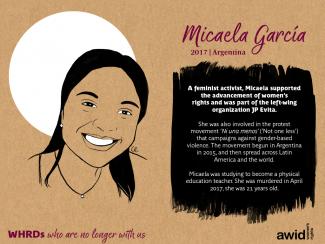
TeleSUR: Outrage Shakes Argentina After Murder of Anti-Femicide Activist
Yes! Please read the Call for Activities and apply here. Deadline is February 1st, 2024.
We will share information about the program, the spaces, and the way for everyone to participate in shaping them, as soon as we can, and ways for you to participate in shaping them - on the road to the Forum, and during the Forum. Please stay tuned!
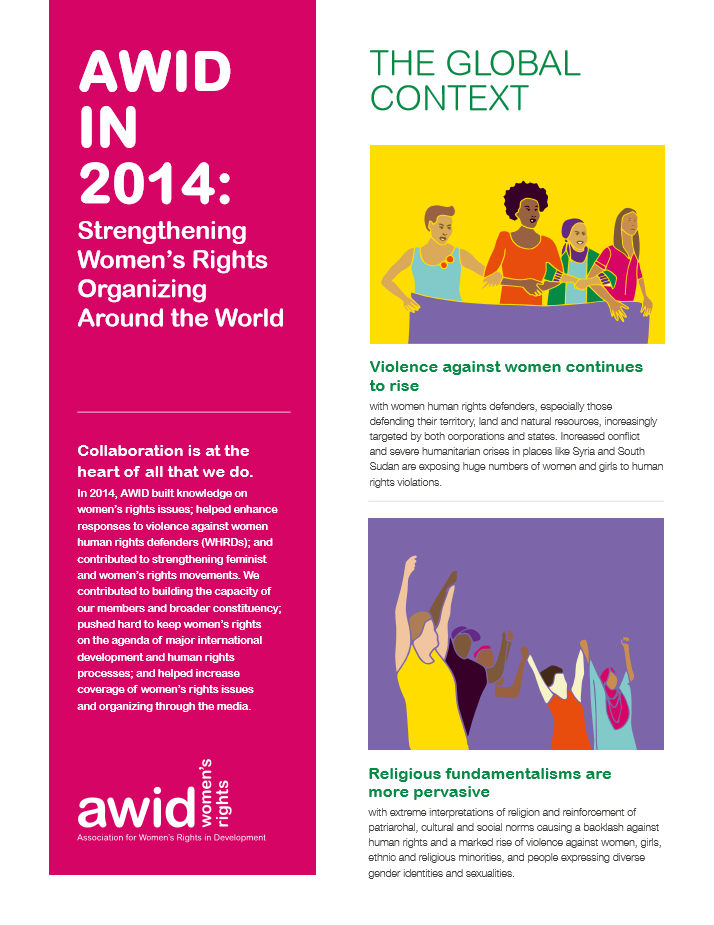
AWID is very pleased to share our 2014 Annual Report.
From building knowledge on women’s rights issues to amplifying responses to violence against women human rights defenders (WHRDs), our work last year continued to strengthen feminist and women’s rights movements across the world.
Get learn how we built the capacity of our members and broader constituency, pushed hard to keep women’s rights on the agenda of major international development and human rights processes, and helped increase coverage of women’s rights issues and organizing through the media. You'll find a panoramic sampling of our projects and some concrete numbers demonstrating our impact.
Collaboration is at the heart of all that we do, and we look forward to another year of working together to take our movements to the next level.
Despite an increasingly challenging panorama, there are important signs of hope for advancing women’s rights agendas. Women’s rights activists remain crucial in creating openings to demand structural change, sustaining their communities, opposing violence and holding the line on key achievements. And there are important opportunities to influence new actors and to mobilize greater resources to support women’s rights organizations.
In this context, strong collective action and organizing among women’s rights activists remains essential.
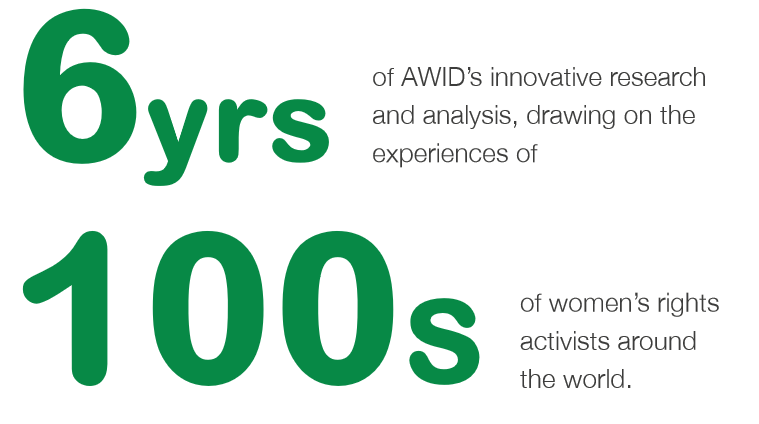
I am sincerely thrilled by AWID’s accomplishments since 1982 and hope to be able to pay at least a modest contribution to its hard work for the benefit of women and situation of gender equality.” — Aleksandra Miletic-Santic, Bosnia Herzegovina

Panel: In Panel discussions, explore an issue or challenge from different perspectives, or share a learning or experience, followed by audience questions if time allows.
Talk Show: Have a more spontaneous conversation in Talk-Show style. Talk Shows can be a conversation among several people, facilitated by a talk-show host. Audience questions can determine the conversation’s direction.
Discussion: These can take the form of world cafes, fishbowls, and other methodologies that facilitate participants’ active involvement in conversations. Highly participatory.
Workshop: Interactive sessions that invite participants to build new skills in any and all areas of life and activism.
Strategy Session: This is an invitation to think through an issue or strategy, in depth, with others. A space to learn from each other: what works, what doesn’t, and how do we develop new and collective strategies to create the worlds we dream of.
Sharing Circle (also known as “Birds of a Feather”): Ideal for small groups, in a more intimate setting, to hear from each other, spark discussion and carefully address topics that may be specific, sensitive and complex.
Arts – Participatory Workshop: Participatory activities involving arts and creative expression. Whether through visual art, theater, film, mural, dance, music, collective craft or artmaking, etc., we welcome all ideas celebrating feminist art and creativity as forms of social change, healing, expression and transformation.
Arts – Performances, Installations and Exhibitions: We welcome submissions that offer Forum participants new experiences and perspectives, expand our horizons, and challenge and inspire us to think, feel and organize in new ways.
Healing: Diverse activities tailored both for groups and individuals, from learning relaxation techniques to discussing burnout prevention, from trauma-informed practices of care for our body, mind and soul to healing rifts within our movements.
Ritu is a feminist technologist who brings her experience in the non-profit sector, driven by a passion for utilizing innovative approaches to finding feminist technological solutions. Holding a Master's in Technology in Computer Applications from the Indian Institute of Technology, her role at AWID encompasses a diverse range of responsibilities. From overseeing digital security and server management to database administration, capacity building, technology evaluation, software implementation and cloud solutions, Ritu ensures that AWID's IT infrastructure is resilient and effective. Prior to joining AWID, she played a pivotal role in advancing technological initiatives in the Health Promotion and Environment sectors, fueled by her dedication to leveraging technology for social good.
جديد
سيجتمع المشاركات/ون فعليًا في عدد من المواقع خارج مكان انعقاد المنتدى في بانكوك، في أجزاء مختلفة من العالم، في كل يوم من أيام المنتدى. وستكون جميع هذه المواقع ذاتية التنظيم مرتبطة افتراضيًا لموقع انعقاد المنتدى في بانكوك. كما هو الحال مع الأفراد المتواصلون عبر الإنترنت، سيتمكن المشاركون/ات من تسيير النشاطات والمشاركة في المحادثات والاستمتاع ببرنامج غني ومتنوع.
سيتم الإعلان عن مواقع التجمعات في عام 2024.
Joanne is an African feminist who is passionate about dismantling gender inequalities on the African continent. Joanne has worked with a number of global organizations, media and think tanks including Amnesty International, Wrthy, Local Development Research Institute, BBC, East African Community (EAC) among others.She serves on a couple of boards including Freely in hope-an NGO based in Kenya and Zambia that seeks to equip survivors and advocates to lead in ending sexual violence and Msingi Trust-a movement of activists that meet at the confluence of faith and human rights. She has a Masters in Business Administration, Masters of Public Policy and a Bachelor of Laws. She is a book junkie with a penchant for fiction.
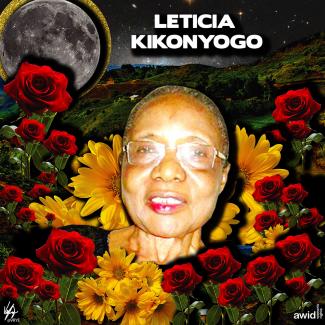
Prior to her retirement, she held many high profile positions including member of the Court of Appeal of Uganda and Deputy Chief Justice of Uganda. She was the first Ugandan woman to hold the position of Chief Magistrate between 1973 and 1986 and the first woman to be appointed High court judge in 1986.
She was one of the first ever women papal knights in the history of the Catholic Church in Africa. She died of a heart attack.
Ekaete Judith Umoh is an international disability rights advocate and inclusive development expert with astute analysis of issues regarding gender, disability and inclusive development. Her dream is to see increased visibility of women and girls with disabilities in the global feminist movement, as well as in all development efforts around the world.
Ekaete enjoys activism and politics, and went on to become the first elected female President of the Joint National Association of Persons with Disabilities (JONAPWD) in Nigeria, where she led Organizations of Persons with disabilities in the struggle to sign the Nigerian Disability Bill into Law in 2019, after over 17 years of consistent advocacy. Thereafter, she joined CBM Global as a pioneer Country Director and led her team for about 3 years, contributing towards ending the circle of poverty and disability in Nigeria. Aside from disability activism, Ekaete has served as consultant to several development agencies, providing technical assistance on disability inclusion in program and project design.