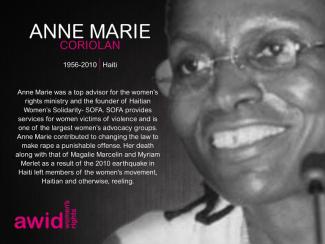
Anne Marie Coriolan
AWID began in 1982 and has grown and transformed since then into a truly global organization.
Read From WID to GAD to Women's Rights: The First 20 Years of AWID
A hands-on deckgame for collectives to explore feminist economic alternatives and systems of care as crisis response. This deckgame is for all movements navigating global climate crises through play and strategy based on real-life scenarios. A creative avenue to strategize in meetings, workshops, and community gatherings!
We invite you to explore the Priority Areas and Stay Informed sections of our website, or use the search function to find information about the specific topics you are researching.
We particularly recommend that you explore our toolkit “Where is the Money for Women’s Rights” (WITM Toolkit). This is a Do-it-Yourself Research methodology to support individuals and organizations who want to conduct their own research on funding trends for a particular region, issue or population by adapting AWID’s research methodology.
High-level panel discussion on the commemoration of the twenty-fifth anniversary of the adoption of the Durban Declaration and Programme of Action Concept note
Annual high-level panel discussion on human rights mainstreaming
Theme: Role of new and emerging digital technologies in preventing and eliminating female genital mutilation Concept note
Panel discussion on human rights and a culture of peace Concept note
Panel discussion on financing sustainable development in line with economic, social and cultural rights obligations. Concept note
Annual interactive debate on the rights of persons with disabilities
Theme: Disability-inclusive infrastructure, including transport and housing Concept note
Anual full-day meeting on the rights of the child Theme: Rights of the child and violations of the human rights of children in armed conflicts Concept note
Additional consultation sessions on the Draft Outcome Document
Over the past few years, a troubling new trend at the international human rights level is being observed, where discourses on ‘protecting the family’ are being employed to defend violations committed against family members, to bolster and justify impunity, and to restrict equal rights within and to family life.
The campaign to "Protect the Family" is driven by ultra-conservative efforts to impose "traditional" and patriarchal interpretations of the family, and to move rights out of the hands of family members and into the institution of ‘the family’.
Since 2014, a group of states have been operating as a bloc in human rights spaces under the name “Group of Friends of the Family”, and resolutions on “Protection of the Family” have been successfully passed every year since 2014.
This agenda has spread beyond the Human Rights Council. We have seen regressive language on “the family” being introduced at the Commission on the Status of Women, and attempts made to introduce it in negotiations on the Sustainable Development Goals.
AWID works with partners and allies to jointly resist “Protection of the Family” and other regressive agendas, and to uphold the universality of human rights.
In response to the increased influence of regressive actors in human rights spaces, AWID joined allies to form the Observatory on the Universality of Rights (OURs). OURs is a collaborative project that monitors, analyzes, and shares information on anti-rights initiatives like “Protection of the Family”.
Rights at Risk, the first OURs report, charts a map of the actors making up the global anti-rights lobby, identifies their key discourses and strategies, and the effect they are having on our human rights.
The report outlines “Protection of the Family” as an agenda that has fostered collaboration across a broad range of regressive actors at the UN. It describes it as: “a strategic framework that houses “multiple patriarchal and anti-rights positions, where the framework, in turn, aims to justify and institutionalize these positions.”
No, you don't have to be an AWID member to participate but AWID members receive a discounted registration fee as well as a number of other benefits.

English body