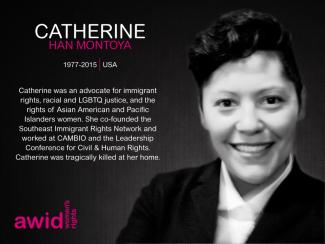
Catherine Han Montoya
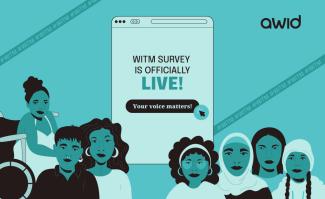
The “Where is the Money?” #WITM survey is now live! Dive in and share your experience with funding your organizing with feminists around the world.
Learn more and take the survey
Around the world, feminist, women’s rights, and allied movements are confronting power and reimagining a politics of liberation. The contributions that fuel this work come in many forms, from financial and political resources to daily acts of resistance and survival.
AWID’s Resourcing Feminist Movements (RFM) Initiative shines a light on the current funding ecosystem, which range from self-generated models of resourcing to more formal funding streams.
Through our research and analysis, we examine how funding practices can better serve our movements. We critically explore the contradictions in “funding” social transformation, especially in the face of increasing political repression, anti-rights agendas, and rising corporate power. Above all, we build collective strategies that support thriving, robust, and resilient movements.
Create and amplify alternatives: We amplify funding practices that center activists’ own priorities and engage a diverse range of funders and activists in crafting new, dynamic models for resourcing feminist movements, particularly in the context of closing civil society space.
Build knowledge: We explore, exchange, and strengthen knowledge about how movements are attracting, organizing, and using the resources they need to accomplish meaningful change.
Advocate: We work in partnerships, such as the Count Me In! Consortium, to influence funding agendas and open space for feminist movements to be in direct dialogue to shift power and money.
Listen to the story here:

A latin-american gender identity
The term travesti is often mistakenly translated as "transvestite" in English. However, it is a Latin American gender identity with no equivalent in other languages, and exclusively female. It is a person designated male at birth who identifies as female. They may or may not undergo bodily changes, and should always be addressed with she/her pronouns.
Travesti is not only a gender identity located outside of gender binarism, it is also a cultural identity rooted in Latin American movements. The term was initially pejorative, but it was later re-appropriated as a symbol of resistance and dignity.
Every travesti is trans because she does not identify with the gender designated at birth, however not every travesti considers themselves as a trans woman, since travesti is already a gender identity on its own.
Source: Berkins, Lohana. (2006). Travestis: una Identidad Política [Travestis: a Political Identity]. Trabajo presentado en el Panel Sexualidades contemporáneas en las VIII Jornadas Nacionales de Historia de las Mujeres/ III Congreso Iberoamericano de Estudios de Género Diferencia Desigualdad. Construirnos en la diversidad, Villa Giardino, Córdoba, 25 al 28 de octubre de 2006.
We work towards a world based on social, environmental, and economic justice; and interdependence, solidarity, and respect. We work towards dismantling systems of oppressive power and against all its manifestations, including patriarchy, fundamentalisms, militarisms, fascisms and corporate power that threaten our lives and our world. We want a just world where resources and power are shared in ways that enable everyone to thrive.
The fight for a world full of workplaces that are free from of all forms of discrimination, stigma and exclusion is a worthy one. A world in which sex work is decriminalized and recognized as work is part of this.
A world where all workers have safe working conditions, dignified wages, and can enjoy the same rights like health care, pension pay, sick days, holidays, job security and more, no matter their gender, race, ethnicity, age or ability. Labor rights are feminist issues, and feminist unions play a key role in advancing the legal, labor and economic rights of all workers, especially migrant workers, domestic workers, informal workers and sex workers. These are folks who have most recently been disproportionately affected by the pandemic, its burdens of care, lockdowns, curfews and increased policing. Let us introduce you to the stories of feminists and union organizers that are fighting for better working conditions and better worlds for all.
by Maryum Saifee
When you do a search for “Female Genital Mutilation” or “FGM” online, an image of four line-drawings of the female anatomy pop up next to its Wikipedia entry. (...)
artwork: “Dreams” by Neesa Sunar >

The Sex Workers' Trade Union Organisation (Organización de Trabajo Sexual, OTRAS) is the first union of sex workers in the history of Spain. It was born out of the need to ensure social, legal and political rights for sex workers in a country where far-right movements are on the rise.
After years of struggles against the Spanish legal system and anti-sex workers groups who petitioned to shut it down, OTRAS finally obtained its legal status as a union in 2021.
Its goal? To decriminalize sex work and to ensure decent working conditions and environments for all sex workers.
The union represents over 600 professional sex workers, many of whom are migrant, trans, queer and gender-diverse.
While fundamentalisms, fascisms and other systems of oppression shapeshift and find new tactics and strategies to consolidate power and influence, feminist movements continue to persevere and celebrate gains nationally and in regional and international spaces.
Through labor and union organizing, Sopo, Sabrina and Linda are not only fighting for the rights of essential workers, women workers, migrant workers and sex workers, but the rights of all workers.
The fight to end workers’ exploitation is a feminist struggle, and shows us that there are no feminist economies without feminist unions.
As heteropatriarchal capitalism continues to force us into consumerism and compliance, we are finding that our struggles are being siloed and separated by physical as well as virtual borders.
And with the additional challenges of a global pandemic to overcome, this divide-and-conquer strategy has been favorable for the proliferation of exploitation across many areas.
Yet, From September 1 to September 30, 2021, Crear | Résister | Transform: a festival for feminist movements! took us on a journey of what it means to embody our realities in virtual spaces. At the festival, feminist activists from across the world came together, not only to share experiences of hard-won freedoms, resistances, and cross-borders solidarities, but to articulate what a transnational form of togetherness could look like.
It is this togetherness that has the potential to defy borders, weaving a vision for a future that is transformative because it is abolitionist and anti-capitalist. Spread out over a month, across digital infrastructures that we occupied with our queerness, our resistance, and our imaginaires, the festival showed a way to deviate from the systems that make us complicit in the oppression of others and ourselves.
Though Audre Lorde taught us that the master’s tools will never dismantle the master’s house, Sara Ahmed showed us that we can misuse them. Because we had to make space for assembly, in spite of all the other demands on our time, it became possible to imagine a disruption to the reality of heteropatriarchal capitalism.
Now, if we understand assembly as a form of pleasure, then it becomes possible to make the link between transgressive pleasure and transnational/transdigital resistance. Between the kinds of pleasure that challenges borders on the one hand, and queerness, campiness, land and indigenous struggle, anti-capitalism, and anti-colonial organizing on the other.
This issue attempted to capture a sense of how the festival’s exercise in assembly took on multiple shapes and imaginations. Beyond direct collaborations with some of its speakers and dreamers, we brought on a plethora of other voices from the Global South to be in conversation with many of its themes and subjects. Below is a map of some of the festival’s panels that most inspired us.
By joining AWID, you are becoming part of worldwide feminist organizing, a collective power that is rooted in working across movements and is based on solidarity.