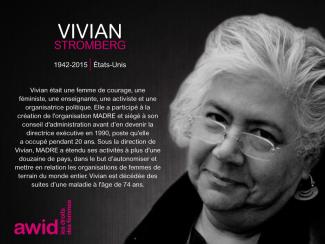
Vivian Stromberg
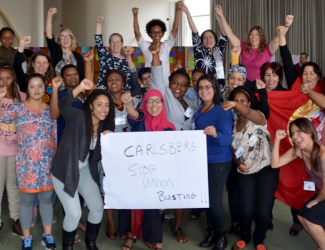
Women human rights defenders (WHRDs) worldwide defend their lands, livelihoods and communities from extractive industries and corporate power. They stand against powerful economic and political interests driving land theft, displacement of communities, loss of livelihoods, and environmental degradation.
Extractivism is an economic and political model of development that commodifies nature and prioritizes profit over human rights and the environment. Rooted in colonial history, it reinforces social and economic inequalities locally and globally. Often, Black, rural and Indigenous women are the most affected by extractivism, and are largely excluded from decision-making. Defying these patriarchal and neo-colonial forces, women rise in defense of rights, lands, people and nature.
WHRDs confronting extractive industries experience a range of risks, threats and violations, including criminalization, stigmatization, violence and intimidation. Their stories reveal a strong aspect of gendered and sexualized violence. Perpetrators include state and local authorities, corporations, police, military, paramilitary and private security forces, and at times their own communities.
AWID and the Women Human Rights Defenders International Coalition (WHRD-IC) are pleased to announce “Women Human Rights Defenders Confronting Extractivism and Corporate Power”; a cross-regional research project documenting the lived experiences of WHRDs from Asia, Africa and Latin America.
"Women Human Rights Defenders confronting extractive industries: an overview of critical risks and Human Rights obligations" is a policy report with a gender perspective. It analyses forms of violations and types of perpetrators, quotes relevant human rights obligations and includes policy recommendations to states, corporations, civil society and donors.
"Weaving resistance through action: Strategies of Women Human Rights Defenders confronting extractive industries" is a practical guide outlining creative and deliberate forms of action, successful tactics and inspiring stories of resistance.
The video “Defending people and planet: Women confronting extractive industries” puts courageous WHRDs from Africa, Asia, and Latin America in the spotlight. They share their struggles for land and life, and speak to the risks and challenges they face in their activism.
Challenging corporate power: Struggles for women’s rights, economic and gender justice is a research paper outlining the impacts of corporate power and offering insights into strategies of resistance.
AWID acknowledges with gratitude the invaluable input of every Woman Human Rights Defender who participated in this project. This project was made possible thanks to your willingness to generously and openly share your experiences and learnings. Your courage, creativity and resilience is an inspiration for us all. Thank you!
AWID no ofrece descuentos para grupos, pero sí ofrece descuentos en la inscripción a sus afiliadxs. (Haz clic aquí para obtener más información sobre cómo sumarte a la membresía)

Explore 150+ regularly updated funding opportunities in this searchable database, created in response to cuts in development aid. Filter by issue, region, funder type, and eligibility.
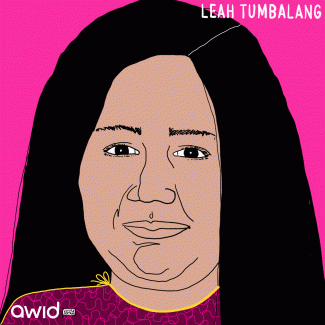
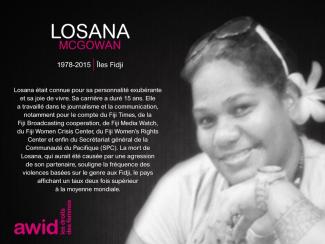
Leah Tumbalang était une femme lumad de Mindanao, aux Philippines. L’histoire du peuple autochtone Lumad recouvre des générations de résistance à l'exploitation minière à grande échelle par les entreprises, la protection des domaines ancestraux, des ressources et de la culture, et la lutte pour le droit à l'autodétermination.
Leah était une leader lumad, ainsi qu’une dirigeante du Kaugalingong Sistema Igpasasindog tu Lumadnong Ogpaan (Kasilo), une organisation paysanne lumad plaidant contre l'arrivée des sociétés minières à Bukidnon, dans la province de Mindanao. Elle s’est montrée inébranlable dans son activisme antimines, militant avec ferveur contre les effets dévastateurs de l'extraction minière sur l'environnement et les terres des peuples autochtones. Leah était également une organisatrice de la liste du parti Bayan Muna, membre du parti politique de gauche Makabayan.
Depuis près d’une décennie, Leah (ainsi que d’autres membres de Kasilo) recevait des menaces du fait qu'elle codirigeait l'opposition contre le déploiement de groupes paramilitaires soupçonnés d’être soutenus par des intérêts miniers.
« En tant que leader des Lumad au sein de leur communauté, elle est au premier plan pour lutter en faveur de leurs droits à la terre ancestrale et à l'autodétermination ». - Organisation régionale lumad de Kalumbay
Être en première ligne de la résistance implique également souvent d’être la cible de violences et victime de l’impunité. Leah a non seulement reçu de nombreuses menaces de mort, mais elle a été assassinée le 23 août 2019 à Valencia, dans la province de Bukidnon.
Selon un rapport de Global Witness, « les Philippines sont le pays à avoir été le plus touché en chiffre absolu » pour ce qui est des meurtres d’activistes écologistes en 2018.
Lisez le rapport du Global Witness, publié en juillet 2019
In the African Commission and the Inter-American System, anti-rights actors push essentialist notions of culture and gender to hamper progress on rights and undermine accountability. As we see, anti-rights actors are exerting influence in regional human rights systems, as well as international spaces.
Ayant conscience des nombreuses difficultés que les déplacements impliquent, nous vous fournirons davantage d’informations et de détails sur les modalités de voyage jusqu’à Bangkok lorsque les Inscriptions ouvriront, au début de l’année prochaine.
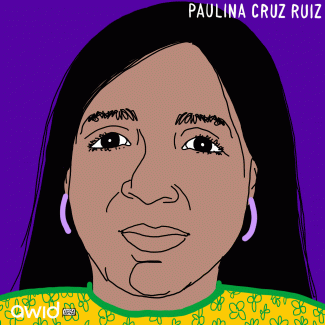
Paulina Cruz Ruiz, from the Rabinal, Baja Verapaz region of Guatemala, was an ancestral Maya Achí (Indigenous) authority and a human rights defender.
She was actively involved in community organizing and resistance, including legal measures against mining projects on Indigenous territory, projects that would severely affect and damage the socio-environmental fabric.
“The extractive industry model promoted by the Guatemalan government and the construction of large-scale development projects on indigenous lands without community consent has been a source of ongoing disputes with resistance movements.” - Minority Rights Group International
Paulina was also part of the March for Dignity, Life and Justice, in which on 1 May 2019 thousands of Guatemalans started a march of eight days against corruption and impunity in the prosecution and assassinations of human rights, peasant and Indigenous leaders and land defenders.
Paulina was murdered on 14 September 2019 near her home in the village of Xococ.
According to the Minority Rights Group International, “one of the major ongoing issues affecting Mayan communities is the increasing activity of the mining industry.”
Read more about the Mayans of Guatemala
Read more about the March for Dignity, Life and Justice
¿Quieren sumarse al creciente número de personas que le están diciendo «basta» a la infiltración de lxs actores anti-derechos en la ONU?
Asking ourselves the same question, we believe there are no simple answers. For many participants the AWID Forum might be one of the few international trips they undertake in their life. The pandemic taught us the possibilities but also the limitations of virtual spaces for movement-building: there is nothing like in-person connection. Movements need cross-border connections to build our collective power in the face of the threats we face, notably the climate crisis. We believe that the upcoming AWID Forum can be a strategic space to hold these conversations and to explore alternatives to international travel. The hybrid element of the Forum is an important part of this exploration.
Où est l’argent pour l’organisation des mouvements féministes ?
Que connaissez-vous du financement féministe ? Répondez au quiz de l’AWID Où est l’argent pour l’organisation des mouvements féministes ? pour tester vos connaissances
Ghiwa Sayegh es una anarcoescritora queer, editora independiente y archivista. Es la editora fundadora de Kohl, una revista para la investigación sobre cuerpo y género, y la cofundadora de Intersectional Knowledge Publishers. Posee una maestría en estudios de género de Université Paris 8 Vincennes, Saint-Denis. Le apasionan la teoría queer, las circulaciones transnacionales y las historias imaginadas o desconocidas. Sus influencias son Audre Lorde y Sara Ahmed.
The rising power of anti-rights actors is not happening in a vacuum. Understanding the rise of ultra-nationalism, unchecked corporate power, growing repression, and diminishing civic space is key to contextualize the anti-rights threats we face today.