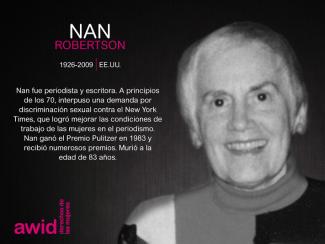
Nan Robertson
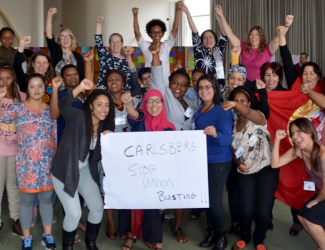
Women human rights defenders (WHRDs) worldwide defend their lands, livelihoods and communities from extractive industries and corporate power. They stand against powerful economic and political interests driving land theft, displacement of communities, loss of livelihoods, and environmental degradation.
Extractivism is an economic and political model of development that commodifies nature and prioritizes profit over human rights and the environment. Rooted in colonial history, it reinforces social and economic inequalities locally and globally. Often, Black, rural and Indigenous women are the most affected by extractivism, and are largely excluded from decision-making. Defying these patriarchal and neo-colonial forces, women rise in defense of rights, lands, people and nature.
WHRDs confronting extractive industries experience a range of risks, threats and violations, including criminalization, stigmatization, violence and intimidation. Their stories reveal a strong aspect of gendered and sexualized violence. Perpetrators include state and local authorities, corporations, police, military, paramilitary and private security forces, and at times their own communities.
AWID and the Women Human Rights Defenders International Coalition (WHRD-IC) are pleased to announce “Women Human Rights Defenders Confronting Extractivism and Corporate Power”; a cross-regional research project documenting the lived experiences of WHRDs from Asia, Africa and Latin America.
"Women Human Rights Defenders confronting extractive industries: an overview of critical risks and Human Rights obligations" is a policy report with a gender perspective. It analyses forms of violations and types of perpetrators, quotes relevant human rights obligations and includes policy recommendations to states, corporations, civil society and donors.
"Weaving resistance through action: Strategies of Women Human Rights Defenders confronting extractive industries" is a practical guide outlining creative and deliberate forms of action, successful tactics and inspiring stories of resistance.
The video “Defending people and planet: Women confronting extractive industries” puts courageous WHRDs from Africa, Asia, and Latin America in the spotlight. They share their struggles for land and life, and speak to the risks and challenges they face in their activism.
Challenging corporate power: Struggles for women’s rights, economic and gender justice is a research paper outlining the impacts of corporate power and offering insights into strategies of resistance.
AWID acknowledges with gratitude the invaluable input of every Woman Human Rights Defender who participated in this project. This project was made possible thanks to your willingness to generously and openly share your experiences and learnings. Your courage, creativity and resilience is an inspiration for us all. Thank you!
En 2021, l’AWID, comme beaucoup d’autres organisations, a dû faire face aux répercussions de la pandémie mondiale en cours sur notre façon de travailler et notre rôle en ces temps particuliers. L’année nous a appris trois leçons essentielles sur la façon de traverser cette période en tant qu’organisation mondiale de soutien au mouvement féministe.
Téléchargez le rapport annuel 2021
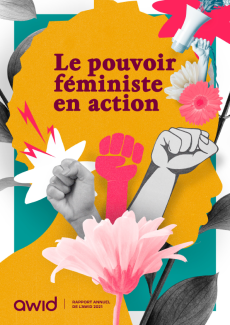
Notre expérience en 2021 nous a permis de constater que l’AWID jouait un rôle important et quelque peu unique dans la création et le maintien d’une communauté féministe mondiale transcendant les identités et les thèmes.
Es un centro comunitario, donde unx puede tomar cursos y capacitarse en actividades creativas que generan ingresos como peluquería local, cocina y creación artística. Lxs niñxs también pueden disfrutar de actividades culturales y educativas.
El MSTC no trabaja solo. Colabora con instituciones y colectivos de arte para producir experiencias culturales, deportivas y educativas, junto con el acceso crítico a la atención médica. Desde su inicio, este proyecto participativo ha sido liderado y llevado a cabo principalmente por mujeres, bajo el liderazgo de la activista afro-brasileña Carmen Silva, quien alguna vez fue una persona sin hogar.
(avec des invités spéciaux!)
📅Mardi 12 mars
🕒18 h - 21 h 30 HNE
🏢 Blue Gallery, 222 E 46th St, New York
Entrée par RSVP uniquement

Con más de 10 años de experiencia en finanzas, Lucy ha dedicado su carrera a misiones con y sin fines de lucro. También ha prestado trabajo voluntario para organizaciones sin fines de lucro. Desde el acelerado mundo de las finanzas, Lucy siente pasión por estar al día con las competencias tecnológicas asociadas con este ámbito. Lucy se incorporó a AWID en 2014. En su tiempo libre disfruta de la música, de viajar y de practicar una variedad de deportes.
L'organisation communautaire des femmes noires dans le Cauca du Nord en Colombie remonte au passé colonial du pays, marqué par le racisme, le patriarcat et le capitalisme qui ont soutenu l'esclavage comme moyen d'exploiter les riches sols de la région. Ces organisatrices sont les héroïnes d'un vaste mouvement pour l'autonomie des personnes noires, luttant pour la gestion durable des forêts et des ressources naturelles de la région, vitales pour leur culture et leur subsistance.
Depuis 25 ans, la Asociación de Mujeres Afrodescendientes del Norte del Cauca (l’Association des Femmes Afro-Descendantes du Cauca du Nord, ASOM) se consacre à la promotion de l'organisation des femmes afro-colombiennes du Cauca du Nord.
L’association a été créée en 1997 en réponse aux violations continues des droits humains, à l'absence de politiques publiques, à la gestion inadéquate des ressources naturelles et au manque d'opportunités pour les femmes dans le territoire.
Elles ont forgé la lutte pour garantir les droits ethno-territoriaux, pour mettre fin aux violences contre les femmes et pour faire reconnaître le rôle des femmes dans la construction de la paix en Colombie.
The WITM survey is focused on the feminist resourcing realities of the last 3 years (2021 to 2023), and has five key sections:
It consists of mandatory* and optional questions, most of which are multiple-choice. You will have a chance to share more on issues that are important to you by responding to the open question(s) at the end of the survey.

To respond to the questions quickly and easily, we advise that you have your key financial information at hand (e.g., your annual budgets from 2021 to 2023). However, if you wish to save your responses and come back to the survey later, you are able to do this whenever needed.
Margarita est une militante féministe et LGBTIQA d'Amérique latine. Elle est passionnée de transformation sociale et de bien-être collectif. Elle est titulaire de diplômes en psychologie, communication et en administration publique, ainsi que de certificats en politiques publiques, leadership, gestion et prise de décision. Durant son parcours professionnel, Margarita a acquis une vaste expérience auprès d'organisations de terrain, d'ONG nationales et régionales, d'universités et du secteur public, développant la facilitation, le renforcement des capacités, le plaidoyer politique, la communication et l'évaluation des politiques.
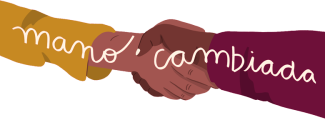
("exchange hand")
Term of the black communities of the Northern Cauca for the minga, the collective work based on solidarity and mutual support.

To claim your power as an expert on the state of resourcing for feminist movements
Faye is a passionate Pan-African feminist, active in movements for women's rights, racial justice, migrant and labor rights, and environmental justice. Her activism builds on the legacy of the struggle against apartheid in South Africa and the aftermath of the apartheid era in Zimbabwe.
In 2019, Faye joined AWID as the Director of Finance, Operations and Development, and strived to ensure that AWID upholds the feminist principles and values in all of its operations. She brings over 20 years of experience in feminist leadership, strategy, and all aspects of finance and organizational development.
Faye is a committed Board Member of UAF-Africa and other women's rights organizations. She previously held a Head of Finance and Operations roles at Paediatric Adolescent Treatment for Africa and JASS - Just Associates Inc. in Southern Africa. She also held Directorship roles for International Computer Driving Licence (ICDL) in Central and Southern Africa. She holds a Bcompt in Accounting Science from University of South Africa and is a member of the Southern African Institute for Business Accountants.

Dans le monde entier, les mouvements féministes, de défense des droits des femmes, pour la justice de genre, pour la défense des personnes LBTQI+ et les mouvements alliés vivent un moment critique, face à de puissantes remises en question de droits et libertés pourtant acquis.
Ces dernières années ont vu la rapide montée de l’autoritarisme, de la violente répression de la société civile et de la criminalisation des défenseur·ses des droits humains des femmes et des personnes de genre divers, l’escalade de guerres et de conflits dans plusieurs régions du monde, la perpétuation des injustices économiques et de crises conjuguant la santé, l’écologie et les changements climatiques.