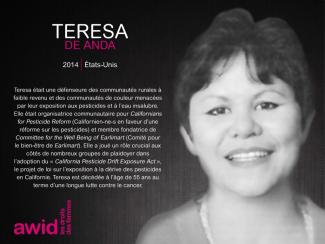
Teresa De Anda
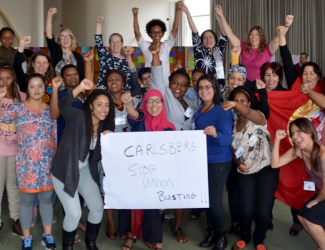
Women human rights defenders (WHRDs) worldwide defend their lands, livelihoods and communities from extractive industries and corporate power. They stand against powerful economic and political interests driving land theft, displacement of communities, loss of livelihoods, and environmental degradation.
Extractivism is an economic and political model of development that commodifies nature and prioritizes profit over human rights and the environment. Rooted in colonial history, it reinforces social and economic inequalities locally and globally. Often, Black, rural and Indigenous women are the most affected by extractivism, and are largely excluded from decision-making. Defying these patriarchal and neo-colonial forces, women rise in defense of rights, lands, people and nature.
WHRDs confronting extractive industries experience a range of risks, threats and violations, including criminalization, stigmatization, violence and intimidation. Their stories reveal a strong aspect of gendered and sexualized violence. Perpetrators include state and local authorities, corporations, police, military, paramilitary and private security forces, and at times their own communities.
AWID and the Women Human Rights Defenders International Coalition (WHRD-IC) are pleased to announce “Women Human Rights Defenders Confronting Extractivism and Corporate Power”; a cross-regional research project documenting the lived experiences of WHRDs from Asia, Africa and Latin America.
"Women Human Rights Defenders confronting extractive industries: an overview of critical risks and Human Rights obligations" is a policy report with a gender perspective. It analyses forms of violations and types of perpetrators, quotes relevant human rights obligations and includes policy recommendations to states, corporations, civil society and donors.
"Weaving resistance through action: Strategies of Women Human Rights Defenders confronting extractive industries" is a practical guide outlining creative and deliberate forms of action, successful tactics and inspiring stories of resistance.
The video “Defending people and planet: Women confronting extractive industries” puts courageous WHRDs from Africa, Asia, and Latin America in the spotlight. They share their struggles for land and life, and speak to the risks and challenges they face in their activism.
Challenging corporate power: Struggles for women’s rights, economic and gender justice is a research paper outlining the impacts of corporate power and offering insights into strategies of resistance.
AWID acknowledges with gratitude the invaluable input of every Woman Human Rights Defender who participated in this project. This project was made possible thanks to your willingness to generously and openly share your experiences and learnings. Your courage, creativity and resilience is an inspiration for us all. Thank you!
La communauté AWID est une plateforme en ligne de réseautage social conçue tout spécialement pour l’AWID. Espace féministe ayant vocation à connecter, résister et célébrer, c’est un endroit où les conversations féministes critiques, le pouvoir et la puissance du collectif et la solidarité sont à l’œuvre. Cet espace est également ouvert pour dialoguer après les différents événements, pour penser, assimiler, digérer les apprentissages politiques difficiles, et pour prendre soin de la communauté.
Devenez membre de l’AWID pour pouvoir faire partie de la Communauté AWID dès aujourd’hui.
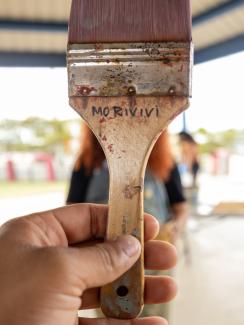
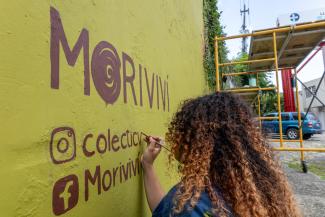
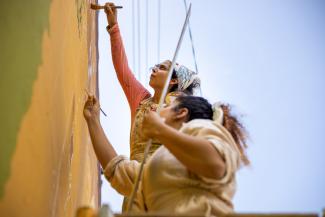
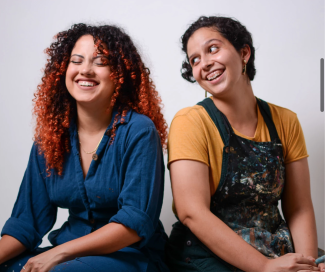
Colectivo Moriviví is an all women artistic collective. Our artistic production consists of muralism, community-led muralism, and protest performance/actions. Our work is about democratizing art and bringing the narratives of Puerto Rican communities to the public sphere to create spaces in which they are validated. We believe that through artivism we can promote consciousness on social issues and strengthen our collective memory.
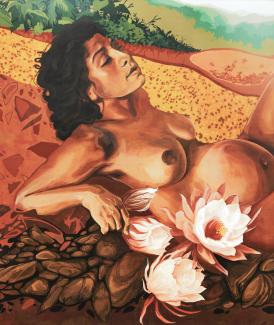
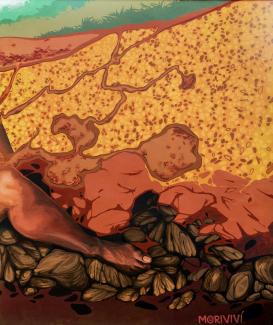
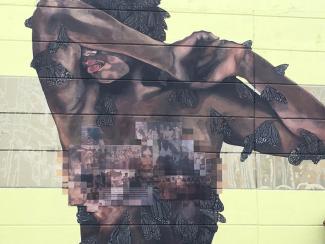
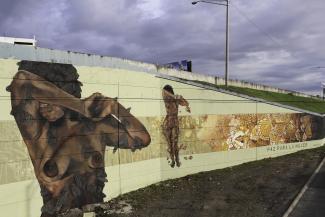
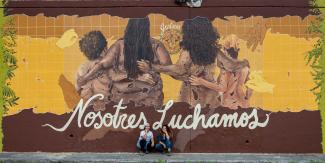
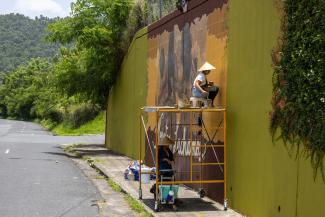
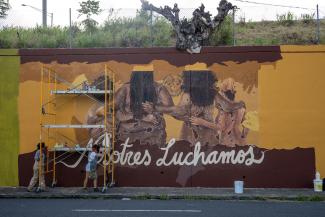
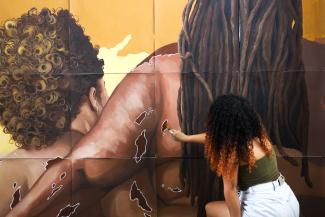
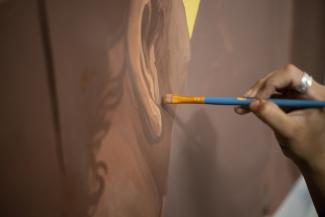
As part of their participation in AWID’s Artist Working Group, Colectivo Morivivi gathered a diverse group of members, partners and staff to facilitate a collaborative process of dreaming into, informing, and deciding on the content for a community mural through a multi-stage co-creation process. The project began with a remote conceptualization with feminists from different parts of the planet brought together by AWID, and then it evolved to its re-contextualization and realization in Puerto Rico. We were honored to have the input of local artists Las Nietas de Nonó(@lasnietasdenono), the participation of local women in the Community Painting Session, the logistics support from the Municipality of Caguas, and FRIDA Young Feminist Fund’s additional support to the collective.
The mural explores the transcendence of borders by presenting bodies like a map, in an embrace that highlights the intersection of the different feminist manifestations, practices and realities.
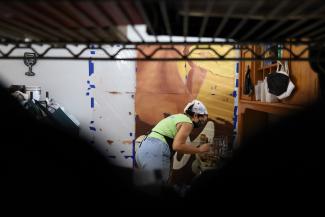
We also thank Kelvin Rodríguez, who documented and captured the different stages of this project in Puerto Rico:

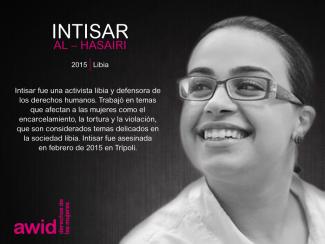
« J’ai constaté la discrimination dans la rue, que ce soit par des taquineries ou des agressions verbales qui y ont lieu. Je me suis aussi faite plein d’ami·e·s et j’y ai rencontré plusieurs personnes. Il se peut que ce soit dangereux là-bas, mais je suis une survivante, et pour le moment, c’est là où je suis. » - Sainimili Naival
Elle a demandé aux responsables et acteurs politiques de fournir des politiques et des services adaptés au handicap, comme la construction de rampes dans les villes et les villages afin d'accroître leur accessibilité. Les barrières physiques n’étaient pas les seules qu’elle aspirait à modifier. Sur la base de sa propre expérience, elle savait que des changements plus difficiles devaient être menés dans les sphères économiques et sociales. Bon nombre des défis avec lesquels sont aux prises les personnes handicapées trouvent leurs racines dans les attitudes discriminantes et stigmatisantes.
Survivante et combattante, Sainimili a contribué à co-créer des réalités féministes qui renforcent l’inclusion et font évoluer les attitudes par rapport à l’égalité des personnes handicapées. Elle a été membre de la Spinal Injury Association of Fiji (SIA) ainsi que participé à la formation « Démarrez votre entreprise » de l’Organisation internationale du Travail à Suva via le projet « Pacific Enable » (le Pacifique rend possible) du Forum Asie-Pacifique sur le handicap. Elle a ainsi pu transformer ses idées en une entreprise qui lui était propre. Elle était commerçante sur l’étal de marché 7 de Suva, offrant des services de manucure, tout en gérant un stand au marché des femmes SIA pour y vendre de l’artisanat, des suls et des objets historiques. Sainimili planifiait d’élargir son commerce et de devenir une employeuse majeure de personnes handicapées.
Outre son activisme, elle était également médaillée de tennis de table et une récente championne.
Avec sa personnalité vive, Sainimili était unique. On savait toujours lorsqu’elle était dans la pièce car ses rires et ses histoires étaient la première chose qu’on pouvait remarquer. - Michelle Reddy
Sainmili est décédée en 2019.
As we navigate the global polycrisis, movements are tirelessly building power beyond traditional power structures. The wave of US presidential executive orders is intended to scare us, but no amount of fascist ideology can erase our existence and resistance.
We invite you to be a part of the solidarity-building campaign to expose and resist fascist forces undermining feminist and gender justice movements in your contexts!
Los actores anti-derechos adoptan una estrategia doble. Además de atacar abiertamente al sistema multilateral, los actores anti-derechos también socavan los derechos humanos desde adentro. Se involucran con el fin de cooptar procesos, consolidar normativas regresivas, y erosionar responsabilidades.
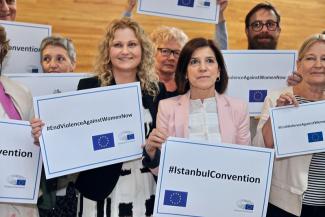
El involucramiento de los actores anti-derechos en espacios internacionales de derechos humanos tiene un objetivo principal: socavar el sistema y su capacidad de respetar, proteger y satisfacer los derechos humanos para todas las personas, y de exigir rendición de cuentas a los Estados miembro por su violación. Algunas tácticas anti-derechos operan por fuera de la ONU, e incluyen la deslegitimación y la presión política para desfinanciar a la ONU, o para que ciertos Estados miembro se retiren de acuerdos internacionales sobre derechos humanos. En los últimos años, algunos actores antiderechos han logrado una creciente influencia dentro de la ONU. Sus tácticas internas incluyen la capacitación de representantes, la distorsión de los marcos de derechos humanos, el debilitamiento de acuerdos sobre derechos humanos, la infiltración en comités de organizaciones no gubernamentales, las solicitudes de ingreso al Consejo Económico y Social bajo nombres neutrales, la infiltración en los espacios de la juventud, y las presiones para ubicar a actores antiderechos en posiciones clave.
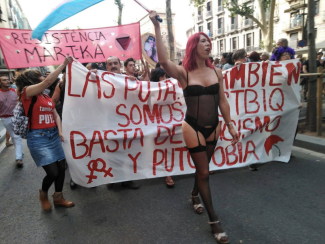
Nous vous présentons Sabrina Sanchez, incroyable femme trans, migrante, travailleuse du sexe, organisatrice, transféministe et l'une des fondatrices du syndicat OTRAS.
Originaire de Mexico, elle a émigré en Espagne il y a 17 ans après avoir obtenu son diplôme en communication et a commencé à travailler comme travailleuse du sexe.
Il ne fallut pas longtemps avant qu'elle ne s'implique dans l'activisme trans et l'activisme des travailleur·euses du sexe à Barcelone. Après avoir rejoint l'Association des Professionnel·les du Sexe (Asociación de Profesionales del Sexo, Aprosex), elle a commencé à travailler dans son secrétariat et a fondé le syndicat espagnol des travailleur·euses du sexe OTRAS.
Elle vit actuellement à Amsterdam, où elle travaille comme coordinatrice de l'Alliance Européenne des Travailleur·euses du Sexe.
Fait divers: elle est aussi mécanicienne automobile et adepte de la course à pied!
Le thème du 14e Forum international de l'AWID est «Réalités féministes : notre pouvoir en action».
Ce Forum célébrera et amplifiera les propositions audacieuses autour de nous, à tous les stades de déveoppement !
“But when was the master
ever seduced from power?
When was a system ever broken
by acceptance?
when will the BOSS hand you power with love?
At Jo’Burg, at Cancun or the U.N?
– Molara Ogundipe
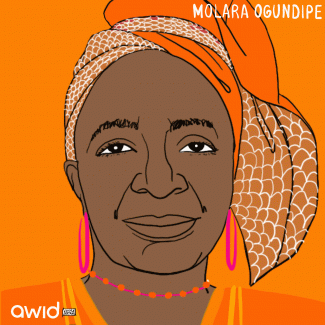
Across the different continents and countries, Professor Ogundipe taught comparative literature, writing, gender, and English studies using literature as a vehicle for social transformation and re-thinking gender relations.
A feminist thinker, writer, editor, social critic, poet, and activist Molara Ogundipe succeeded in combining theoretical work with creativity and practical action. She is considered to be one of the leading critical voices on African feminism(s), gender studies and literary theory.
Molara famously coined the concept of “stiwanism’ from the acronym STIWA – Social Transformations in Africa Including Women recognizing the need to move “away from defining feminism and feminisms in relation to Euro-America or elsewhere, and from declaiming loyalties or disloyalties.”
In her seminal work ‘Re-creating Ourselves’ in 1994, Molara Ogundipe (published under Molara Ogundipe-Leslie) left behind an immense body of knowledge that decolonized feminist discourse and “re-centered African women in their full, complex narratives...guided by an exploration of economic, political and social liberation of African women and restoration of female agency across different cultures in Africa.”
In speaking about the challenges she faced as a young academic she said:
”When I began talking and writing feminism in the late sixties and seventies, I was seen as a good and admirable girl who had gone astray, a woman whose head has been spoilt by too much learning".
Molara Ogundipe stood out for her leadership in combining activism and academia; in 1977 she was among the founding members of AAWORD, the Association of Women in Research and Development. In 1982 she founded WIN (Women In Nigeria) to advocate for full “economic, social and political rights” for Nigerian women. She then went on to establish and direct the Foundation for International Education and Monitoring and spent many years on the editorial board of The Guardian.
Growing up with the Yoruba people, their traditions, culture, and language she once said :
“I think the celebration of life, of people who pass away after an achieved life is one of the beautiful aspects of Yoruba culture.”
Molara’s Yoruba ‘Oiki’ praise name was Ayike. She was born on 27 December 1940 and at the age of 78, Molara passed away on 18 June 2019 in Ijebu-Igbo, Ogun State, Nigeria.
✉️ By registration only. Register here
📅 Tuesday, March 11, 2025
🕒 6.00-8.00pm EST
🏢 Chef's Kitchen Loft with Terrace, 216 East 45th St 13th Floor New York
Organizer: AWID
Une expérience magique de narration féministe animée par la féministe panafricaine Coumba Touré, dans la tradition séculaire des griots d’Afrique de l’Ouest
Et nous nous réunissons à nouveau
Nous avons rassemblé nos histoires, notre force
nos chansons
nos larmes
notre rage
nos rêves
nos succès
nos échecs
nous les avons rassemblés dans un grand bol pour le partage
pendant une lune de pensées
Aussi, nous restons en contact
Nous nous secouons l'esprit
nous nous caressons l'âme
Alors que nos mains sont toujours liées
Et que nos baisers et nos câlins sont interdits
Pourtant, nous nous renforcons d’heure en heure
Tissant ensemble nos voix
Franchissant les barrières sonores
comme nous parlons en langues
Nous sommes de plus en plus fortes
Nous connaissons ce qui nous différencie des autres
et les différences entre nous,
alors nous cousons nos beautés en patchwork de pensées
De nos apprentissages les plus profonds
de nos pouvoirs
Parfois, nous sommes entourées de terreur,
Par la confusion, la malhonnêteté
Mais nous nous purifions dans l'océan de l'amour
Nous sommes des tisserands de rêves
Pour vêtir un nouveau monde
Fil après fil
Aussi petites que nous soyons,
comme de petites fourmis construisant nos mouvements
comme de petites gouttes construisant nos rivières
Nous faisons des pas en avant et des pas en arrière
dansons notre chemin de retour à un mental sain
Nous soutenons le rythme de nos coeurs
Continuez à battre,
s'il vous plaît, ne vous arrêtez pas
ainsi nous sommes les transmetteurs d'une générosité oubliée
Goutte après gouttes, grandissant comme l'océan
grandissant comme la rivière qui coule de nos âmes
montrant notre force pour être l'eau qui lavera ce monde
et nous nous rassemblons à nouveau,
peux-tu nous sentir ?
Je mentirais si je disais que ça va
Que cela ne me dérange pas de ne pas vous voir.
Vos voix non filtrées et non enregistrées me manquent
Nos murmures et nos cris me manquent.
Nos cris de la révolution avortée
Nous voulonsêseulement donner naissance à de nouveaux mondes
Alors luttons pour effacer les frontières entre nous
Sil vous plait n’arrêtez pas