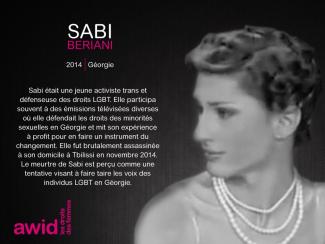
Sabi Beriani
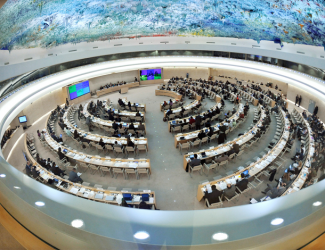
The Human Rights Council (HRC) is the key intergovernmental body within the United Nations system responsible for the promotion and protection of all human rights around the globe. It holds three regular sessions a year: in March, June and September. The Office of the UN High Commissioner for Human Rights (OHCHR) is the secretariat for the HRC.
Debating and passing resolutions on global human rights issues and human rights situations in particular countries
Examining complaints from victims of human rights violations or activist organizations on behalf of victims of human rights violations
Appointing independent experts (known as “Special Procedures”) to review human rights violations in specific countries and examine and further global human rights issues
Engaging in discussions with experts and governments on human rights issues
Assessing the human rights records of all UN Member States every four and a half years through the Universal Periodic Review
AWID works with feminist, progressive and human rights partners to share key knowledge, convene civil society dialogues and events, and influence negotiations and outcomes of the session.
Nous œuvrons en faveur d’un monde fondé sur la justice sociale, environnementale et économique, ainsi que sur l'interdépendance, la solidarité et le respect. Nous travaillons au démantèlement des systèmes de pouvoir oppressif et contre toutes ses manifestations, y compris tout forme de patriarcat, de fondamentalisme, de militarisme et de fascisme, et le pouvoir des entreprises qui menacent nos vies et notre monde. Nous voulons un monde juste où le partage des ressources et celui du pouvoir permettront à chacun·e de s'épanouir.
Esta comunidad es un lugar para las conexiones, para entender nuestras luchas individuales como parte de las luchas globales y, a veces, ¡también para bailar! En línea, no existen otros lugares como este, en el que puedes encontrarte con auténtiques activistas de base de todo el mundo y forjar lazos de solidaridad y sororidad..- Paz Romero, Argentina
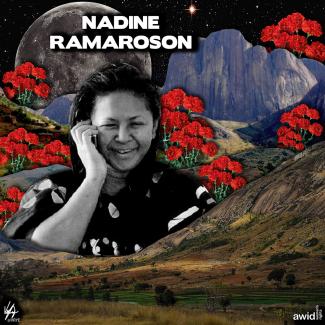
Nadine was a role model to many for her work supporting women and the most vulnerable in her community. She was committed to helping the poor and homeless in particular.
Though her death was reported as an accident, the Ramaroson family, led by her father, André Ramaroson led an investigation that pointed to evidence that she had been murdered. She is reported to have died in a fatal accident occurred between Soanierano - Ivongo and Ste Marie - a story that has been refuted by her family.
She received numerous death threats for her bold political positions. Her case remains in court in Antananarivo (the capital of Madagascar).
Meet Sabrina Sanchez, remarkable trans migrant woman, sex worker, organizer, transfeminist and one of the founders of the union OTRAS.
Originally from Mexico City, she migrated to Spain 17 years ago after getting a degree in communications and started working as a sex worker.
It didn’t take long before she became involved with trans activism and sex worker activism in Barcelona. After joining the collective Asociación de Profesionales del Sexo (Association of Sex Workers, Aprosex), she started working in its secretariat and founded the Spanish sex workers union OTRAS.
She currently lives in Amsterdam where she works as the coordinator of the European Sex Workers’ Alliance.
Fun fact: she’s also a car mechanic and serious runner!
The theme of the 14th AWID International Forum is: “Feminist Realities: our power in action”.
In this Forum, we will celebrate and amplify powerful propositions that are around us, in all stages of development.
In the 30 years since the adoption of the Beijing Declaration & Platform for Action, a rising tide of fascisms is exerting significant power and influence within multilateral spaces, backpedalling gender justice gains and human rights protections globally.
Around CSW69, we're co-organizing horizontal, brave spaces on-ground and online, to share strategies and build feminist power beyond Beijing+30. Our collective presence disrupts institutional practices of exclusion in such spaces while supporting movements to organize around feminist alternatives to systems of oppression.
Join the conversations from March 10-21, 2025, as we collectively transform CSW69 into spaces for and about resistance and solidarity.
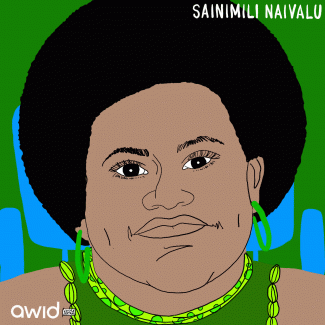
“I’ve witnessed discrimination on the streets, being teased on the streets and verbally abused on the streets. I have also made numerous friends and have met a lot of people. There may be dangers out there but I am a survivor and this is where I will be for now.”
- Sainimili Naivalu
She demanded policy makers and stakeholders provide disability friendly policies and services such as the construction of ramps in towns and cities to increase accessibility. Physical barriers were not the only ones she strived to change. From her own experience, she knew that more difficult changes need to take place in social and economic spheres. Many of the challenges disabled people face are rooted in attitudes that carry discrimination and stigma.
A survivor and a fighter, Sainimili contributed to co-creating feminist realities that foster inclusion and shift attitudes towards disabled people. As a member of the Spinal Injury Association of Fiji (SIA) and through Pacific Disability Forum’s Pacific Enable project she attended the International Labour Organisation “Start Your Business” training in Suva, enabling her to transform her ideas into her own business. She was an entrepreneur at the Suva Market Stall 7, offering manicure services, as well as running SIA’s women’s market stall selling handicrafts, sulus and artifacts. Sainimili’s plan was to expand her business and become a major employer of disabled people.
In addition to her activism, she was also a table tennis medalist and youth champion.
A vivacious personality, Sainimili was one of a kind. You would always know that Sainimili is in a room because her laughter and her stories would be the first thing that you would notice.
- Michelle Reddy
Sainmili passed away in 2019.
Enciende tu fuego feminista leyendo nuestras investigaciones y publicaciones varias sobre financiamiento, defensoras de derechos humanos, construcción de movimientos, fundamentalismos, justicia económica, seguimiento y evaluación feminista y más
✉️ Requiere inscripción previa para grandes grupos. Entrada libre para grupos reducidos. Reserven aquí
📅Martes 11 de marzo de 2025
🕒 de 12:00 a 02:00 p.m. y de 04:00 a 06:00 p.m., EST
🏢 Chef's Kitchen Loft with Terrace, 216 East 45th St 13th Floor New York
Organiza: AWID
Conocida como la Drag Queen de color de Nueva York, Sylvia fue feroz e incansable en su voluntad por cambiar las cosas, y en su defensa de quienes quedaron marginadxs y excluidxs cuando el movimiento por los "derechos de la comunidad gay" se volvió predominante en los Estados Unidos, a principios de los 70.
En 1973, durante un conocido discurso por el día de Christopher Street, Sylvia gritó en medio de la multitud de integrantes de la comunidad LGBT:
"Todos ustedes me dicen, anda y esconde la cola entre las patas.
No voy a seguir aguantando esta mierda.
Me han golpeado.
Me han roto la nariz.
Me han metido en la cárcel.
He perdido mi trabajo.
He perdido mi departamento
por la liberación gay, ¿y todos ustedes me tratan así?
¿Qué carajo les pasa a todos ustedes?
¡Piensen en eso!"
En 1969, a la edad de 17 años, Sylvia participó en los emblemáticos disturbios de Stonewall, al lanzar, presuntamente, el segundo cóctel molotov para protestar por la redada policial en este bar gay de Manhattan. Siguió siendo una figura central en los levantamientos posteriores, organizando mítines y luchando contra la brutalidad policial.
En 1970, Sylvia trabajó junto con Marsha P. Johnson para establecer Street Transvestite Action Revolutionaries [Acción Travesti Callejera Revolucionaria] (S.T.A.R., por sus siglas en inglés), un colectivo político y una organización que establecería proyectos de apoyo mutuo para las personas trans que vivían en la calle, aquellxs que luchaban contra la drogadicción, las que estaban encarceladas y, en particular, para las personas trans de color que vivían en la pobreza.
Desafiante de las etiquetas, Silvia vivió la vida de una manera que retaba a las personas del movimiento de liberación gay a pensar de manera diferente. Ella dijo:
"Me fui de casa a los 10 años, en 1961. Hice la calle en la 42. El inicio de los años 60 no era un buen momento para lxs drag queens, los chicos afeminados o los chicos que usaban maquillaje como nosotrxs. En ese entonces nos golpeaba la policía, y todo el mundo. Yo no salí realmente como drag queen hasta finales de los 60, cuando se arrestaba a lxs drag queens, qué degradación había. Recuerdo que la primera vez que me arrestaron, ni siquiera estaba vestida totalmente en drag. Estaba caminando y los policías me arrebataron de la calle. La gente ahora quiere llamarme lesbiana porque estoy con Julia, y yo digo: "No. Soy sólo yo. No soy lesbiana". Estoy cansada de que me etiqueten. Ni siquiera me gusta la etiqueta transgénero. Estoy cansada de vivir con etiquetas. Sólo quiero ser quien soy. Soy Sylvia Rivera.
A través de su activismo y su coraje, Sylvia ofreció un espejo que reflejaba todo lo que estaba mal en la sociedad, pero también la posibilidad de transformación. Sylvia nació en 1951 y falleció en 2002.
Écoutez cette histoire ici :
par Maryum Saifee
Lorsqu’on effectue une recherche en ligne sur les « Mutilations génitales féminines » ou « MGF », un schéma en quatre parties sur l’anatomie des femmes apparaît à côté d’une page Wikipédia dédiée. (...)
Illustration : « Rêves », par Neesa Sunar >
AWID began preparing this annual report just as the global pandemic began to unravel how we gather, organize and live our lives. It is impossible to review what we have done without COVID-19 tinting our assessment.
Download the full 2019 Annual review
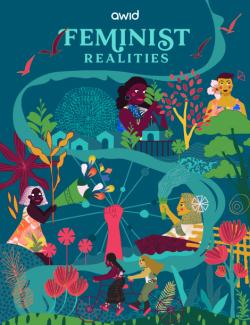
It is an urgently needed affirmation that there are other, more just ways of organizing our lives. During 2019 hundreds of groups shared their experiences and proposals for feminist realities with us, ranging from radical networks of community support in Latin America facilitating self-managed abortion, to practices of community-centered economies in Indonesia and community-centered food systems in India and the US, to a re-imagination and new practice of harm-free rites of passage in Sierra Leone. These are the experiences that will chart a path forward for a “new normal”.
Yet long histories of oppression and violence can make it difficult to imagine the possible. A key part of our work in 2019 was to spark these explorations through a toolkit AWID launched to support groups interested in unearthing the stories and aspirations that are the building blocks of feminist propositions.
Through the Observatory on the Universality of Rights, Feminists for a Binding Treaty, Count Me In! and other alliances, AWID has continued to push back against unfettered corporate power and fascist and fundamentalist agendas that undermine women’s rights and gender justice. With dim prospects for transformative change through multilateral processes and limited responsiveness from most states, we are redoubling our efforts to ensure that feminist movements, in all their diversity, are resourced in ways that match the critical roles they play - supporting their communities, demanding rights and responding to crises. In 2019 we introduced feminist principles and approaches to ground-breaking funds like the Spotlight Initiative and the Equality Fund, and succeeded in leveraging resources through feminist reality seed grant funding from feminist funders.
As we look ahead, it is clear that the context is calling for a transformation of our organizing strategies:
AWID is embarking on a new membership model that lowers barriers to access and emphasizes opportunities for engagement and cross-member connection. We will continue to experiment with different online tools and processes for building community. Cross-movement engagement will stay at the center of our work. AWID’s actions in solidarity with oppressed movements and identities, even and especially where these are marginalized in feminist movements, are important to drive change and support broad and inclusive movements for all.
We are resilient, we adapt, and we show up for each other. And we have to keep doing better. Thank you to all who are part of the journey with us.
Download the full 2019 Annual review