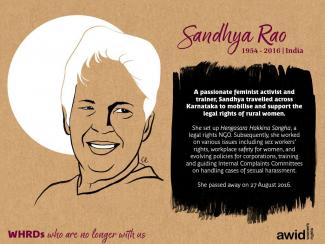
Sandhya Rao
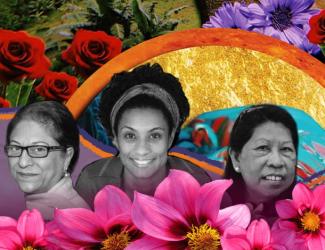
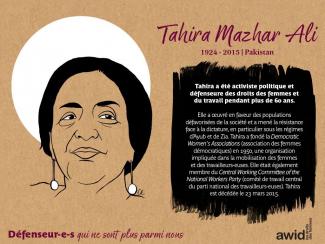
AWID’s Tribute is an art exhibition honouring feminists, women’s rights and social justice activists from around the world who are no longer with us.
This year’s tribute tells stories and shares narratives about those who co-created feminist realities, have offered visions of alternatives to systems and actors that oppress us, and have proposed new ways of organising, mobilising, fighting, working, living, and learning.
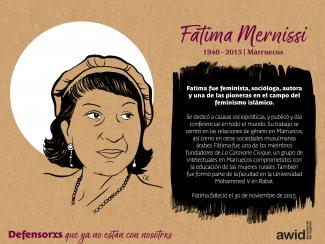
49 new portraits of feminists and Women Human Rights Defenders (WHRDs) are added to the gallery. While many of those we honour have passed away due to old age or illness, too many have been killed as a result of their work and who they are.
This increasing violence (by states, corporations, organized crime, unknown gunmen...) is not only aimed at individual activists but at our joint work and feminist realities.
The portraits of the 2020 edition are designed by award winning illustrator and animator, Louisa Bertman.
AWID would like to thank the families and organizations who shared their personal stories and contributed to this memorial. We join them in continuing the remarkable work of these activists and WHRDs and forging efforts to ensure justice is achieved in cases that remain in impunity.
“They tried to bury us. They didn’t know we were seeds.” - Mexican Proverb
It took shape with a physical exhibit of portraits and biographies of feminists and activists who passed away at AWID’s 12th International Forum, in Turkey. It now lives as an online gallery, updated every year.
To date, 467 feminists and WHRDs are featured.
The growing dominance of international financial markets and institutions in defining global economic policies has resulted in the capture of people’s power in the interest of global elites and big corporations.
Our policy brief on Illicit Financial Flows explores their disproportional gender impact and unveils the current legal and political frameworks that allow multinational corporations to benefit from tax abuse to the detriment of people and planet.
The brief concludes with these seven feminist policy recommendations to demand transparency and corporate accountability in order to curb illicit financial flows.
Illicit financial flows are gaining unprecedented attention: whether in development negotiations, like those leading to Agenda 2030 and the Addis Ababa Financing for Development Conference in 2015; or making headlines in mainstream media with the release of leaked documents on offshore finance known as the ‘Panama Papers’. In another example, the Ecuadorean people voted to bar politicians and civil servants from having assets, companies or capital in tax havens, in a referendum in February 2017. The Ecuadorian government is now a leading voice within the group of G77, in the United Nations, to create a UN global tax body to end tax havens.
This public attention potentially builds momentum for feminists, social movements and tax justice advocates to pressure for the transformation of the global financial system, which entrenches global inequalities, including gendered inequalities.
We offer below a set of seven policy asks as a contribution to growing advocacy efforts from social justice, feminist, women’s rights and gender equality actors:

Centers activists’ voices and experiences to analyze how money moves and who it is reaching

Additional consultation sessions on the Draft Outcome Document
Nous vous présentons une sélection motivante de puissantes histoires et d’images de transformations et de résistances créées par des activistes, des écrivain·e·s et des artistes du monde entier.

To strengthen our collective voice and power for more and better funding for feminist, women's rights, LBTQI+ and allied organizing globally
Meet Sopo Japaridze, fierce feminist, union leader and chair of the independent service trade union at the Solidarity Network.
She left the country when she was very young to go to the United States where she first became very politically active as a labor organizer. She kept Georgia in the back of her mind all that time, until one day, two decades later, she decided to return.
The existing Georgian union confederation back then was less than ideal. So, equipped with her skills, knowledge and labor organizing experience, Sopo went back to Georgia and built her own union.
Sopo is a passionate researcher and writer. She studies labor and social relations, writes for various publications and is the contributing editor of LeftEast, an Eastern European analytical platform. She also co-founded the political history initiative and podcast, Reimagining Soviet Georgia, where she explores the complexities and nuances of the country's experiences under the Soviet Union, to better understand its past in order to shed light on how to build a better future.
Súmate al Women’s Working Group on Financing for Development [Grupo de Trabajo de Mujeres sobre Financiación para el Desarrollo, WWG on FfD en inglés] y entérate de cuáles son sus aportes al proceso de la FpD (también puedes enviar un mensaje electrónico a: wwgonffd@gmail.com).
Únete al Grupo de las OSC en la Conferencia Internacional sobre la FpD (en inglés) o envía un mensaje electrónico a addiscoordinatinggroup@gmail.com pidiendo sumarte: https://groups.google.com/forum/#!forum/global-social-economy).
Otros enlaces importantes para mantenerse informada/o:
Think big! With our international reach, we combine analytical work with political and practical tools for advocacy and transformation to advance the cause of feminist movements at all levels.

En planifiant l’activité que vous voulez présenter au Forum, pensez aussi à la façon dont vous financerez votre participation. Prenez en compte : l’hébergement, le voyage, le visa, les frais d’inscription au forum, etc.
Veuillez noter que ce Forum offrira de nombreux « espaces ouverts » et moments d’apprentissage et d’échange entre mouvements, mais aussi moins de sessions formelles. (Consultez la section « Comment décrire le Forum pour votre levée de fonds » ci-dessous concernant le langage à adopter dans votre demande).
Votre meilleure option sera toujours de faire appel à vos bailleurs de fonds actuels : Si votre groupe bénéficie de l'appui d'organismes donateurs, dites-leur que vous souhaitez participer au Forum de l’AWID pour apprendre, expérimenter, échanger et travailler en réseau, et ce même si votre activité n'est pas sélectionnée dans le programme final.
Pour soutenir votre participation, vos bailleurs de fonds devront en être informés longtemps à l'avance, alors n’attendez pas pour leur en parler déjà tout de suite ! (Ils sont déjà en train de décider des fonds qu’ils vont distribuer en 2020. Nous vous recommandons de les contacter au plus tard début 2020.) Bon nombre de donateurs qui soutiennent les organisations féministes disposent de budgets alloués au déplacement pour le Forum.
D’autres pourraient les inclure dans des renouvellements de subventions ou dans d’autres financements permettant de couvrir les frais de déplacements.
Si vous ne disposez pas actuellement d’un soutien financier, ou que vous ne pouvez garantir de subventions dédiées au déplacement pour le Forum, vous pouvez envisager de contacter de nouveaux donateurs.
Les délais et exigences varient d’un donateur à l’autre, et la procédure d’octroi de financement peut prendre plusieurs mois. Si vous envisagez d’effectuer de nouvelles demandes de financement, nous vous encourageons à le faire au plus tôt.
Les mouvements féministes ont depuis longtemps fait preuve de créativité lorsque s’agissait de financer leur propre militantisme. Voici quelques idées que nous avons été en mesure de rassembler afin d’inspirer des modes alternatifs de financement.
Pour plus d’inspiration, vous pouvez consulter les informations continues de l’AWID sur le financement autonome, comprenant des idées spécifiques sur le financement de la participation aux conférences.
Le Fonds d’accès de l’AWID : l’AWID s'efforce de faire du Forum un véritable rassemblement mondial avec la participation de divers mouvements, régions et générations. A cette fin, l'AWID mobilise des ressources pour constituer un Fonds d'accès limité (AF, selon son sigle anglais) afin d'aider les participant-e-s à couvrir leurs frais de participation.
Vous pouvez indiquer dans votre candidature si vous souhaitez soumettre une demande de financement au Fonds d'accès de l’AWID.
N'oubliez pas que ces ressources sont très limitées et que nous ne serons pas en mesure de soutenir tou.te.s les candidat.e.s. Même si vous faites une demande pour le Fonds d'accès de l’AWID, nous vous encourageons à continuer à explorer d'autres options pour financer votre participation au Forum. Les décisions relatives au Fonds d'accès seront confirmées d'ici la fin du mois de juin 2020.
Voici quelques extraits de messages qui peuvent vous aider à prendre contact avec vos donateurs ou votre réseau. N’hésitez pas à les adapter de la façon que vous jugerez la plus utile à vos yeux !
Le Forum de l’AWID est un espace cocréé par des mouvements féministes qui stimule les participant·e·s dans leur propre activisme, et renforce les connexions entre divers mouvements de droits et de justice. Les participant·e·s en tirent des sources d’espoir, d’énergie et d’imagination débridée, tout en approfondissant leurs analyses partagées et leurs apprentissages. C’est aussi un lieu de renforcement de la solidarité entre mouvements qui permet de développer des programmes d’action intégrés et de faire avancer des stratégies communes.
Notre organisation est à la recherche de fonds pour participer à ce Forum afin de se connecter à d’autres activistes et mouvements du monde entier, de consolider nos stratégies et de partager notre travail. Les participant·e·s des années précédentes nous inspirent, notamment lorsque ces personnes décrivent le pouvoir de ce rassemblement mondial féministe :
« Pendant quelques jours… les voix se sont tissées en une perspective mondiale sur l’état de l’égalité de genre. Et lorsque je dis mondiale, je fais référence à des traductions simultanées en sept langues… »
« Nous nous sommes rappelé·e·s que nous n’étions pas seul·e·s. Le Forum est un moyen pour traduire le collectif dans nos mouvements. En dépit des idéologies, des identités ou des frontières, notre force réside dans notre vision et notre soutien les un·e·s pour les autres. »
Veuillez noter que ce Forum offrira de nombreux « espaces ouverts » et moments d’apprentissage et d’échange entre mouvements, mais aussi moins de sessions formelles.
Même si beaucoup de participant·e·s ne feront pas de présentation aux sessions formelles, le Forum offrira cependant un espace précieux d’apprentissage, de réflexion stratégique et d’expérimentation du pouvoir collectif en action des mouvements féministes.
Lors du calcul de vos coûts et du montant nécessaire à financer, il est important de prendre en compte certaines dépenses qui peuvent survenir. Voici des exemples d’éléments clés à considérer :
Le 14ème Forum de l'AWID aura lieu du 11 au 14 janvier 2021 à Taipei, Taiwan.
C'est bien plus qu’un événement de quatre jours. C’est un arrêt de plus dans un parcours de renforcement de mouvement autour des réalités féministes, lequel a déjà commencé et continuera bien au-delà des dates du Forum.
El 11 de julio de 2024, tuvimos una conversación increíble con grandes feministas sobre el estado del ecosistema de financiación y el poder de la investigación "¿Dónde está el dinero?".
Le agradecemos de manera especial a Cindy Clark (Thousand Currents), Sachini Perera (RESURJ), Vanessa Thomas (Black Feminist Fund), Lisa Mossberg (SIDA) y Althea Anderson (Hewlett Foundation).
Recuerda: ¡la encuesta permanecerá abierta hasta el 31 de agosto de 2024!
La mayoría de los Estados miembros de la Unión Europea tienen leyes y prácticas que penalizan o controlan a las trabajadoras sexuales de formas inaceptables para ellas. La criminalización de las trabajadoras sexuales y/o sus clientes solo contribuye a aumentar la vulnerabilidad de las trabajadoras sexuales, que ya enfrentan el estigma, la discriminación y la exclusión por parte del Estado y de la sociedad a diario, especialmente las mujeres trabajadoras, lxs trabajadorxs trans, migrantes y/o racializadxs. En España por ejemplo, el gobierno esta actualmente intentando pasar una Ley Orgánica para la Abolición de la Prostitución, que resultara en mas clandestinidad y violencia. Ven a conocer las historias de trabajadoras sexuales y organizadores sindicales que luchan para decriminilizar el trabajo sexual y promover derechos laborales y condiciones de trabajo digno para lxs trabajadxs sexuales.
對於與“論壇活動徵集”有關的任何問題,請與我們聯繫,請使用“論壇活動徵集”作為您電子郵件的主題。
Sostenemos la completa aplicación del principio de derechos, incluidos aquellos consagrados en leyes internacionales, y afirmamos la convicción de que todos los derechos humanos están interrelacionados y son interdependientes e indivisibles. Estamos comprometidxs a trabajar por la erradicación de todas las discriminaciones basadas en el género, la sexualidad, la religión, la edad, la capacidad, la etnia, la raza, la nacionalidad, la clase, u otros factores.