Over the past few years, a troubling new trend at the international human rights level is being observed, where discourses on ‘protecting the family’ are being employed to defend violations committed against family members, to bolster and justify impunity, and to restrict equal rights within and to family life.
The campaign to "Protect the Family" is driven by ultra-conservative efforts to impose "traditional" and patriarchal interpretations of the family, and to move rights out of the hands of family members and into the institution of ‘the family’.
“Protection of the Family” efforts stem from:
rising traditionalism,
rising cultural, social and religious conservatism and
sentiment hostile to women’s human rights, sexual rights, child rights and the rights of persons with non-normative gender identities and sexual orientations.
Since 2014, a group of states have been operating as a bloc in human rights spaces under the name “Group of Friends of the Family”, and resolutions on “Protection of the Family” have been successfully passed every year since 2014.
This agenda has spread beyond the Human Rights Council. We have seen regressive language on “the family” being introduced at the Commission on the Status of Women, and attempts made to introduce it in negotiations on the Sustainable Development Goals.
Our Approach
AWID works with partners and allies to jointly resist “Protection of the Family” and other regressive agendas, and to uphold the universality of human rights.
In response to the increased influence of regressive actors in human rights spaces, AWID joined allies to form the Observatory on the Universality of Rights (OURs). OURs is a collaborative project that monitors, analyzes, and shares information on anti-rights initiatives like “Protection of the Family”.
Rights at Risk, the first OURs report, charts a map of the actors making up the global anti-rights lobby, identifies their key discourses and strategies, and the effect they are having on our human rights.
The report outlines “Protection of the Family” as an agenda that has fostered collaboration across a broad range of regressive actors at the UN. It describes it as: “a strategic framework that houses “multiple patriarchal and anti-rights positions, where the framework, in turn, aims to justify and institutionalize these positions.”
Related Content
Snippet - WITM Infographic annual budget 2 in 4- EN
Ever Wondered What Budgets for Feminist Organizations Look Like?
A closer look at actual budgets reveals major income diversity and inequality.
Does AWID provide scholarships to attend the Forum?
Our Access Fund will offer a limited number of scholarships to fund the participation of activists who cannot otherwise make it, and don’t have relationships with funders who could cover their participation. So if you have other possibilities, please explore them. We will do our best to offer as many scholarships as we can, and will share more information about this process and how to apply in early 2024.
Love letter to Feminist Movements #7
Dearest Feminist community,
I am pleased to share with you one of my remarkable dates as feminist with disability. It was May 30, 2014 when we (the Nationwide Organization of Visually-Impaired Empowered Ladies NOVEL) participated in the Philippine Fashion Week Holiday 2014 for our white cane advocacy campaign. Two ladies who are blind walked down the catwalk to promote the white cane as one of the symbols of gender equality, empowerment, full inclusion and equal participation of women and girls with visual impairment in society.
Their walk in front of the crowd were extremely a nerve-wracking experience for me, as the proponent of our project with the Runway Productions (I enduringly waited for a year for its approval), knowing that they were not models, they were the crowned Ms. Philippines Vision and 1st Runner Up of 2013 Ms. Philippines on Wheels, Signs and Vision by Tahanang Walang Hagdanan, Inc. (House with No Steps). Also, they fell on their orientation and practiced the evening before the event and they didn’t have practice with professional models. Before the show started, I talked to them via mobile phone to boost their confidence and to pray together for God’s guidance. When they exited the catwalk, I breathed deeply while my tears were flowing. I was feeling euphoric because we did it despite the challenges we’ve been through! Our message to the world that women and girls with visual impairment can walk with dignity, freedom and independence on an equal basis with others, with the use of our assistive device - white canes was successfully delivered! We trended in social media and we were featured by television networks.
My life as a feminist with disability started as a means to mend my broken spirit and to see a different path towards finding my life’s purpose after I became victim-survivor to a vicious acid attack in 2007 while I was waiting for a ride going home from office. My eyes were severely damaged, to the point that I became a woman with low vision.
I never knew how joyful and purposeful my life could be again until I met women leaders in the gender and disability movement who influenced me to keep going. Their words of encouragement attracted me and became the sweetest music to my ears. My broken heart leaped like a hummingbird in flight every time I think of them and feminism which stimulated me to partake in making difference for our invisible sisters with disabilities and to those who continue to experience discrimination. To date, I am consumed by the desire to be with the movement. I cannot hide my excitement whenever I submit project proposals to different stakeholders for our sisters with disabilities' empowerment, development and advancement; and to make representations in local, national and international conversations to amplify our voices even at my expense.
Unexpectedly, I was selected as our country’s female representative in the 2012 World Blind Union (WBU) General Assembly in Thailand even though I was a newcomer in the disability movement. In the same year, I was elected as the only woman officer of the Philippine Blind Union (PBU) in its assembly. I was inspired to reach out, gather and empower our sisters with visual impairment on their rights and to know their intersecting issues. In 2013, we officially launched the Nationwide Organization of Visually-Impaired Empowered Ladies (NOVEL) to support the empowerment of our sisters with disabilities, build coalitions with cross-disability and women’s movements and promote gender and disability-inclusive development.
My participation as co-focal person of women with disabilities in our 2016 CEDAW Shadow Report submission convened by Women’s Legal and Human Rights Bureau (WLB) with the marginalized groups of women, opened many doors such as working with various women’s organizations and attending the 2017 Inclusion Days International in Berlin, Germany together with 3 Filipino women leaders with disabilities to share our good practices, mainly our engagement with the women’s movement in our country.
My journey as feminist with disability has been an emotional roller coaster for me. It gave me happiness and a sense of worth when I participated in promoting for our sisters with disabilities full inclusion, equal and effective participation in society, yet I felt frustrated and upset when I gave my all but I received negative remarks. Nevertheless, I feel that way because I am in love with the movement.
I see my future working in solidarity with the movement to ensure that our sisters with and without disabilities can equally and fully enjoy and participate in society.
Love lots,
Gina Rose P. Balanlay
Feminist with disability
Philippines
Résumé : Identifiez les principaux groupes et réfutez leurs arguments
Résumé :
Identifiez les principaux groupes et réfutez leurs arguments
Décideur·se politique à l’ONU, vous souhaitez apprendre à repérer les principaux groupes et discours antidroits au sein de l’institution ? Vous êtes un·e féministe, à la recherche de contre-arguments éclairs ? Ce résumé vous propose les informations essentielles en 8 pages seulement.
Fadila M. était une activiste “tribale” Soulaliyate d’Azrou, dans la province marocaine d’Ifrane. Elle s'est battue contre une forme spécifique de discrimination à l'égard des femmes “tribales” liée à la propriété foncière.
Dans le cadre du Mouvement en faveur des droits fonciers des femmes Soulaliyates, elle a travaillé pour la révision de la législation-cadre relative à la gestion des biens communautaires, avec l'adoption en 2019 de trois projets de lois garantissant l'égalité des femmes et des hommes.
Selon le droit coutumier en vigueur, les femmes n'avaient pas le droit de bénéficier de la terre, surtout celles qui étaient célibataires, veuves ou divorcées. Au Maroc, les droits à la terre collective se transmettaient traditionnellement entre les membres masculins de plus de 16 ans issus d’une même famille. Depuis 2007, Fadila M. faisait partie du mouvement des femmes, à savoir la première mobilisation populaire nationale de revendication de leurs droits fonciers. Parmi leurs victoires, citons le fait qu'en 2012, les femmes Soulaliyates ont pu, pour la première fois, s'inscrire sur les listes de bénéficiaires et disposer d'une indemnisation liée à la cession des terres. Le mouvement a également réussi à faire modifier le dahir de 1919 (décret du roi du Maroc) de façon à garantir aux femmes le droit à l'égalité.
Fadila M. s’est éteinte le 27 septembre 2018. Les circonstances de sa mort, survenue alors qu’elle participait à une marche de protestation sur la question des terres collectives, ne sont pas claires. Si les autorités déclarent que sa mort est accidentelle et qu'elle a fait un arrêt cardiaque sur le chemin de l'hôpital, la section locale de l'Association marocaine des droits de l'homme (AMDH), affirme quant à elle que Fadila a été étouffée par un membre des forces policières arborant un drapeau marocain. Sa famille a demandé qu’une enquête soit menée mais les résultats de l'autopsie n'ont pas été communiqués.
Veuillez noter: Nous n'avons pu trouver aucune photo de Fadima M. C'est pourquoi cette illustration (au lieu d'un portrait) représente ce pour quoi elle s'est battue et a travaillé : la terre et le droit d'y vivre et d'avoir accès à cette terre et ce qui y pousse.
Les organisations féministes et de défense des droits des femmes ne dépendent pas uniquement des financements institutionnels, elles s’autofinancent. Nos mouvements sont animés par la passion, la solidarité, l’engagement politique et le soin collectif.
Ces ressources autonomes et autogénérées sont souvent invisibles dans les budgets, mais elles sont le pilier de notre action collective.
¿Habrá encuentros regionales, temáticos o de otro tipo previos al Foro?
¡Creemos que sí! Todavía estamos en las etapas iniciales del proceso de planificación, así que mantente atentx mientras les vamos dando a estos planes.
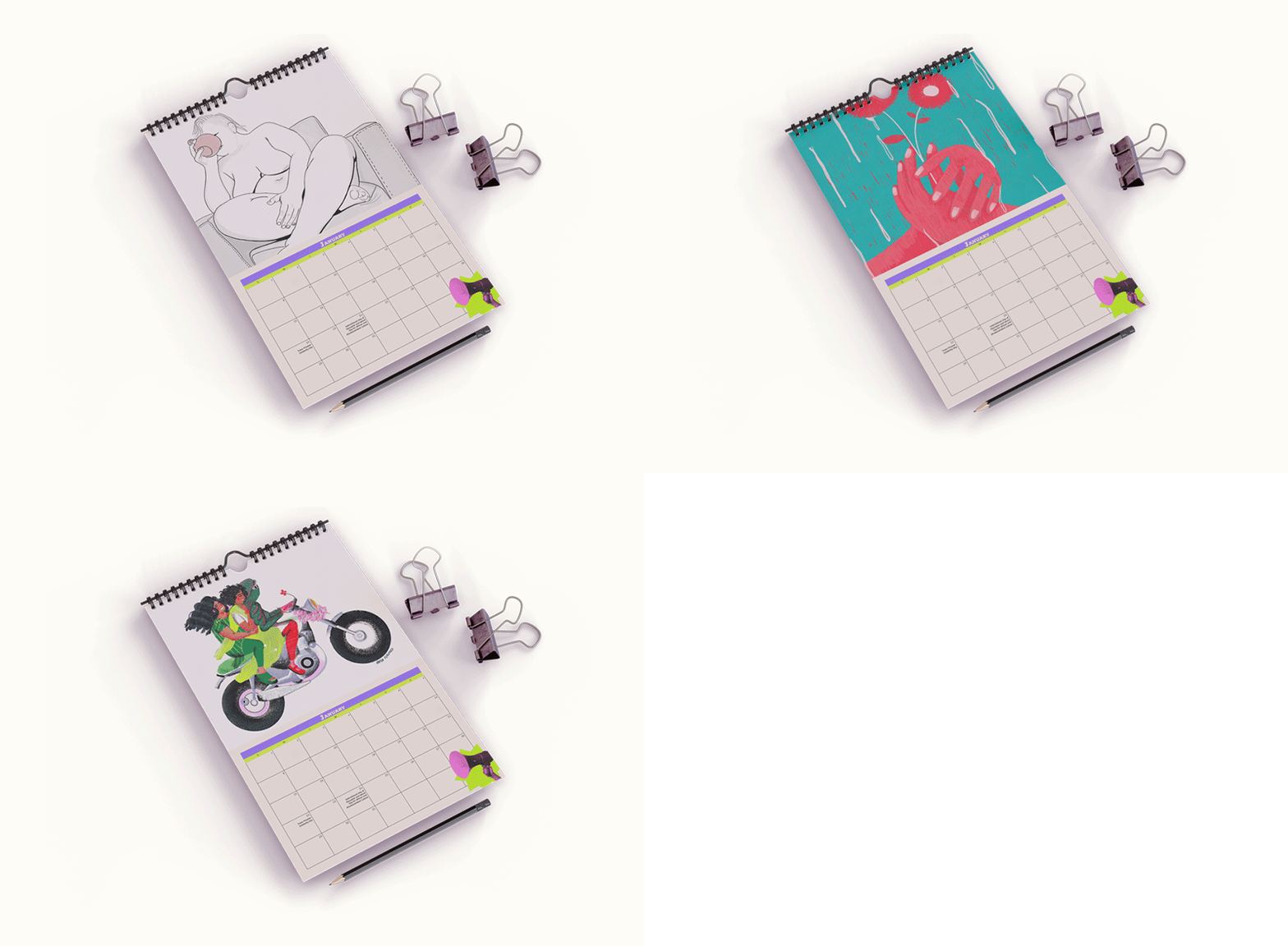
El Calendario Feminista 2023
AWID es parte de un impresionante ecosistema de movimientos feministas que trabajan para alcanzar la justicia de género y la justicia social en todo el mundo. Al acercarse nuestro 40° aniversario estamos celebrando todo lo que hemos construido a lo largo de estos últimos cuarenta años. Como organización global de apoyo a los movimientos feministas, sabemos que nuestro camino hacia adelante es trabajar con feminismos apasionados, reconociendo tanto la multiplicidad de los feminismos como el valor de un impulso por la justicia apasionado y sin reservas. El estado del planeta y de los movimientos feministas requiere conversaciones y acciones valientes. Esperamos con ansia trabajar junto con nuestrxs afiliadxs, asociadxs y donantes para crear los mundos en los que creemos,celebrar los logros y expresar la verdad ante el poder, al servicio de los movimientos feministas a nivel global.
El Calendario Feminista 2023 es un regalo para los movimientos. Presenta las obras de arte de algunxs de nuestrxs maravillosxs afiliadxs de AWID.
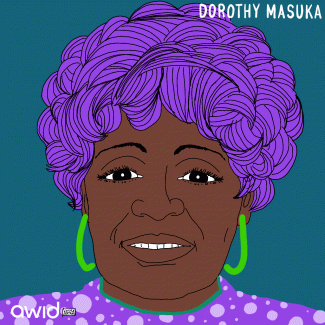
“I didn’t plan to be a singer, singing planned to be in me.” - Dorothy Masuka (interview with Mail & Guardian)
Dorothy Masuka, born 1935 in Bulawayo (then Southern Rhodesia, now Zimbabwe), grew up in South Africa to become a well-known songwriter, composer, jazz singer and activist, a fervent advocate of the struggle against apartheid. Called “an architect of the discourse of popular African liberation music”, Dorothy often sang about politics in indigenous African languages and throughout her work she confronted the racist policies of the South African government.
One such song titled “Dr. Malan” (named after the pro-apartheid politician D.F. Malan) was banned. She went on to record “Lumumba” (1961), a song about the assassination of the anti-colonial leader Patrice Lumumba. Dorothy’s work and activism attracted the attention of the Special Branch of the South African police and she was forced into a political exile that would span over three decades. Throughout this time, she worked with pro-independence groups including the African National Congress. In 1992, as apartheid started to crumble and Nelson Mandela was released from prison, she returned to South Africa.
Some of her other work includes the first song she recorded in 1953 entitled “Hamba Notsokolo”, a hit in the 1950s and a valued classic. She also wrote “El Yow Phata Phata”, a song that was adapted by Miriam Makeba, making “Pata, Pata” popular internationally.
Rooted in resistance, Dorothy’s music and activism were intertwined, leaving a magnificent and inspiring legacy. She was also widely known as “Auntie Dot”.
On 23 February 2019 at the age of 83, Dorothy passed away in Johannesburg due to ill health.
Je suis un bailleur de fonds ou un donateur individuel. Comment puis-je soutenir le Forum de l'AWID ?
Nous vous invitons à prendre contact avec nous pour trouver des moyens d’apporter un soutien significatif au Forum.
Become an AWID member
By joining AWID, you are becoming part of worldwide feminist organizing, a collective power that is rooted in working across movements and is based on solidarity.
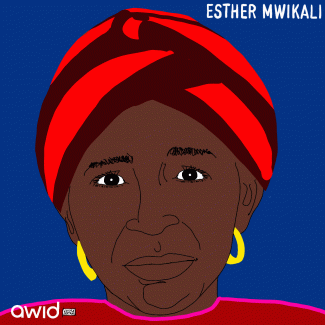
El hogar de Esther Mwikali estaba en la aldea de Mithini, en el condado de Murang'a, Kenya. Esther fue una defensora del derecho a la tierra destacada y valorada que investigó los abusos contra okupas de tierras reclamadas por magnates. La investigación de la que participó Esther incluyó también violaciones del derecho a la tierra cometidas por personas con poder en Makuyu.
Luego de que Esther faltara a una de las reuniones de la aldea, un grupo de búsqueda salió a rastrear a Esther. El 27 de agosto de 2019, dos días después de su desaparición, el cuerpo de Esther fue encontrado en una granja cerca de su casa, con signos de tortura. Esther había sido brutalmente asesinada.
"El trabajo de Esther por evitar el desalojo de lxs integrantes de las comunidades de las tierras reclamadas por magnates era conocido por todxs. Para lxs activistas locales no existía ninguna duda de que su asesinato estaba relacionado con las luchas en la zona por el acceso a la tierra; un trágico recordatorio de la alarmante frecuencia con que se llevan a cabo las ejecuciones extrajudiciales en Kenia."- Global Wittness Report, Julio 2020
"Asociamos la muerte de Mwikali con las luchas locales por el derecho a la tierra, y exigimos al Gobierno que investigue el asunto sin demora." - James Mburu, portavoz de lxs okupas.
"Es necesario tomar medidas con respecto a las personas que presuntamente han amenazado a lxs ocupantes ilegales, incluida la familia de Mwikali". - Alice Karanja, Coalición Nacional de Defensorxs de Derechos Humanos
"El impacto de su trabajo y su tenacidad permanecerán vivos en Kenia durante décadas. El CJGEA consuela a las personas afligidas y pide justicia". - Comunicado de prensa del Centro para la Justicia y la Acción Gubernamental (CJGEA, por sus siglas en inglés), 13 de septiembre de 2019