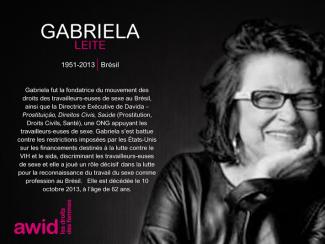
Gabriela Leite
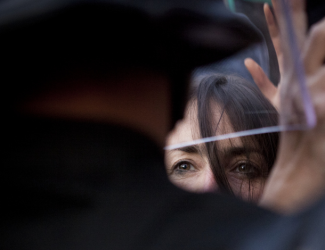
WHRDs are self-identified women and lesbian, bisexual, transgender, queer and intersex (LBTQI) people and others who defend rights and are subject to gender-specific risks and threats due to their human rights work and/or as a direct consequence of their gender identity or sexual orientation.
WHRDs are subject to systematic violence and discrimination due to their identities and unyielding struggles for rights, equality and justice.
The WHRD Program collaborates with international and regional partners as well as the AWID membership to raise awareness about these risks and threats, advocate for feminist and holistic measures of protection and safety, and actively promote a culture of self-care and collective well being in our movements.
WHRDs are exposed to the same types of risks that all other defenders who defend human rights, communities, and the environment face. However, they are also exposed to gender-based violence and gender-specific risks because they challenge existing gender norms within their communities and societies.
We work collaboratively with international and regional networks and our membership
We aim to contribute to a safer world for WHRDs, their families and communities. We believe that action for rights and justice should not put WHRDs at risk; it should be appreciated and celebrated.
Promoting collaboration and coordination among human rights and women’s rights organizations at the international level to strengthen responses concerning safety and wellbeing of WHRDs.
Supporting regional networks of WHRDs and their organizations, such as the Mesoamerican Initiative for WHRDs and the WHRD Middle East and North Africa Coalition, in promoting and strengthening collective action for protection - emphasizing the establishment of solidarity and protection networks, the promotion of self-care, and advocacy and mobilization for the safety of WHRDs;
Increasing the visibility and recognition of WHRDs and their struggles, as well as the risks that they encounter by documenting the attacks that they face, and researching, producing, and disseminating information on their struggles, strategies, and challenges:
Mobilizing urgent responses of international solidarity for WHRDs at risk through our international and regional networks, and our active membership.
The theme of the 14th AWID International Forum is: “Feminist Realities: our power in action”.
In this Forum, we will celebrate and amplify powerful propositions that are around us, in all stages of development.
Безусловно, эти вопросы являются необязательными, мы ценим ваше право сохранять конфиденциальность. Пожалуйста, заполните опрос независимо от того, указываете вы название вашей группы, организации и/или движения и контактные данные или нет.
Welcome to Crear | Résister | Transform: a festival for feminist movements!
AWID is committed to creating an online space that invites and challenges us all to operate from a place of courage, curiosity, generosity and shared responsibility.
We invite you to co-create spaces with us that are free of harassment and violence, where everyone is respected in their gender identity and expression, race, ability, class, religion, language, ethnicity, age, occupation, type of education, sexuality, body size, and physical appearance. Spaces where we recognize inequalities in our world and strive to transform them in our own interactions with each other.
This means that we are able to listen, understand and relate to each other. To feel close, in spite of it all being virtual. For this, we will make interpretation available and open channels (like chat and other tools) for you to react and share. To hear each other better, we invite you to wear headphones during the conversation. If it is possible for you , we suggest that you close your email and any other likely source of distraction while you are in the conversation.
Let us celebrate the multiple ways in which knowledge shows up in our lives. We invite you to approach the conversation with curiosity and openness to learn from others, allowing ourselves to unlearn and relearn through the exchange, as a way to start collectively building knowledge.
We are committed to holistically approaching accessibility by being mindful of different physical, language, mental and safety needs. We want a space that is welcoming of folks from various backgrounds, beliefs, abilities and experiences. We will be proactive but we also ask that you communicate your needs with us, and we will do our best within our capacity to address these needs.
We all commit individually and collectively to respect each other’s privacy and to seek people’s consent before sharing any images or content generated during the conversation that involves them.
Creating a safer, respectful and enjoyable environment for the conversations, is everybody's responsibility.
If you notice that someone is behaving in a discriminatory or offensive manner, please contact the reference person who will be indicated at the beginning of the session.
Any participants that express oppressive language or images, will be removed from the call and will not be readmitted. We will not engage with them in any way.
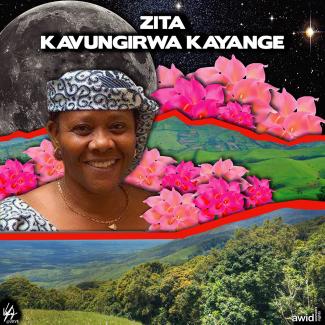
Zita était une défenseure des droits des femmes de la région du Grand Kivu.
Elle a été la première directrice exécutive d’UWAKI, une organisation de femmes bien connue. Par son travail avec le Réseau des Femmes pour la Défense des Droits et la Paix (RFDP) et le Caucus des femmes du Sud-Kivu pour la paix, elle a consacré sa vie à rétablir la paix dans l'est de la RDC. Elle a très fermement dénoncé l'utilisation de la violence sexuelle comme arme de guerre.
En 2006, elle s'est présentée comme candidate aux premières élections démocratiques en RDC. Bien qu’elle n’ait pas gagné, elle a continué à défendre les droits des femmes et la communauté du Sud-Kivu se souvient d’elle avec affection.
Enciende tu fuego feminista leyendo nuestras investigaciones y publicaciones varias sobre financiamiento, defensoras de derechos humanos, construcción de movimientos, fundamentalismos, justicia económica, seguimiento y evaluación feminista y más
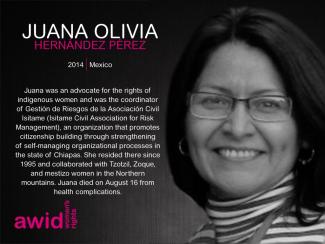
Iremos analisar as respostas ao inquérito para obter informações e tendências, e iremos apresentar os resultados durante o 15.º Fórum Internacional da AWID em Bangkok, e online em dezembro de 2024. Registe-se para participar no Fórum aqui!
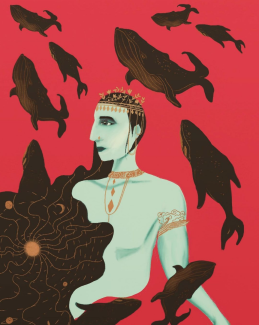
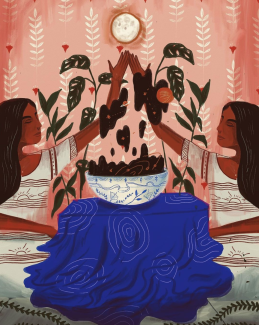
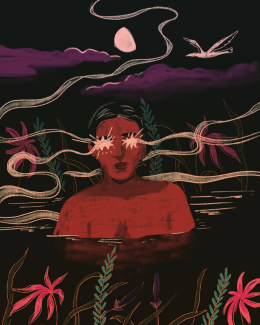
Écoutez cette histoire ici :
Bessy était aussi membre d’Arcoíris, une organisation qui soutient la communauté LGBTI+. Elle était en outre la personne référente de la plateforme Derechos aquí y Ahora (les droits ici et maintenant) au Honduras et plaidait fermement en faveur d’une pleine citoyenneté pour les personnes trans, ainsi que pour l’adoption d’une loi sur l’identité de genre qui permettrait aux personnes trans de changer légalement d’identité de genre.
« Depuis le début de l’année [2019], la communauté trans a été victime d’une série d’attaques, parce qu’elle a défendu et demandé des droits. » Rihanna Ferrera (sœur de Bessy)
Bessy était une travailleuse du sexe qui a été tuée par balle par deux hommes, au début du mois de juillet 2019, alors qu’elle travaillait dans les rues Comayagüela. Ses assaillants ont par la suite été arrêtés.
Bessy fait partie des nombreux·ses activistes des droits LGBTI+ du Honduras, assassiné·e·s en raison de leur identité et de leur travail, parmi qui se trouvent : Cynthia Nicole, Angy Ferreira, Estefania "Nia" Zuniga, Gloria Carolina Hernandez Vasquez, Paola Barraza, Violeta Rivas et Sherly Montoya.
Le cas de Bessy incarne l’injustice, de même qu’un problème plus large de violence systémique à laquelle se confronte la communauté LGBTI+ au Honduras, puisque l’État ne parvient pas à garantir l’offre de droits ni à fournir une protection. Cela est à l’origine d’une culture de l’impunité.
Malgré les risques auxquels sont confronté.e.s les activistes LGBTI+ au Honduras, tous et toutes continuent leur travail pour défier et résister à la violence, ainsi que pour combattre la stigmatisation et la discrimination au quotidien.
« Si je meurs, il faut que ce soit pour quelque chose de bien, pas pour une futilité. Je ne veux pas mourir en fuyant, en étant lâche. Si je meurs, je veux que les gens disent que je suis mort·e en me battant pour ce qui m’appartient » - membre d’Arcoíris
par Maryum Saifee
Lorsqu’on effectue une recherche en ligne sur les « Mutilations génitales féminines » ou « MGF », un schéma en quatre parties sur l’anatomie des femmes apparaît à côté d’une page Wikipédia dédiée. (...)
Illustration : « Rêves », par Neesa Sunar >
Esta comunidad es un lugar para las conexiones, para entender nuestras luchas individuales como parte de las luchas globales y, a veces, ¡también para bailar! En línea, no existen otros lugares como este, en el que puedes encontrarte con auténtiques activistas de base de todo el mundo y forjar lazos de solidaridad y sororidad..- Paz Romero, Argentina
Bien plus de la moitié de la population mondiale est aujourd’hui dirigée par l’extrême droite. C’est sur cette toile de fond que défenseur·e·s des droits humains et féministes luttent pour « tenir bon », protéger le multilatéralisme et le système international des droits humains, alors que leurs engagements les exposent à de violentes répressions. Ces institutions sont cependant de plus en plus soumises aux intérêts du secteur privé. Les grandes entreprises, surtout les sociétés transnationales, siègent à la table des négociations et occupent des fonctions de leadership dans plusieurs institutions multilatérales, l’ONU notamment. Le lien entre ultranationalisme, restriction de l’espace civique et emprise des entreprises a un impact considérable sur la réalisation ou non des droits humains pour tout le monde.
We are thrilled to announce the launch of AWID’s new podcast THAT FEMINIST FIRE. Our narrative series unravels over 40 years of feminist movements—and reimagines a way forward.
In our pilot season, you’ll hear five compelling stories that are part of a constellation of feminist activism today. Hosted by our very own Gopika Bashi, Deputy Director of Programmes at AWID, each episode explores unique but interconnected feminist realities that are achieving greater gender justice and human rights.
Produced by our Webby-winning podcast partner Hueman Group Media, you can subscribe to THAT FEMINIST FIRE and listen to our first episode here.
Find us on Apple Podcasts, Spotify, or wherever you get your podcasts. Share with your network! Help us spread stories that ignite our feminist fire and move us to action.