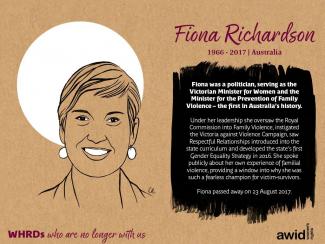
Fiona Richardson
Over the past few years, a troubling new trend at the international human rights level is being observed, where discourses on ‘protecting the family’ are being employed to defend violations committed against family members, to bolster and justify impunity, and to restrict equal rights within and to family life.
The campaign to "Protect the Family" is driven by ultra-conservative efforts to impose "traditional" and patriarchal interpretations of the family, and to move rights out of the hands of family members and into the institution of ‘the family’.
Since 2014, a group of states have been operating as a bloc in human rights spaces under the name “Group of Friends of the Family”, and resolutions on “Protection of the Family” have been successfully passed every year since 2014.
This agenda has spread beyond the Human Rights Council. We have seen regressive language on “the family” being introduced at the Commission on the Status of Women, and attempts made to introduce it in negotiations on the Sustainable Development Goals.
AWID works with partners and allies to jointly resist “Protection of the Family” and other regressive agendas, and to uphold the universality of human rights.
In response to the increased influence of regressive actors in human rights spaces, AWID joined allies to form the Observatory on the Universality of Rights (OURs). OURs is a collaborative project that monitors, analyzes, and shares information on anti-rights initiatives like “Protection of the Family”.
Rights at Risk, the first OURs report, charts a map of the actors making up the global anti-rights lobby, identifies their key discourses and strategies, and the effect they are having on our human rights.
The report outlines “Protection of the Family” as an agenda that has fostered collaboration across a broad range of regressive actors at the UN. It describes it as: “a strategic framework that houses “multiple patriarchal and anti-rights positions, where the framework, in turn, aims to justify and institutionalize these positions.”
Jemutai se passionne pour les plantes et puise son inspiration dans la nature et dans toutes les interconnexions qui la composent. Cette fascination pour l’interdépendance des éléments se reflète dans son approche du travail, de la construction communautaire, des soins et du soutien. Iel croit en la présence vibrante de ses ancêtres au fond d’iel et vit pour expérimenter, se souvenir, défendre, apprécier et célébrer leurs luttes, leurs triomphes et leurs valeurs.
En tant que féministe queer intersectionnel·le et défenseur·euse des droits humains, Jemutai a consacré sa carrière à l’équité et à l’inclusion. Passionné·e par le développement organisationnel, iel dispose d’une formation en administration et en octroi de subventions. Iel œuvre désormais à la création de rassemblements pertinents, en fournissant un soutien et un leadership opérationnels et en veillant à ce que les espaces soient inclusifs, sûrs et élaborés avec soin et précision.
Jemutai croit profondément en la philosophie de l’Ubuntu, l’idée que « je suis parce que nous sommes ». Cette croyance en notre humanité partagée et en notre interdépendance mutuelle inspire son approche, basée sur la collaboration, ainsi que son engagement à créer un environnement favorable et inclusif pour tous·tes, en particulier pour les personnes structurellement réduites au silence et marginalisées.
 The Cover
|
 The Powerful
|
 The Ivy
|
 The Howl
|

Production and entrepreneurship |
 Artisana
|
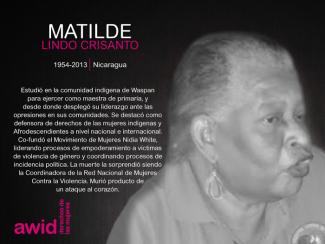
No, we are asking for just one completed survey per group.
AWID’s work is made possible through the financial support of a wide range of donors including multilateral and bilateral agencies, private foundations and women’s funds.

Salvo que existan cuestiones de accesibilidad o que respondas la encuesta en otro idioma, alentamos encarecidamente a usar KOBO a los efectos de contar con una recopilación y un análisis de datos estandarizados para la investigación ¿Dónde está el dinero?
Varios hombres que comparten nuestro compromiso con el feminismo y los derechos humanos de las mujeres están afiliados a AWID.
Nous Sommes la Solution es un movimiento de mujeres rurales por la soberanía alimentaria en África Occidental. Originalmente fundada como una campaña contra la agricultura hiper-industrializada, Nous Sommes la Solution se ha convertido en un movimiento de más de 500 asociaciones de mujeres rurales de Burkina Faso, Senegal, Ghana, Gambia, Guinea Bissau, Malí y Guinea.
Este movimiento liderado por mujeres está construyendo y fortaleciendo la soberanía alimentaria y de semillas en África Occidental. Alimentan a las comunidades, fortalecen las economías locales, amplían el conocimiento de las mujeres agricultoras y mitigan los efectos devastadores de la crisis climática a través de las prácticas agroecológicas. También organizan talleres, foros y transmisiones de radio comunitarias para compartir sus mensajes, conocimientos tradicionales y prácticas agroecológicas en las comunidades rurales.
En colaboración con universidades y centros públicos de investigación, Nous Sommes la Solution trabaja para restaurar las variedades indígenas de arroz (un alimento esencial de África Occidental) y promover economías alimentarias locales basadas en principios agroecológicos para influir en la formulación de políticas nacionales, mientras apoya a las mujeres en la creación de asociaciones agrícolas y su acceso a la propiedad y gestión colectiva de las tierras agrícolas.