AWID Forum: Co-creating Feminist Futures

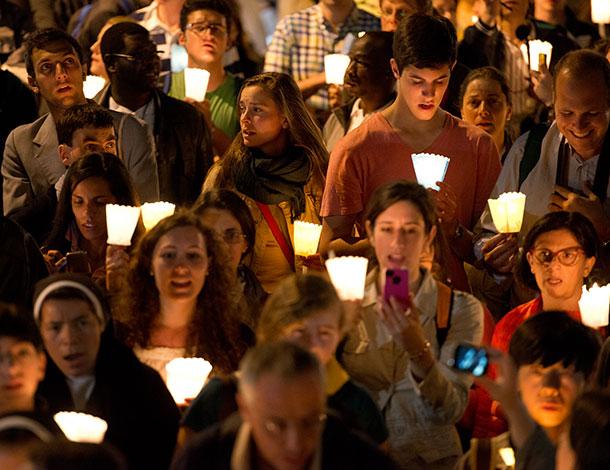
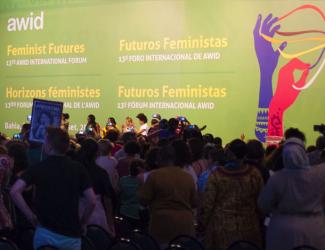
In September 2016, the 13th AWID international Forum brought together in Brazil over 1800 feminists and women’s rights advocates in a spirit of resistance and resilience.

This section highlights the gains, learnings and resources that came out of our rich conversations. We invite you to explore, share and comment!


What has happened since 2016?

One of the key takeaways from the 2016 Forum was the need to broaden and deepen our cross-movement work to address rising fascisms, fundamentalisms, corporate greed and climate change.

With this in mind, we have been working with multiple allies to grow these seeds of resistance:

And through our next strategic plan and Forum process, we are committed to keep developing ideas and deepen the learnings ignited at the 2016 Forum.

What happens now?

The world is a much different place than it was a year ago, and it will continue to change.

The next AWID Forum will take place in the Asia Pacific region (exact location and dates to be announced in 2018).

We look forward to you joining us!

About the AWID Forum

AWID Forums started in 1983, in Washington DC. Since then, the event has grown to become many things to many peoples: an iterative process of sharpening our analyses, vision and actions; a watershed moment that reinvigorates participants’ feminisms and energizes their organizing; and a political home for women human rights defenders to find sanctuary and solidarity.

Learn more about previous Forums

Related Content

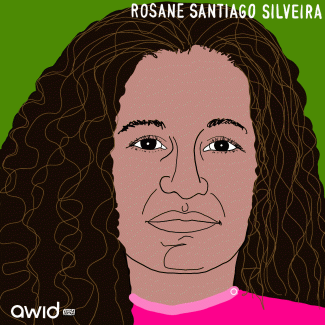
Rosane Santiago Silveira

Rosane Santiago Silveira era conocida afectuosamente como «Rô Conceição». Fue una activista ambiental y por los derechos humanos que luchó fervientemente para proteger el medio ambiente en las zonas más amenazadas.

Esta lucha incluyó la defensa así como también la protección ambiental en la isla de Barra Velha, cuando estuvo amenazada por la exploración petrolera, mediante campañas contra la apropiación de tierras y la expansión de las plantaciones de eucaliptus en el Estado de Bahía, donde Rosane integraba el Consejo de la Reserva Extractivista de Cassurubá.

«La Reserva Extractiva es un área protegida donde las familias residentes se ganan la vida con productos naturales extraídos del bosque. Estas actividades ayudan a mantener la integridad del bosque.» - Global Justice Ecology Project (fuente original: Rede Brasil Atual)

Rosane participó en actividades sindicales, y en movimientos culturales y por los derechos humanos. Dedicó gran parte de sí misma, no solamente a las causas que la afectaban directamente, sino a problemas de la tierra, los bosques, los ríos y las comunidades cuyos derechos y vidas están continuamente en riesgo.

Fue torturada y asesinada el 29 de enero de 2019 en Nova Viçosa, una ciudad del sur de Bahía.

«Lamentablemente, hoy existe un sentimiento de inseguridad total, por la ausencia del Estado  en la investigación de estos delitos. Estuvimos con ella en Navidad, todos se dieron cuenta de que estaba preocupada, y ahora sabemos que había recibido tres amenazas de muerte.» - Tuian, hijo de Rosane, en una entrevista con Rádio Brasil Atual (fuente original: Rede Brasil Atual)

Snippet FEA EoS The Bold (FR)

Yellow and pink cog wheels

L’audacieux·se
Production et entrepreneuriat

I don't feel comfortable sharing the name of my group and our contact information with AWID, should I still fill out the survey?

Absolutely. These questions are optional, we value your right to remain anonymous. Please fill the survey regardless of your decision to share the name and contact information of your group, organization and/or movement.

8. Finalización y formato

Ya tienes el producto final y completo de la investigación organizado y editado. Ahora querrás facilitar la difusión de los resultados y para ello necesitarás que sean visualmente accesibles e interesantes.

En esta sección

Prepara el informe para la difusión pública

Considera la posibilidad de elaborar productos más breves además del informe extenso.

Como dijéramos en «Sintetiza los resultados de la investigación», AWID muchas veces prepara productos más breves a partir del informe de investigación completo. Esto permite difundirlo más y mejor entre audiencias específicas de importancia clave.

Siempre ten presente cuál es la población a la que te diriges: ¿quién va a leer tu informe?

Ejemplos de productos breves derivados de un informe más extenso:

  • Infografías
  • Galería en línea
  • Una secuencia animada que presente los argumentos

1. Piensa tal como lo hace tu público

Todo el tiempo nos bombardean con información. Para conservar el interés de la audiencia, el producto deberá tener un atractivo visual. Una vez más, saber qué quieres lograr y a quién esperas llegar, permitirá que quien se encargue del diseño pueda crear productos para audiencias específicas.

Un informe escrito de muchas páginas en PDF tal vez te parezca la única forma posible de presentar la investigación, pero a mucha gente le puede resultar abrumador — sobre todo en Internet.

Si quieres compartir el producto con una comunidad en línea, piensa en crear memes e infografías para usar en las redes sociales, blogs y plataformas virtuales.

Para decidir si vas a crear o no productos más breves, piensa si podrás dividir los resultados en varios productos más breves para compartirlos con poblaciones específicas o en distintos momentos del año, reavivando así el interés por el producto.

2. Trabaja con profesionales del diseño

Si cuentas con un tiempo limitado y el presupuesto te lo permite, te recomendamos contratar a profesionales del diseño.

Por razones económicas puedes sentir la tentación de pedirle al personal de tu organización que le dé formato al informe. Pero un diseño gráfico profesional puede marcar una gran diferencia en el aspecto del producto final y por lo tanto en el impacto que podrá alcanzar.

Las personas que se encarguen del diseño (ya sean de tu organización o contratadxs) deben ser capaces de:

  • Acercarte muestras de trabajos suyos previos que sean similares a lo que estás buscando.
  • Brindarte consejos claros acerca de cómo presentar la investigación a partir de los contenidos que les aportes y del público al que te diriges.
  • Sugerir materiales adicionales o diferentes para presentar el producto.

¿Qué necesitarás aportarles a quienes se encarguen del diseño?

  • Una idea general de lo que te gustaría destacar del informe extenso utilizando herramientas visuales y gráficos (cuáles son los elementos más importantes sobre los que quieres informar, por ejemplo, los resultados principales) y algunas ideas acerca de qué clase de productos más breves quisieras producir (por ejemplo, un folleto, una infografía, una serie de memes virales). Si puedes, muéstrale a las personas encargadas del diseño ejemplos de documentos similares elaborados por otras organizaciones.
  • Tu presupuesto y cronograma.
  • Las pautas visuales de la organización, si es que las tienes (logo, colores y tipos de letra oficiales, etc.)
  • Algunas fotos de uso libre o acceso a tu banco de fotos si lo tienes.
  • Las principales herramientas visuales que deben ser incluidas: gráficos, tablas y otras figuras tomadas de la investigación.

Recuerda que estarás trabajando con profesionales del diseño, que no necesariamente conocen las temáticas de las mujeres ni tampoco los resultados de la investigación, sobre todo si son personas contratadas y que no forman parte de tu organización.

Comunícales qué elementos del informe son importantes para ti y cuál es tu audiencia. Ellxs te sugerirán formas de destacar esos elementos y de hacer que todo el producto resulte atractivo a lxs usuarixs.

3. Asegura la consistencia de los productos

Cuando hayas creado un conjunto de productos informativos más breves, no olvides vincularlos entre sí:

  • Una versión breve del informe centrada solo en los resultados finales y las recomendaciones deberá incluir un vínculo al informe completo, en su versión final.
  • Una infografía visualmente atractiva que comunique un mensaje acerca de la situación del financiamiento de acuerdo a la temática que investigaste tendrá que incluir un vínculo a tu sitio de Internet y a la correspondiente sección en el informe completo. También deberá incluir una invitación a compartir la infografía en las redes sociales.
  • Una breve secuencia animada que utilice la información, los resultados y recomendaciones del informe deberá incluir un vínculo al sitio de tu organización en Internet y a sus redes sociales
  • Una serie de memes virales que se puedan difundir por Internet deberá incluir un vínculo al informe, a las infografías, a la versión breve del informe, etc.

También es importante que el personal que hizo la investigación se involucre en este estadio del proceso, para garantizar que todos los productos derivados sean consistentes con los resultados de la investigación.

Volver al comienzo


Controla la calidad de las traducciones

Una vez que hayas completado el diseño y la presentación del informe de investigación en su versión final, asegúrate de volver a enviar a traducir cualquier modificación que se haya producido en la terminología o el contenido.

Si además creaste productos breves, una vez que estén diseñados y listos para ser difundidos también necesitarás contar con copias en los idiomas a los que se tradujo el informe. Las traducciones deben ser lo suficientemente claras como para que quien se encarga del diseño pueda elaborar los productos aun si no habla el idioma en que están escritos.

Una vez completadas las traducciones, asegúrate de que una persona que sea hablante nativa del/los idioma/s que corresponda/n las revise, antes de difundirlas.

Volver al comienzo


Paso previo

7. Sintetiza los resultados de la investigación

Paso siguiente

9. Haz incidencia y cuéntale al mundo


Duración estimada

• 2 - 3 meses

Personas que se necesitan

• 1 persona (o más) de investigación
• 1 Editor (editor web o si crea un producto en línea)
• Personal o empresa de diseño
• Traductores, de ofrecer encuesta en varios idiomas

Recursos necesarios

• Lista de los espacios en línea para la difusión


Paso previo

7. Sintetiza los resultados de la investigación

Paso siguiente

9. Haz incidencia y cuéntale al mundo


Planilla «¿Estoy listx?»

Descargar el manual en PDF

Ayanda Denge

« Je suis un miracle… Je suis donc née d’une mère! Moi qui commence à bégayer, J’ai eu une vie à nulle autre pareille... » - Ayanda Denge  (lisez le poème entier ci-dessous) 

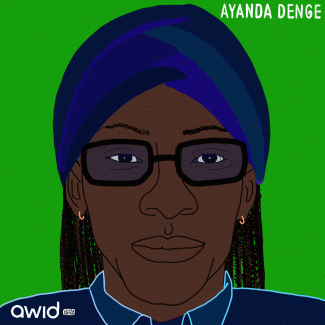
Ayanda Denge était une femme trans, travailleuse du sexe, activiste et poète. Elle était une Xhosa de Port Elizabeth, dans la province du Cap-Oriental en Afrique du Sud. Après avoir traversé différentes villes du pays, elle s'est installée au Cap. 

En tant qu’activiste fervente et engagée de la justice sociale, elle s'est battue pour les droits des travailleures du sexe, des personnes trans et des personnes vivant avec le VIH et le sida. Elle a également été une conférencière motivatrice sur la sensibilisation au cancer ainsi que fait campagne en faveur de logements sociaux et abordables, en particulier au profit des pauvres et des travailleures. Ayanda s'est dressée comme une montagne contre les différents visages souvent violents de la discrimination. 

« Lorsque vous êtes transgenre, ce n’est pas une double dose, mais une triple dose de stigmatisation et de discrimination que vous recevez. Vous êtes discriminé·e en raison de votre identité sexuelle, en raison de votre travail et en raison de votre statut sérologique VIH. » - Ayanda Denge, 2016

Elle a été présidente par intérim de la Sex Workers Education and Advocacy Taskforce (SWEAT, groupe de travail sur l’éducation et la défense des travailleures du sexe) et coordonnatrice de liaison pour Sisonke, un mouvement national de travailleures du sexe sud-africain. 

« D’ici, de notre siège régional à SWEAT, où je siège au conseil d'administration, en passant par Sisonke, un mouvement de travailleures du sexe au Cap, nous ne faisons qu’un. Nous avons un même cri et c'est un cri qui est reconnu dans le monde entier par les travailleures du sexe de toute la planète. Nous voulons la décriminalisation du travail du sexe ». - Ayanda Denge, 2016 

Elle vivait dans la maison Ahmed Kathrada, qui était occupée par la campagne Reclaim the City en faveur de logements sociaux. En 2018, Ayanda avait été élue responsable de la maison. Le 24 mars 2019, elle a été poignardée à mort dans sa chambre. L'année précédente, un autre résident avait été tué. 

Reclaim the City fait le lien entre la sécurité des résident·e·s des maisons et le gouvernement de province qui les prive d'électricité et du droit humain à l'eau potable :  

« Nous ne pouvons dissocier la sécurité des femmes et des personnes LGBTQI vivant dans le squat du refus du gouvernement de la province du Cap-Occidental de rétablir l'électricité et l'eau potable dans la maison Ahmed Kathrada. 

La maison est dans le noir complet le soir. Nous avons besoin de lumière pour nous protéger les un·e·s les autres. On a l'impression que la province veut punir les pauvres et les ouvrier·ère·s, dont le seul crime était d'avoir besoin d'un toit. Certes, ils ont le droit de ne pas être d’accord avec nos raisons de squatter, mais ils devraient avoir honte de faire passer la politique avant la sécurité et la dignité des résident·e·s de cette ville. 

Repose en paix, camarade Ayanda Denge, nous reprenons le flambeau et nous nous souviendrons de toi dans cette lutte pour un logement décent et central. »

Poème d’Ayanda : 

Je suis un miracle…
Je suis donc née d’une mère!
Moi qui commence à bégayer,
j’ai eu une vie à nulle autre pareille.
Née dans la douleur 
Nourrie par la pluie
Pour gagner en hauteur
Je vivais dans les égouts.
Là je verse une larme, 
je me relève et brandis ma lance.
Les voix résonnent, n’ayez pas peur 
Des défis à relever dans l’année,
Des défis de souffrance dans mon dossier; 
La communauté applaudit, croyant que j’ai gagné la course; 
Mais en réalité mon travail avance à pas de tortue; 
À genoux je m’incline et demande grâce.
Car le Seigneur 
Est mon épée;
Pour rappeler à l’humanité
Qu’il apporte la sérénité.
Pourquoi, Seigneur, suis-je ce miracle? 
Le Seigneur me répond par la pluie et le tonnerre, 
Pour avoir interrogé mon père
Qui a dans le livre des agneaux
Un prénom nommé Ayanda.
Dans la rue ma vie n’a jamais été douce
Les personnes que j’ai dû croiser; 
Parfois, je ne les saluais jamais; 
Et même lorsque j’avais besoin de manger;
Je préférais tirer ma révérence
Plutôt que de prendre place.

Écoutez le poème de la voix d'Ayanda

« Car ma vie est pareille à celle d’une fleur de lotus, hors des eaux sombres et troubles, j'ai fleuri pour être belle et forte… »- Ayanda Denge, regardez et écoutez  


Hommages : 

« Ayanda, je voudrais te dire que dans nos coeurs, dans nos esprits, tu es toujours une survivante. Tu n’es plus là mais tu es partout, parce que tu es amour. Comme c’est merveilleux d’être aimé·e, et de donner de l’amour. Et c’est là, Ayanda, le cadeau que tu nous as fait. Merci pour tout cet amour, nous avions vraiment besoin de toi. Je te promets qu’à l’avenir, nous nous engageons tou·te·s à poursuivre la lutte à laquelle tu as consacré tant d’énergie et de temps. Et nous nous engagerons à obtenir justice pour cette fin de vie abominable que tu as connue. » - Transcription d’un message, lors d’un hommage d'adieu à Ayanda

« Ayanda était une activiste par nature. Elle connaissait ses droits et n’hésitait pas à se battre pour les droits des autres. En ce qui me concerne, je n’ai pas été surprise qu’elle s’implique auprès de nombreuses organisations, il était évident qu’elle aimait les gens. Elle ne défendait pas nécessairement les droits des LGBTI, mais les droits de toutes et de tous. » - la soeur d’Ayanda

Snippet FEA Nous Sommes la Solution (FR)

The logo of We Are The Solution with green silhouettes of four rural woment

Nous Sommes la Solution est un mouvement de femmes rurales pour la souveraineté alimentaire en Afrique de l'Ouest. Fondée à l'origine comme une campagne contre l'agriculture hyper-industrialisée, Nous Sommes la Solution est devenue un mouvement de plus de 500 associations de femmes rurales du Burkina Faso, du Sénégal, du Ghana, de la Gambie, de la Guinée Bissau, du Mali et de la Guinée.

Ensemble, ce mouvement dirigé par des femmes construit et renforce la souveraineté alimentaire et semencière en Afrique de l'Ouest. Elles nourrissent les communautés, renforcent les économies locales, amplifient les connaissances des agricultrices et atténuent les effets dévastateurs du changement climatique grâce aux pratiques de l'agroécologie. Elles organisent également des ateliers, des forums et des émissions de radio communautaires pour partager leurs messages, leurs connaissances traditionnelles et leurs pratiques agroécologiques dans les communautés rurales.

En collaboration avec des universités et des centres de recherche publics, Nous Sommes la Solution travaille à la restauration des variétés indigènes traditionnelles de riz (un aliment de base en Afrique de l'Ouest) et à la promotion d'économies alimentaires locales basées sur des principes agroécologiques pour influencer l'élaboration des politiques nationales, tout en soutenant les femmes dans la création d'associations agricoles et leur accès à la propriété et à la gestion collectives des terres agricoles.

¿Cuándo estarán disponibles los resultados de la encuesta?

Analizaremos las respuestas a la encuesta para extraer conclusiones y tendencias, y presentaremos los resultados durante el 15º Foro Internacional de AWID en Bangkok y en línea, en diciembre de 2024. Para asistir al Foro, puedes inscribirte aquí.

Notre vision : La justice économique dans un monde féministe

En tant que féministes luttant pour la justice de genre, la paix, la justice économique, sociale et environnementale, nous savons qu'il n'existe pas de recette miracle, mais plutôt un éventail de possibilités qui peuvent faire changer les choses, et qui les font changer.


Cet éventail d’options est aussi diversifié que nos mouvements et les communautés dans lesquelles nous vivons et nous luttons.

Avant de vous présenter quelques-unes de ces propositions féministes pour un autre monde, voici les principes qui encadrent nos propositions :

1. Un développement autodéterminé, du local au global

Nous croyons qu'il ne doit pas y avoir un seul modèle pour tous, et que chacun-e doit avoir le droit de revendiquer et de contribuer à la construction d'un autre monde possible, comme le formule le slogan du Forum social mondial.

Cela inclut le droit de participer à la gouvernance démocratique et d'influer sur son avenir, politiquement, économiquement, socialement et culturellement.

L'autodétermination économique permet aux peuples de prendre le contrôle de leurs ressources naturelles et d'utiliser ces ressources pour atteindre leurs propres objectifs ou pour un usage collectif. En outre, le pouvoir d’agir des femmes dans la sphère économique est fondamental pour atténuer le caractère souvent cyclique de la pauvreté, le déni de l'éducation, de la sécurité et de la sûreté.

2. Les droits, l'égalité réelle et la justice au cœur de l'économie

Le principe de l'égalité réelle est énoncé dans la Convention sur l'élimination de toutes les formes de discrimination à l'égard des femmes (CEDAW) et d'autres instruments internationaux relatifs aux droits humains. Ce principe est fondamental pour le développement et la transformation vers une économie juste, car il affirme que tous les êtres humains naissent libres et égaux.

La non-discrimination fait partie intégrante du principe d'égalité, qui veille à ce que personne ne soit privé de ses droits en raison de facteurs tels que la race, le sexe, la langue, la religion, l'orientation sexuelle, l'identité sexuelle, une opinion politique ou autre, l’origine nationale ou sociale, la fortune ou la naissance.

La dignité inhérente à toute personne sans distinction doit être maintenue et respectée. Alors que les États doivent veiller à l'utilisation d’un maximum de ressources disponibles pour la réalisation des droits humains, le fait d’exiger ces droits et la dignité est un enjeu clé pour la lutte de la société civile et la mobilisation populaire.

3. Une redistribution juste pour tous et toutes, sans monopolisation ou accaparement (le principe d’anti-avidité)

Ce principe, mis en œuvre par les efforts coordonnés visant à transformer les institutions injustes, soutient le rétablissement de l’équilibre entre la « participation » (entrées) et la « distribution » (sorties), lorsque celui-ci est rompu.

Il permet de poser des limites à l'accumulation monopolistique de capital et d'autres abus liés à la propriété. Ce concept est fondé sur un modèle économique qui repose sur l'équité et la justice.

4. La solidarité féministe et inter-mouvements est fondamentale

Pour changer les choses, nous avons besoin de réseaux féministes solides et diversifiés. Nous avons besoin de mouvements qui renforcent la solidarité du niveau personnel au niveau politique, du niveau local au niveau global, et inversement.
 
Construire le pouvoir collectif grâce aux mouvements permet de convertir la lutte pour les droits humains, l'égalité et la justice en une force politique pour le changement qui ne peut être ignorée.

 « Seuls les mouvements sont en mesure de créer des changements durables à des niveaux que la politique et les lois seules ne permettraient pas d’atteindre. »


Pour en savoir plus sur ce sujet, consulter S. Batliwala, 2012 Changer leur monde. Mouvements féministes, concepts et pratiques.


Voir également

Le projet

5 menaces principales

Snippet FEA Objectives NSS - Traditional Knowledge (EN)

TRADITIONAL KNOWLEDGE

Brown hands with yellow seeds in the palms
To use and promote traditional knowledge and practices transmitted from generation to generation, which supports food sovereignty and the preservation of peasant seed.

Snippet - WITM why - RU

Почему Мне Следовало Бы Пройти Этот Опрос?

Alternative framework for economic governance

Context

The current global economic crisis provides stark evidence that the economic policies of the last 3 decades have not been working.

The devastation that the crisis has wrought on the most vulnerable households in the Global North and Global South is a reminder that the formulation of economic policy and the realization of human rights (economic, social, political, civil and cultural) have for too long been divorced from one another. Economic policy and human rights do not have to be opposing forces, but can exist symbiotically.

Macroeconomic policies affect the operation of the economy as a whole, shaping the availability and distribution of resources. Within this context, fiscal and monetary policies are key.

Definition

  • Fiscal policy refers to both public revenue and public expenditure, and the relationships between them as expressed in the government budget.
  • Monetary policy includes policies on interest and exchange rates and the money supply, as well as the regulation of the financial sector.
  • Macroeconomic policies are implemented using instruments such as taxation, government spending, and control over the supply of money and credit.

These policies affect key prices such as interest and exchange rates that directly influence, among other things, the level of employment, access to affordable credit, and the housing market.

Applying a human rights framework to macroeconomic policy allows States to better comply with their obligation to respect, protect, and fulfill economic and social rights. Human rights are internationally agreed-upon universal standards. These legal norms are articulated in United Nations treaties including, the Universal Declaration of Human Rights (UDHR), the International Covenant on Civil and Political Rights (ICCPR), and the International Covenant on Economic, Social and Cultural Rights (ICESCR).

Article 1 of the UDHR states that, “All human beings are born free and equal in dignity and rights.”

Although the UDHR was written about six decades ago its relevance is enduring. Many of the ideas address concerns and critical issues that people continue to face globally. Issues regarding inhuman punishment (Art. 5), discrimination (Art. 7), property ownership (Art. 17), equal pay for equal work (Art. 23/2), and access to education (Art. 26/1) are pertinent matters in countries South and North of the equator.

More specifically, States have an obligation under international law to respect, protect and fulfill human rights, including the economic and social rights of people within their jurisdiction. This is particularly relevant now given the financial crisis. In the U.S., regulation is skewed in favor of certain interests. The failure to extend government’s supervisory role in the context of social and economic change is a failure with regard to the obligation to protect human rights.

Feminist perspective

States should abide by key human rights principles to achieve economic and social rights. Some of the principles have potentially important implications for governance of financial institutions and markets, yet these possibilities have been underexplored.

Economic and social rights have a concrete institutional and legal grounding. Global declarations, international treaties, covenants, and, in a number of cases, national constitutions have incorporated aspects of the economic and social rights framework—providing an institutional infrastructure in national and international law.

Some have suggested that a consideration of global justice may not be a useful pursuit because of the institutional complexities involved. However, this does not get around that fact that global institutions already have an impact on social justice, both positive and negative.

It is useful to tease out the implications that elements of alternative frameworks have for economic governance, specifically those supported by existing institutions. Economic and social rights represent one such concrete framework. The framework is an evolving one, and ongoing discussion and deliberation is necessary to address underdeveloped areas and potential deficiencies.


Learn more about this proposition

This section is based on CWGL’s blog “Applying a Human Rights Framework to Macroeconomic Policies” (2012).

Part of our series of


  Feminist Propositions for a Just Economy

Snippet - WITM To make - AR

لجعل الواقع المركّب لتمويل الأشكال المختلفة من التنظيم النسوي، مرئي

Key opposition discourses

Ultra conservative actors have developed a number of discourses at the international human rights level that call on arguments manipulating religion, culture, tradition, and national sovereignty in order to undermine rights related to gender and sexuality.

Anti-rights actors have increasingly moved away from explicitly religious language. Increasingly, we see regressive actors - who may previously have derided human rights concepts - instead manipulating and co-opting these very concepts to further their objectives.


Protection of the family

This emerging and successful discourse appears innocuous, but it functions as a useful umbrella theme to house multiple patriarchal and anti-rights positions. The ‘protection of the family’ theme is thus a key example of regressive actors’ move towards holistic and integrated advocacy.

The language of ‘protection of the family’ works to shift the subject of human rights from the individual and onto already powerful institutions.

It also affirms a unitary, hierarchical, and patriarchal conception of the family that discriminates against family forms outside of these rigid boundaries. It also attempts to change the focus from recognition and protection of the rights of vulnerable family members to non-discrimination, autonomy, and freedom from violence in the context of family relations.

The Right to Life

The Holy See and a number of Christian Right groups seek to appropriate the right to life in service of an anti-abortion mission.  Infusing human rights language with conservative religious doctrine, they argue that the right to life, as set out in the Universal Declaration of Human Rights and the International Covenant on Civil and Political Rights, applies at the moment of conception.

The discourse has no support in any universal human rights instrument. Yet this is an appealing tactic for anti-rights actors, because the right to life cannot be violated under any circumstances and is a binding legal standard.

Sexual rights

Anti-rights actors use a number of rhetorical devices in their campaign to undermine sexual rights: they argue that sexual rights do not exist or are ‘new rights,’ that they cause harm to children and society, and/or that these rights stand in opposition to culture, tradition or national laws.

Conservative actors engaged in advocacy at the UN attack the right to comprehensive sexuality education from several directions. They claim that CSE violates ‘parental rights’, harms children, and that it is not education but ideological indoctrination. They also claim that comprehensive sexuality education is pushed on children, parents, and the United Nations by powerful lobbyists seeking to profit from services they provide to children and youth.

Attempts to invalidate rights related to sexual orientation and gender identity have proliferated. Ultra conservative actors argue that application of long-standing human rights principles and law on this issue constitutes the creation of ‘new rights’; and that the meaning of rights should vary radically because they should be interpreted through the lens of ‘culture’ or ‘national particularities.’

Reproductive Rights

Christian Right organizations have been mobilizing against reproductive rights alongside the Holy See and other anti-rights allies for several years. They often argue that reproductive rights are at heart a form of Western-imposed population control over countries in the global South. Ironically, this claim often originates from U.S. and Western Europe-affiliated actors, many of whom actively work to export their fundamentalist discourses and policies.

Regressive actors also cite to ‘scientific’ arguments from ultra-conservative think tanks, and from sources that rely on unsound research methodologies, to suggest that abortion causes an array of psychological, sexual, physical, and relational side effects.

Protection of children and parental rights

Just as anti-rights actors aim to construct a new category of ‘protection of the family,’ they are attempting to construct a new category of ‘parental rights,’ which has no support in existing human rights standards.

This discourse paradoxically endeavours to use the rights protections with which children are endowed, as articulated in the Convention on the Rights of the Child, to support the rights of parents to control their children and limit their rights.

Violence against women

Increasingly, anti-rights actors are attempting to infiltrate and subvert standards and discourses developed by women human rights defenders, such as violence against women (VAW).

At the Commission on the Status of Women and other spaces, one rhetorical move is to treat VAW as a concept in which to embed anti-reproductive rights and patriarchal arguments. Ultra conservative actors, for example, have argued that non-heteronormative or traditional intimate partner relationships are a risk factor for violence, and emphasize that fathers are necessary to protect families from violence.

Gender and ‘gender ideology’

The Holy See has set off a sustained critique of gender, ‘gender ideology’, ‘gender radicals,’ and gender theory, and anti-rights actors often read the term as code for LGBTQ rights. Gender is used by the religious right as a cross-cutting concept that links together many of their discourses. Increasingly, the hysteria on this subject fixates on gender identity and trans rights.

Complementarity and human dignity

Complementarity of the sexes is a discourse employed by a number of ultra-conservative actors today. Its rhetoric is structured around an assumption of difference: men and women are meant to have differing but complementary roles in marriage and family life, and with respect to their engagement in the community and political and economic life.

Reference to ‘natural’ roles is meant to fundamentally reject universal human rights to equality and non-discrimination.

It is also used to justify State and non-State violations of these rights, and non-compliance with respect to State obligations to eliminate prejudices and practices based on stereotyped roles for men or women.

National sovereignty and anti-imperialism

This discourse suggests that national governments are being unjustly targeted by UN bodies, or by other States acting through the UN. This is an attempt to shift the subject of human rights from the individual or marginalized community suffering a rights violation to a powerful and/or regressive institution - i.e. the state, in order to justify national exceptions from universal rights or to support state impunity. 

Religious freedom

Anti-rights actors have taken up the discourse of freedom of religion in order to justify violations of human rights. Yet, ultra-conservative actors refer to religious freedom in a way that directly contradicts the purpose of this human right and fundamentally conflicts with the principle of the universality of rights. The inference is that religious liberty is threatened and undermined by the protection of human rights, particularly those related to gender and sexuality.

The central move is to suggest that the right to freedom of religion is intended to protect a religion rather than those who are free to hold or not hold different religious beliefs.

Yet under international human rights law, the right protects believers rather than beliefs, and the right to freedom of religion, thought and conscience includes the right not to profess any religion or belief or to change one’s religion or belief.

Cultural rights and traditional values

The deployment of references to culture and tradition to undermine human rights, including the right to equality, is a common tactic amongst anti-rights actors. Culture is presented as monolithic, static, and immutable, and it is is often presented in opposition to ‘Western norms.’

Allusions to culture by anti-rights actors in international policy debates aim to undermine the universality of rights, arguing for cultural relativism that trumps or limits rights claims. Regressive actors’ use of cultural rights is founded on a purposeful misrepresentation of the human right. States must ensure that traditional or cultural attitudes are not used to justify violations of equality, and human rights law calls for equal access, participation and contribution in all aspects of cultural life for all, including women, religious, and racial minorities, and those with non-conforming genders and sexualities.

Subverting ‘universal’

Anti-rights actors in international policy spaces increasingly manipulate references to universal or fundamental human rights to reverse the meaning of the universality of rights.

Rather than using the term universal to describe the full set of indivisible and interrelated human rights, ultra conservative actors employ this term to instead delineate and describe a subset of human rights as ‘truly fundamental.’ Other rights would thus be subject to State discretion, ‘new’ rights or optional. This discourse is especially powerful as their category of the truly universal remains unarticulated and hence open to shifting interpretation.


Other Chapters

Read the full report
Main image
FFC - Banners.png
Body

Club de Cine Feminista

Como parte del Viaje por las Realidades Feministas de AWID, te invitamos a explorar nuestro nuevo Club de Cine Feminista: una colección de cortometrajes y largometrajes seleccionados por nuestrxs curadorxs y narradorxs feministas de todo el mundo, que incluyen a Jess X. Snow (Asia-Pacífico), Gabrielle Tesfaye (África/Diáspora Africana) y Esra Ozban (Sudoeste Asiático y África del Norte). Alejandra Laprea es la curadora del programa de América Latina y Centroamérica, que inauguraremos en septiembre, durante el evento de AWID Crear, Résister, Transform: un festival para movimientos feministas. Mientras tanto, ¡mantente atentx a los anuncios sobre proyecciones especiales y conversaciones con cineastas!