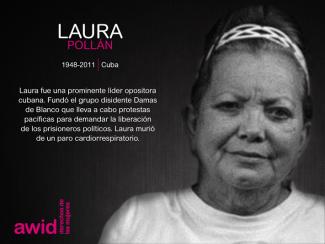
Laura Pollán

In September 2016, the 13th AWID international Forum brought together in Brazil over 1800 feminists and women’s rights advocates in a spirit of resistance and resilience.
This section highlights the gains, learnings and resources that came out of our rich conversations. We invite you to explore, share and comment!
One of the key takeaways from the 2016 Forum was the need to broaden and deepen our cross-movement work to address rising fascisms, fundamentalisms, corporate greed and climate change.
With this in mind, we have been working with multiple allies to grow these seeds of resistance:
And through our next strategic plan and Forum process, we are committed to keep developing ideas and deepen the learnings ignited at the 2016 Forum.
AWID Forums started in 1983, in Washington DC. Since then, the event has grown to become many things to many peoples: an iterative process of sharpening our analyses, vision and actions; a watershed moment that reinvigorates participants’ feminisms and energizes their organizing; and a political home for women human rights defenders to find sanctuary and solidarity.
Be part of an international feminist membership organization and community. Our members are based in all regions of the world, learning and supporting each other in a global network based on solidarity.
هنالك العديد من الأسباب لتعبئة الاستطلاع منها أنه لديك الفرصة لمشاركة تجربتك المعاشة المتعلقة بحشد الموارد لدعم تنظيمك، أن تعمل/ين من منطلق قوة كخبير/ة بما يتعلق بالأموال ولأين تتحرك ولأين تصل وبذلك المشاركة بالجهد المشترك والمناصرة لتحريك التمويلات الأكبر والأفضل. لقد أثبت استطلاع "أين المال" في العشرين عام الأخيرة أنه مصدر أساسي للشركاء/ الشريكات وكذلك للممولين/ات. ندعوك من كل قلبنا للمشاركة بالنسخة الثالثة لتسليط الضوء على الوضع الفعلي للموارد، وتحد الحلول الخاطئة، والإشارة إلى كيفية تغيير التمويل حتى تزدهر الحركات وتواجه التحديات المعقدة في عصرنا.
Madiha fue una destacada profesora de Sociología con activa participación en la sociedad civil como defensora de los derechos de las mujeres en la región árabe.
Presidió la Alianza para las Mujeres Árabes y dentro del Consejo Nacional de Mujeres fue miembro del Comité de la Sociedad Civil y del Comité para el Desarrollo de la Gobernación de Minia. Fue autora de numerosas publicaciones en las que analizó y arrojó luz sobre las desigualdades de género y la discriminación contra las mujeres.
Es recordada con cariño por colegas, estudiantes y amigxs.

Juhi is a tech enthusiast with a Bachelor's degree in Computer Engineering from Gujarat Technological University and a postgraduate background in Wireless Telecommunications and Project Management from Humber College. With a passion for problem-solving and a love for staying ahead in the ever-evolving tech landscape, Juhi has found herself navigating through various industries as an IT Technician. to the nurturing environment of the School Board, Juhi has had the opportunity to apply her technical skills in diverse settings, always embracing new challenges with enthusiasm. Beyond the code and circuits, Juhi loves life's adventures. Exploring new places and cultures is like a breath of fresh air to her. Whether it's discovering hidden gems in the city, trying out exotic cuisines, or embarking on thrilling adventure sports, Juhi is always up for new experiences.
After assessing your organization’s capacity and research goals, you may choose to conduct a survey as one of the methods of data collection for your research analysis.
In this section:
- Why conduct a survey?
- Identify your survey population 1. Online survey 2. Paper survey
- Create your questions 1. Short and clear questions 2. Simple and universal language 3. "Closed" and "open" questions 4. Logical organization 5. Less than 20 mins 6. Simple and exciting
- Test and translate 1. Your advisors 2. Draft and test 3. Translation
- Target the right population 1. Sample size 2. Degree of participation 3. Database and contact list
A survey is an excellent way to gather information on individual organizations to capture trends at a collective level.
For example, one organization’s budget size does not tell you much about a trend in women’s rights funding, but if you know the budgets of 1,000 women’s rights organizations or even 100, you can start to form a picture of the collective state of women’s rights funding.
As you develop your survey questions, keep in mind the research framing that you developed in the previous section.
Remember: Your framing helps you determine what information you are trying to procure through your survey. The data collected from this survey should allow you to accomplish your goals, answer your key questions, and create your final products.
This is an important step – the clearer you are about which populations you want to survey, the more refined your questions will be.
Depending on your research goals, you may want to create separate surveys for women’s rights organizations, women’s funds and donors. Or you may want to focus your survey on women’s groups and collect interviews for women’s funds and donors, as a survey for each population can be resource-intensive.
The questions you ask women’s groups may be different than ones you would ask women’s funds. If you plan on surveying more than one population, we encourage you to tailor your data collection to each population.
At the same time, some key questions for each population can and should overlap in order to draw comparative analysis from the answers.
If you can reach your survey population online, it is useful and efficient to create an online survey.
We recommend two online tools, both which offer free versions:
Survey Gizmo allows you to convert your data for SPSS, a statistical software useful for advanced data analysis
Your data analyst person(s) will be the best person(s) to determine which tool is best for your survey based on staff capacity and analysis plans.
For accessibility, consider making a PDF form version of your survey that you can attach via email. This ensures organizations that have sporadic internet connections or those that pay for it by the minute can download the survey and complete it without requiring a constant online connection.
You may decide that an online approach is not sufficiently accessible or inclusive enough for your popuation.
In this case, you will need to create a paper survey and methods to reach offline populations (through popular events or through post, with pre-stamped envelopes for returning).
Make it easy for participants to complete your survey.
If the questions are confusing or require complex answers, you risk having participants leave the survey unfinished or providing answers that are unusable for your analysis.
Ensure your questions only ask for one item of information at a time.
For example:
- What is your organization’s budget this year?
Easy to answer: participant can easily locate this information for their organization, and it is only asking for one item of information.- What percentage of your budget have you identified as likely sources for funding for your organization, but are still unconfirmed?
Confusing and difficult to answer: are you asking for a list of unconfirmed funding sources or percentage of funding that is likely but unconfirmed?
This information is difficult to obtain: the respondent will have to calculate percentages, which they may not have on hand. This increases the risk that they will not complete the survey.
Many words and acronyms that are familiar to you may be unknown to survey participants, such as “resource mobilization”, “WHRD”, and “M&E”, so be sure to choose more universal language to express your questions.
If you must use industry lingo – phrases and words common to your colleagues but not widely known – then providing a definition will make your survey questions easier to understand.
Be sure to spell out any acronyms you use. For example, if you use WHRD, spell it out as “Women’s Human Rights Defenders".
Closed questions:
Only one response is possible (such as “yes,” “no” or a number). Survey participants cannot answer in their own words and they typically have to choose from predetermined categories that you created or enter in a specific number. Responses to closed questions are easier to measure collectively and are often quantitative.
Example of a closed question: What is your organization’s budget?
Open-ended questions:
These are qualitative questions that are often descriptive. Respondents answer these questions entirely in their own words. These are more suitable for interviews than surveys.
They are harder to analyze at a collective level as compared to closed-end questions, especially if your survey sample is large. However, by making open-ended questions very specific, you will make it easier to analyze the responses.
Whenever possible, design your survey questions so that participants must select from a list of options instead of offering open-ended questions. This will save a lot of data cleaning and analysis time.
Example of open-ended question: What specific challenges did you face in fundraising this year?
Familiarize yourself with different types of questions
There are several ways to ask closed-ended questions. Here are some examples you can review and determine what fits best for the type of data you want to collect:
If you plan to conduct this research at regular intervals (such as every two years), we recommend developing a baseline survey that you can repeat in order to track trends over time.
Set 1: Screening questions
Screening questions will determine the participant’s eligibility for the survey.
The online survey options we provided allow you to end the survey if respondents do not meet your eligibility criteria. Instead of completing the survey, they will be directed to a page that thanks them for their interest but explains that this survey is intended for a different type of respondent.
For example, you only want women’s rights groups in a given location to take this survey. The screening questions can determine the location of the participant and prevent respondents from other locations from continuing the survey.
Set 2: Standardized, basic demographic questions
These questions would collect data specific to the respondent, such as name and location of organization. These may overlap with your screening questions.
If resources permit, you can store these answers on a database and only ask these questions the first year an organization participates in your survey.
This way when the survey is repeated in future years, it is faster for organizations to complete the entire survey, increasing chances of completion.
Set 3: Standardized and mandatory funding questions
These questions will allow you to track income and funding sustainability. Conducted every year or every other year, this allows you to capture trends across time.
Set 4: Special issues questions
These questions account for current context. They can refer to a changing political or economic climate. They can be non-mandatory funding questions, such as attitudes towards fundraising.
For example, AWID’s 2011 WITM Global Survey asked questions on the new “women & girls” investment trend from the private sector.
The shorter, the better: your survey shouldn’t exceed 20 minutes to ensure completion and respect respondents’ time.
It is natural to get excited and carried away by all the types of questions that could be asked and all the information that could be obtained. However, long surveys will lead to fatigue and abandonment from participants or loss of connection between participants and your organization.
Every additional question in your survey will add to your analytical burden once the survey is complete.
General tips
- Ask for exact budgets instead of offering a range (in our experience, specific amounts are more useful in analysis).
- Specify currency! If necessary, ask everyone to convert their answers to the same currency or ask survey takers to clearly state the currency they are using in their financial answers.
- Ensure you collect enough demographic information on each organization to contextualize results and draw out nuanced trends.
For example, if you are analyzing WITM for a particular country, it will be useful to know what region each organization is from or at what level (rural, urban, national, local) they work in order to capture important trends such as the availability of greater funding for urban groups or specific issues.
Involving your partners from the start will allow you to build deeper relationships and ensure more inclusive, higher quality research.
They will provide feedback on your draft survey, pilot test the survey, and review your draft research analysis drawn from your survey results and other data collection.
These advisors will also publicize the survey to their audiences once it is ready for release. If you plan on having the survey in multiple languages, ensure you have partners who use those languages.
If you decide to do both survey and interviews for your data collection, your advisor-partners on your survey design can also double as interviewees for your interview data collection process.
After your survey draft is complete, test it with your partners before opening it up to your respondents. This will allow you to catch and adjust any technical glitches or confusing questions in the survey.
It will also give you a realistic idea of the time it takes to take the survey.
Once the survey is finalized and tested in your native language, it can be translated.
Be sure to test the translated versions of your survey as well. At least some of your pilot testers should be native speakers of the translated languages to ensure clarity.
Your survey sample size is the number of participants that complete your survey.
Your survey sample should reflect the qualities of the larger population you intend to analyze.
For example: you would like to analyze the millions of women’s rights groups in Valyria but you lack the time and resources to survey every single one.
Instead, you can survey only 500 of the Valyrian women’s rights groups – a sample size - to represent the qualities of all the women’s groups in the region.
Recommended sample size
Although it is not necessary to determine your exact sample size before you launch your survey, having a size in mind will allow you to determine when you have reached enough participants or whether you should extend the dates that the survey is available, in case you feel that you have not reached enough people.
Even more important than size of a sample is the degree to which all members of the target population are able to participate in a survey.
If large or important segments of the population are systematically excluded (whether due to language, accessibility, timing, database problems, internet access or another factor) it becomes impossible to accurately assess the statistical reliability of the survey data.
In our example: you need to ensure all women’s groups in Valyria had the opportunity to participate in the survey.
If a segment of women’s groups in Valyria do not use internet, and you only pull participants for your sample through online methods, then you are missing an important segment when you have your final sample, thus it is not representative of all women’s groups in Valyria.
You cannot accurately draw conclusions on your data if segments of the population are missing in your sample size; and ensuring a representative sample allows you to avoid this mistake.
To gain an idea of what the makeup of women’s groups for your area of research (region, population, issue, etc) looks like, it may be useful to look at databases.
By understanding the overall makeup of women’s groups that you plan to target, you can have an idea of what you want your sample to look like - it should be like a mini-version of the larger population.
After participants have taken your survey, you can then gauge if the resulting population you reached (your sample size) matches the makeup of the larger population. If it doesn’t match, you may then decide to do outreach to segments you believe are missing or extend the window period that your survey is open.
Do not be paralyzed if you are unsure of how representative your sample size is – do your best to spread your survey as far and wide as possible.

4. Collect and analyze your data
"Sabemos que todo está en nuestra contra y hay muy pocas posibilidades de cambiar eso. Pero creemos en la intervención y creo que tenemos una oportunidad y deberíamos usarla. Es por eso que estamos haciendo todo lo que estamos haciendo. Estamos dispuestos a presionar por cosas inauditas".
- Sopo Japaridze para OpenDemocracy
Photo @სოლიდარობის ქსელი / Solidarity Network

Participa en el Foro Internacional de AWID - un importante encuentro feminista global—, y accede a descuentos especiales para afiliadxs de AWID y puntos de entrada para el diálogo virtual. Creado en conjunto por los movimientos feministas, el Foro es un espacio único para una discusión profunda y para dejar correr la imaginación, donde desafiamos y fortalecemos nuestros procesos organizativos, donde conectamos nuestras luchas y las realidades feministas.
Да! Мы признаем и ценим различные причины, по которым феминистки(-ты), работающие в различных контекстах, не имеют внешнего финансирования. Эти причины могут разниться: от невозможности подавать заявки на гранты из-за несоответствия требованиями и/или невозможности получения денег из-за рубежа, до использования генерируемых автономно ресурсов, в качестве самостоятельной политической стратегии. Мы хотим услышать ваше мнение, независимо от наличия или отсутствия у вас опыта работы с внешним финансированием.
Considérée par le Guardian comme l'une des icônes nationales de Kiribati, Teresia était une avocate téméraire.
Elle travaillait en étroite collaboration avec des groupes féministes aux îles Fidji. Ses travaux de recherche ont servi à aborder les problèmes du féminisme et de l'égalité de genre dans le Pacifique. Elle était également corédactrice de l’International Feminist Journal of Politics. En Océanie, son influence a traversé les frontières académiques, ainsi que les mouvements pour la justice sociale.

Patience es profesional global en recursos humanos y ha acumulado más de 10 años de experiencia en la gestión de recursos humanos (RRHH) en el sector sin fines de lucro. Anteriormente, trabajó en Mercy Corps como Oficial Global de Recursos Humanos para África, donde brindaba apoyo en todo lo concerniente al ciclo de vida del personal para personas expatriadas en la región de África oriental y meridional, y brindaba orientación técnica en recursos humanos a les encargades de recursos humanos en las oficinas nacionales de la región africana. Antes de sumarse al equipo global de personal, se desempeñaba como Punto Focal Nacional de Recursos Humanos y Salvaguardia, formó parte del equipo de gestión superior encargado de dirigir todos los asuntos de recursos humanos y salvaguardia. Antes de Mercy Corps, dirigió el Departamento de Recursos Humanos y Operaciones de SNV Netherlands Development Organization e integró el equipo de gestión nacional. Asimismo, posee experiencia de consultoría en Recursos Humanos que adquirió mientras estudiaba para su licenciatura en Gestión de Recursos Humanos que terminó con honores. Es una apasionada de la gestión de recursos humanos, le encanta trabajar con la gente y tiene al bienestar y la salvaguardia como sus valores fundamentales, los que aplica en su vida profesional. Por su pasión por los deportes, también se puede encontrar a Patience en un estadio de baloncesto, de tenis o de fútbol.
Ya tienes el producto final y completo de la investigación organizado y editado. Ahora querrás facilitar la difusión de los resultados y para ello necesitarás que sean visualmente accesibles e interesantes.
En esta sección
- Prepara el informe extenso para la difusión pública
1. Piensa tal como lo hace tu público
2. Trabaja con profesionales del diseño
3. Asegura la consistencia de los productos- Controla la calidad de las traducciones
Considera la posibilidad de elaborar productos más breves además del informe extenso.
Como dijéramos en «Sintetiza los resultados de la investigación», AWID muchas veces prepara productos más breves a partir del informe de investigación completo. Esto permite difundirlo más y mejor entre audiencias específicas de importancia clave.
Siempre ten presente cuál es la población a la que te diriges: ¿quién va a leer tu informe?
Ejemplos de productos breves derivados de un informe más extenso:
Todo el tiempo nos bombardean con información. Para conservar el interés de la audiencia, el producto deberá tener un atractivo visual. Una vez más, saber qué quieres lograr y a quién esperas llegar, permitirá que quien se encargue del diseño pueda crear productos para audiencias específicas.
Un informe escrito de muchas páginas en PDF tal vez te parezca la única forma posible de presentar la investigación, pero a mucha gente le puede resultar abrumador — sobre todo en Internet.
Si quieres compartir el producto con una comunidad en línea, piensa en crear memes e infografías para usar en las redes sociales, blogs y plataformas virtuales.
Para decidir si vas a crear o no productos más breves, piensa si podrás dividir los resultados en varios productos más breves para compartirlos con poblaciones específicas o en distintos momentos del año, reavivando así el interés por el producto.
Si cuentas con un tiempo limitado y el presupuesto te lo permite, te recomendamos contratar a profesionales del diseño.
Por razones económicas puedes sentir la tentación de pedirle al personal de tu organización que le dé formato al informe. Pero un diseño gráfico profesional puede marcar una gran diferencia en el aspecto del producto final y por lo tanto en el impacto que podrá alcanzar.
Las personas que se encarguen del diseño (ya sean de tu organización o contratadxs) deben ser capaces de:
¿Qué necesitarás aportarles a quienes se encarguen del diseño?
Recuerda que estarás trabajando con profesionales del diseño, que no necesariamente conocen las temáticas de las mujeres ni tampoco los resultados de la investigación, sobre todo si son personas contratadas y que no forman parte de tu organización.
Comunícales qué elementos del informe son importantes para ti y cuál es tu audiencia. Ellxs te sugerirán formas de destacar esos elementos y de hacer que todo el producto resulte atractivo a lxs usuarixs.
Cuando hayas creado un conjunto de productos informativos más breves, no olvides vincularlos entre sí:
También es importante que el personal que hizo la investigación se involucre en este estadio del proceso, para garantizar que todos los productos derivados sean consistentes con los resultados de la investigación.
Una vez que hayas completado el diseño y la presentación del informe de investigación en su versión final, asegúrate de volver a enviar a traducir cualquier modificación que se haya producido en la terminología o el contenido.
Si además creaste productos breves, una vez que estén diseñados y listos para ser difundidos también necesitarás contar con copias en los idiomas a los que se tradujo el informe. Las traducciones deben ser lo suficientemente claras como para que quien se encarga del diseño pueda elaborar los productos aun si no habla el idioma en que están escritos.
Una vez completadas las traducciones, asegúrate de que una persona que sea hablante nativa del/los idioma/s que corresponda/n las revise, antes de difundirlas.
7. Sintetiza los resultados de la investigación

• 2 - 3 meses
• 1 persona (o más) de investigación
• 1 Editor (editor web o si crea un producto en línea)
• Personal o empresa de diseño
• Traductores, de ofrecer encuesta en varios idiomas
• Lista de los espacios en línea para la difusión
7. Sintetiza los resultados de la investigación
9. Haz incidencia y cuéntale al mundo

Nous nous attachons à faire preuve de transparence, à utiliser nos ressources de manière responsable, à être équitables dans nos collaborations et à faire preuve de responsabilité et d'intégrité envers nos membres, nos partenaires, nos bailleurs de fonds et les mouvements avec lesquels nous travaillons. Nous nous engageons à réfléchir sur nos expériences, à partager ouvertement nos connaissances et à nous efforcer de modifier nos pratiques en conséquence.
Por enquanto, o inquérito no KOBO está disponível em árabe, inglês, francês, português, russo e espanhol. Terá a oportunidade de selecionar um dos idiomas no início do inquérito.
Amal was a prominent politician and parliamentarian in Libya. She was a faculty member at Benghazi University from 1995 until her death in 2017.
Amal was a civil society activist and a member of various social and political initiatives. She assisted the families of martyrs and the disappeared, and was a founding member of a youth initiative called ‘’Youth of Benghazi Libya”. In the 2014 parliamentary elections, Amal was elected to the House of Representatives with more than 14,000 votes (the highest number of votes anyone received in the 2014 elections).
Amal will remain in the memories of many as a woman politician working to ensure a better future in one the most difficult and conflict-ridden contexts in the region.

Tout au long de ses 38 années de carrière, Debbie Stothard a collaboré avec diverses communautés pour impliquer des États, des organisations intergouvernementales et autres parties prenantes en Asie, en Afrique, en Europe et dans les Amériques sur des questions de droits humains et de justice. Son travail porte essentiellement sur les thématiques des affaires et des droits humains, de la prévention des atrocités et du leadership des femmes. Elle a, de ce fait, animé ou secondé près de 300 formations au cours des 15 dernières années. La plupart de ces formations était des ateliers à destination de groupes de base et organisés sur le terrain, centrés sur le plaidoyer en faveur des droits humains, les connaissances économiques fondamentales, les affaires et les droits humains, la justice transitionnelle et la prévention des atrocités. Son travail dans le domaine de la justice transitionnelle et de la prévention des atrocités s’est principalement déroulé au Myanmar, mais elle a également été conseillère en matière d’interventions dans d’autres situations nationales dans le monde.
Entre 1981 et 1996, Debbie a été reporter spécialisée dans les affaires criminelles, organisatrice d’évènements étudiants, analyste politique, universitaire, conseillère gouvernementale et traiteure en Malaisie et en Australie, tout en étant bénévole pour des causes en lien avec les droits humains. Elle a fondé ALTSEAN-Burma en 1996, qui fut à l’initiative d’un large éventail de programmes sur les droits humains à la fois innovants et autonomisants. ALTSEAN mène notamment un programme permanent et intensif de leadership à destination de diverses jeunes femmes à Burma qui, au cours des 22 dernières années, a aidé à renforcer et élargir le leadership des femmes dans les zones touchées par un conflit. Debbie Stothard a siégé au Conseil de la fédération internationale des droits humains (FIDH) pendant neuf années en sa qualité de secrétaire générale adjointe (2010–2013) puis de secrétaire générale (2013–2019). Elle a mis cette période à profit en promouvant la mission et le profil de la FIDH lors de près de 100 réunions et conférences par année.
En tant que féministes luttant pour la justice de genre, la paix, la justice économique, sociale et environnementale, nous savons qu'il n'existe pas de recette miracle, mais plutôt un éventail de possibilités qui peuvent faire changer les choses, et qui les font changer.
Cet éventail d’options est aussi diversifié que nos mouvements et les communautés dans lesquelles nous vivons et nous luttons.
Avant de vous présenter quelques-unes de ces propositions féministes pour un autre monde, voici les principes qui encadrent nos propositions :
Nous croyons qu'il ne doit pas y avoir un seul modèle pour tous, et que chacun-e doit avoir le droit de revendiquer et de contribuer à la construction d'un autre monde possible, comme le formule le slogan du Forum social mondial.
Cela inclut le droit de participer à la gouvernance démocratique et d'influer sur son avenir, politiquement, économiquement, socialement et culturellement.
L'autodétermination économique permet aux peuples de prendre le contrôle de leurs ressources naturelles et d'utiliser ces ressources pour atteindre leurs propres objectifs ou pour un usage collectif. En outre, le pouvoir d’agir des femmes dans la sphère économique est fondamental pour atténuer le caractère souvent cyclique de la pauvreté, le déni de l'éducation, de la sécurité et de la sûreté.
Le principe de l'égalité réelle est énoncé dans la Convention sur l'élimination de toutes les formes de discrimination à l'égard des femmes (CEDAW) et d'autres instruments internationaux relatifs aux droits humains. Ce principe est fondamental pour le développement et la transformation vers une économie juste, car il affirme que tous les êtres humains naissent libres et égaux.
La non-discrimination fait partie intégrante du principe d'égalité, qui veille à ce que personne ne soit privé de ses droits en raison de facteurs tels que la race, le sexe, la langue, la religion, l'orientation sexuelle, l'identité sexuelle, une opinion politique ou autre, l’origine nationale ou sociale, la fortune ou la naissance.
La dignité inhérente à toute personne sans distinction doit être maintenue et respectée. Alors que les États doivent veiller à l'utilisation d’un maximum de ressources disponibles pour la réalisation des droits humains, le fait d’exiger ces droits et la dignité est un enjeu clé pour la lutte de la société civile et la mobilisation populaire.
Ce principe, mis en œuvre par les efforts coordonnés visant à transformer les institutions injustes, soutient le rétablissement de l’équilibre entre la « participation » (entrées) et la « distribution » (sorties), lorsque celui-ci est rompu.
Il permet de poser des limites à l'accumulation monopolistique de capital et d'autres abus liés à la propriété. Ce concept est fondé sur un modèle économique qui repose sur l'équité et la justice.
Pour changer les choses, nous avons besoin de réseaux féministes solides et diversifiés. Nous avons besoin de mouvements qui renforcent la solidarité du niveau personnel au niveau politique, du niveau local au niveau global, et inversement.
Construire le pouvoir collectif grâce aux mouvements permet de convertir la lutte pour les droits humains, l'égalité et la justice en une force politique pour le changement qui ne peut être ignorée.
« Seuls les mouvements sont en mesure de créer des changements durables à des niveaux que la politique et les lois seules ne permettraient pas d’atteindre. »
Pour en savoir plus sur ce sujet, consulter S. Batliwala, 2012 Changer leur monde. Mouvements féministes, concepts et pratiques.