Jean-Marc Ferré | Flickr (CC BY-NC-ND 2.0)
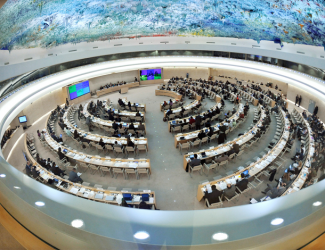
A general view of participants at the 16th session of the Human Rights Council in Geneva, Switzerland.

Human Rights Council (HRC)

The Human Rights Council (HRC) is the key intergovernmental body within the United Nations system responsible for the promotion and protection of all human rights around the globe. It holds three regular sessions a year: in March, June and September. The Office of the UN High Commissioner for Human Rights (OHCHR) is the secretariat for the HRC.

The HRC works by:

  • Debating and passing resolutions on global human rights issues and human rights situations in particular countries

  • Examining complaints from victims of human rights violations or activist organizations on behalf of victims of human rights violations

  • Appointing independent experts (known as “Special Procedures”) to review human rights violations in specific countries and examine and further global human rights issues

  • Engaging in discussions with experts and governments on human rights issues

  • Assessing the human rights records of all UN Member States every four and a half years through the Universal Periodic Review

Learn more about the HRC


AWID works with feminist, progressive and human rights partners to share key knowledge, convene civil society dialogues and events, and influence negotiations and outcomes of the session.

With our partners, our work will:

◾️ Monitor, track and analyze anti-rights actors, discourses and strategies and their impact on resolutions

◾️ Raise awareness of the findings of the 2017 and 2021 OURs Trends Reports.

◾️Support the work of feminist UN experts in the face of backlash and pressure

◾️Advocate for state accountability
 
◾️ Work with feminist movements and civil society organizations to advance rights related to gender and sexuality.
 

Related Content

Snippet FEA We are living in a world right (ES)

Incluso en tiempos de crisis climática, los gobiernos continúan alentando el crecimiento de las industrias agrícolas a gran escala. Estas actividades envenenan la tierra, amenazan la biodiversidad y destruyen la producción de alimentos y los medios de vida locales. Mientras tanto, aunque las mujeres producen la mayoría de nuestros alimentos en el mundo, casi no poseen tierra.

¿Qué pasaría si percibiéramos la tierra y la Naturaleza no como una propiedad privada para ser explotada, sino como una totalidad con la cual aprender y coexistir en armonía? ¿Y si repararíamos nuestras relaciones con la tierra y adoptaríamos alternativas más sostenibles que nutran tanto al planeta como a sus comunidades?

Nous Sommes la Solution (Somos la Solución, NSS) es uno de los muchos movimientos liderados por mujeres que se esfuerzan por lograr este objetivo.

Esta es su historia.

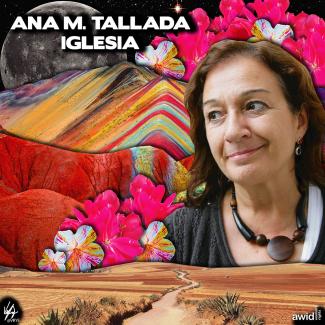
Ana M. Tallada Iglesia

Ana était un ardente défenseure des droits des femmes et travaillait avec un large éventail de femmes au sein d’organisations de terrain ainsi que dans le secteur privé.

Elle croyait en la construction de ponts entre les secteurs. Ana était membre du Réseau national de promotion de la femme (RNPM) et participait activement à l'élaboration de nombreux programmes sociaux traitant de questions telles que la santé et les droits sexuels et reproductifs.


Ana M. Tallada Iglesia, Peru

FRMag - Resistance from the Kitchen

Nuestra arepa: Cocina en resistencia

por Alejandra Laprea

Vivo en un país de lo imposible, donde no caen bombas pero padecemos una guerra. (...)

Leer

arte: «Entretejidas», Surmercé >

Snippet - CSW69 Image - FR

Estoy escribiendo un artículo de investigación, ¿puede AWID ayudarme?

AWID ofrece una amplia gama de recursos para ayudarte en tu investigación

AWID proporciona una gran cantidad de recursos que pueden ayudarte en tu investigación. Te invitamos a explorar las Áreas Prioritarias y la sección «Infórmate» de nuestro sitio web, o que utilices la función de búsqueda para encontrar información sobre los temas específicos que estás investigando. .

Recomendamos especialmente que explores nuestro manual «¿Dónde está el dinero para los derechos de las mujeres» (WITM). Este manual es una demostración política y práctica de los recursos y procesos necesarios para llevar a cabo una sólida investigación-acción.

Explora el manual «¿Dónde está el dinero» (WITM).

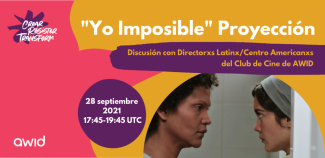
Yo, Imposible proyección: la guía de participación

Snippet - GII Intro (EN)

Gender Impact Investing & The Rise of False Solutions:

An Analysis for Feminist Movements

Gender Impact Investing (GII) is now trending as a solution to gender inequality. Yet, as our report indicates, it is actually part of the problem. Public and private institutions marketing GII equate it with promotion of gender equality and with increased resources for women and girls.

Neither claim is evidence-based.

Rather, GII is another expression of subjecting our lives and societies to the same financial logic that has shaped, and continues shaping, the profound inequalities in our world.

With this report, AWID offers the readers - feminists, gender justice advocates and stakeholders in gender impact investing - a critical analysis and substantiated evidence to understand GII, its narratives, and economic and political implications for feminist movements.

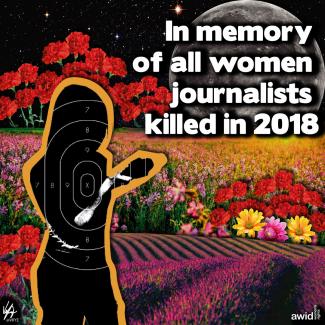
In memory of all women journalists who were killed in 2018

Just like women have learned to avoid dark streets for their safety, women journalists are forced to avoid reporting certain stories as a result of online harassment.

The physical, sexual and online abuse that has become a part of their daily work lives should never be normalized.

Harassment is not part of the job description and should be called out and challenged at every turn to ensure these important voices are not silenced.

This tribute to journalists was made on behalf of IFEX
In memory of all women journalists who were killed in 2018

FRMag - Armenians

Arménien·ne·s, le féminisme est notre passé et notre avenir

par Sophia Armen 

Que cela vous plaise ou non, les ungerhouis font partie intégrante de nos histoires de résistance et elles ne disparaîtront pas de sitôt.  (...)

Lire

Snippet - Rights and Resources - FR

Droits et ressources : se préparer pour les 30 prochaines années

✉️ Les inscriptions en personne sont closes. Inscrivez-vous au livestream ici
Événement en anglais 

📅 Mercredi 12 mars 2025
🕒 12.00h-13.30h EST

🏢 PNUD, 304 E 45th St. Doha Room, 11th Floor (FF Building)

Organisé par : PNUD, Femena, SRI et AWID

2005: le second Dialogue de haut niveau a lieu

Second Dialogue de haut niveau sur le financement du développement

  • Organisé les 27 et 28 juin 2015, le second Dialogue de haut niveau sur le financement du développement,  avait pour thème Le Consensus de Monterrey : état de la mise en œuvre et responsabilités futures.
  • Outre les six traditionnelles tables rondes portant   sur chacun des chapitres du Consensus de Monterrey, un dialogue interactif officieux a été instauré entre différentes parties prenantes, parmi lesquelles des groupes de défense des droits des femmes.
  • Les nations « en développement » ont lancé un appel à prendre en compte les défis mondiaux aussi bien que les possibilités et besoins locaux dans les interactions avec les différents groupes sociaux ­–notamment les femmes, les jeunes, les personnes handicapées, etc. – sur les thèmes identifiés dans le Consensus de Monterrey. 

Ali Chavez Leeds

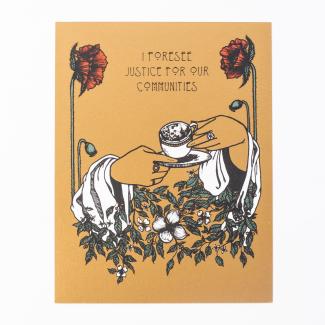
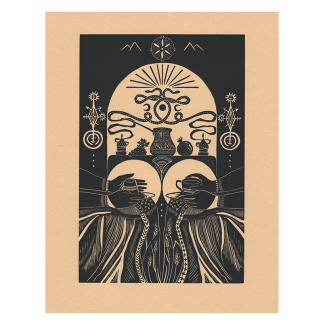
tasseography print justice. Print on paper, 4 color screen print, 8.5x11, 2016
Impression sur papier, sérigraphie 4 couleurs, 8.5x11, 2016

«Tasseography» (Tasséomancie)

La tasséomancie est une méthode de divination qui interprète les motifs dans les feuilles de thé et/ou le marc de café. Il s’agit d’une pratique qui se transmet par les femmes de mon côté arménien et qui m’a été enseignée par ma mère, qui elle-même l’a apprise de sa mère, et ainsi de suite. Lorsque je regardais ma grand-mère lire le marc de café du café arménien préparé pour la famille et les amis, je remarquais que, souvent, elle voyait ce qu'elle avait envie de dire. Ces gravures disent certaines des choses que j’ai envie de voir dans le monde ; j'espère que vous aussi.  

Our Promise
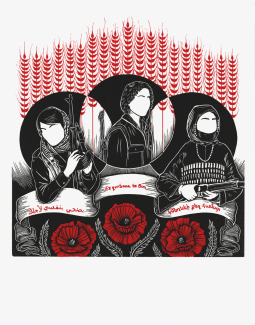
Impression relief sur papier, 11 × 14 in, 2021

«Our Promise» (Notre promesse)

Cette gravure célèbre la résilience, le sacrifice et la force des combattant·e·s de la liberté de l’Asie du Sud-Ouest et de l’Afrique du Nord à travers l'histoire et la solidarité qui existe. Elle a été inspirée à l'origine par un article que j'ai lu sur une exposition organisée à Tatvan, un district de Bitlis, qui mettait en lumière la présence arménienne dans la région. Mes ancêtres sont originaires de Bitlis, se situant aujourd'hui sur le territoire de la Turquie actuelle.

looking at the cup
Impression relief sur papier, 8.5 × 11 in, 2020

«Looking at the Cup» (Regarder la tasse)

La tasséomancie (la lecture du marc de café) est une pratique culturelle utilisée par les femmes arméniennes depuis des siècles pour se parler entre elles et les unes aux autres, un langage codé permettant d'entamer des conversations, d'établir des relations et de tisser des liens.

À propos d’Ali Chavez Leeds 

]Ali Chavez Leeds portrait
Ali Cat Leeds (elle/iel) est une artiste et graveuse qui vit sur les territoires non cédés de Cowlitz, Multnomah et des tribus confédérées de Grand Ronde, au confluent de deux rivières, également connu sous le nom de Portland, Oregon. Elle produit ses œuvres sous le nom de Entangled Roots Press. Ses impressions mêlent le littéral et le métaphorique pour éclairer et commenter le monde qui nous entoure. Les impressions en relief, sérigraphiques et typographiques vont du carnage de la déforestation à la beauté des mouvements des peuples. Les impressions d'Ali s'inspirent d'histoires ancestrales et s'orientent vers des avenirs libérateurs ; elles enchevêtrent les leçons des jardins, les symboles dans le marc de café, les fils tissés d'Arménie et d'Euskal Herria, jusqu'à la page imprimée.

Snippet Stories of Change Full - Download (FR)

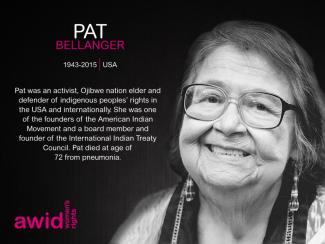
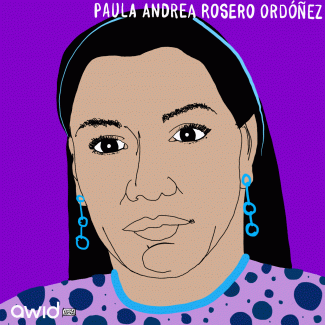
Paula Andrea Rosero Ordóñez

“[She] was a person who was characterized by her hard work in favor of the defense of human rights and the construction of peace in Nariño, especially in the municipality of Samaniego-Nariño.”
- Jorge Luis Congacha Yunda for Página10

Paula Andrea Rosero Ordóñez was a trial lawyer in the office of the Public Ministry in Samaniego, Nariño, the main agency defending citizens’ rights in Colombia.

She focused on civil and political rights, issues of impunity and justice, and contributed to uncovering the abuse of power, including corruption. She also participated in peacebuilding projects in her hometown Samaniego, such as the Municipal Peace Council and the Municipal Women’s Board. 

Paula received death threats after exposing the irregular handling of resources and complaining about acts of corruption at the Lorencita Villegas Hospital in the Nariñense municipality. She was murdered on 20 May 2019, when two men approached and shot her at close range. 
FRMag - Ghosts Of Girlhood

Ghosts Of Girlhood

by Akua Antiwiwaa

There is an old, hazy picture laying in front of me. In it I am dressed in all white, from the pearl beads fastened into my hair and tucked against my ears, to the ones that trail loosely around my tiny wrists. (...)

Read

artwork: “Cultura Negra” [Black Culture] by Astrid Milena González Quintero

Snippet - CSW69 - Feminist Solidarity Space 12 - EN

Feminist Solidarity Space

✉️ By registration for larger groups. Drop-ins for smaller groups. Register here

📅 Wednesday, March 12, 2025
🕒 2.00-4.00pm EST

🏢 Chef's Kitchen Loft with Terrace, 216 East 45th St 13th Floor New York 

Organizer: AWID

2013: The sixth High-level Dialogue reviews progress of MDGs

The Sixth High-level Dialogue on Financing for Development, 7-8 October 2013 focused on reviewing the progress of MDG’s, and identifying gaps to be addressed in discussions on the new development framework.

A report by the MDG’s Gap Task Force launched during the session pointed to the failure to meet MDG 8 (Global Partnership for Development) as a major factor in the challenges to meeting the MDGs. The report showed that more focus should be given to developing stronger global partnerships that would ensure binding commitments for the new development framework post 2015.