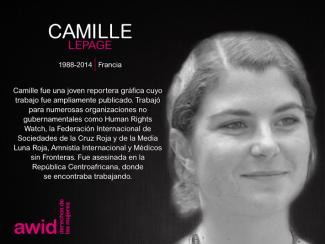
Camille Lepage
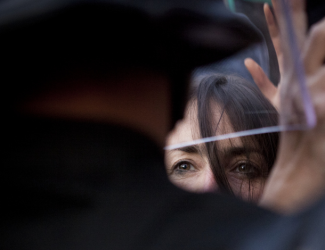
WHRDs are self-identified women and lesbian, bisexual, transgender, queer and intersex (LBTQI) people and others who defend rights and are subject to gender-specific risks and threats due to their human rights work and/or as a direct consequence of their gender identity or sexual orientation.
WHRDs are subject to systematic violence and discrimination due to their identities and unyielding struggles for rights, equality and justice.
The WHRD Program collaborates with international and regional partners as well as the AWID membership to raise awareness about these risks and threats, advocate for feminist and holistic measures of protection and safety, and actively promote a culture of self-care and collective well being in our movements.
WHRDs are exposed to the same types of risks that all other defenders who defend human rights, communities, and the environment face. However, they are also exposed to gender-based violence and gender-specific risks because they challenge existing gender norms within their communities and societies.
We work collaboratively with international and regional networks and our membership
We aim to contribute to a safer world for WHRDs, their families and communities. We believe that action for rights and justice should not put WHRDs at risk; it should be appreciated and celebrated.
Promoting collaboration and coordination among human rights and women’s rights organizations at the international level to strengthen responses concerning safety and wellbeing of WHRDs.
Supporting regional networks of WHRDs and their organizations, such as the Mesoamerican Initiative for WHRDs and the WHRD Middle East and North Africa Coalition, in promoting and strengthening collective action for protection - emphasizing the establishment of solidarity and protection networks, the promotion of self-care, and advocacy and mobilization for the safety of WHRDs;
Increasing the visibility and recognition of WHRDs and their struggles, as well as the risks that they encounter by documenting the attacks that they face, and researching, producing, and disseminating information on their struggles, strategies, and challenges:
Mobilizing urgent responses of international solidarity for WHRDs at risk through our international and regional networks, and our active membership.
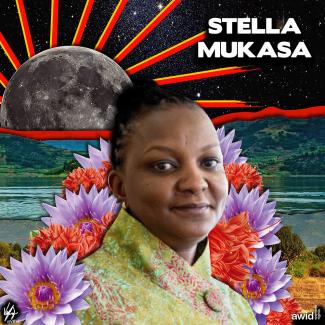
Stella began her career at the Ministry of Gender and Community Development in Uganda engaging with policymakers for law reform, including the 1995 Ugandan Constitution, which established some of the most progressive reforms for women in the region.
She is revered throughout the region for her tireless efforts to create and enforce gender-responsive laws and policies. She played a key role in drafting Uganda’s Domestic Violence Act and in mobilizing support for gender-responsive constitutions in both Uganda and in Rwanda.
Through her work with International Center for Research on Women (ICRW), she worked on violence against children, and worked to strengthen the capacities of grassroots organizations addressing gender-based violence. She was a lecturer on gender rights and the law at Makerere University and served on the boards of Akina Mama wa Afrika, ActionAid International Uganda and the Open Society Initiative for Eastern Africa.
وسيكون التحقيق مفتوحًا حتى 31 أغسطس 2024. الرجاء تكملته خلال هذا الوقت للتأكد بأن تشمل ردودكم/ن في التحليل.
Ȃurea Mouzinho is a feminist economic justice organizer from Luanda, Angola, with a 10-year career in research, grant-making, advocacy, and movement-building for women's rights and economic justice across Africa and the global south. Currently the Program Manager for Africa at Thousand Currents, she also serves on the Feminist Africa Editorial Board and is a member of Ondjango Feminista, a feminist collective she co-founded in 2016. A new mom to a Gemini boy, urea enjoys slow days with her young family and taking long strolls by the beach.
She occasionally tweets at @kitondowe.
يتبيّن من هذه التويتات الفكاهة المقرونة بالإثارة والاهتياج الجنسيّ، التي تتّسم بها المقاربة النسوية لكتابة الرسائل ذات المضامين الجنسية، دون أن تُسقط عن نفسها الالتزام بالمساواة والعدالة.
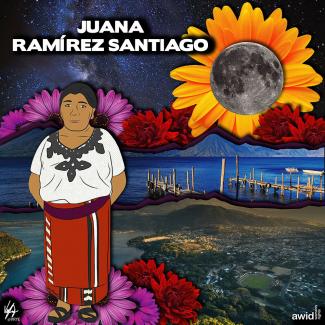
Juana fue una de las fundadoras y era actualmente integrante de la junta directiva de la Red de Mujeres Ixiles de Nebaj, una organización por los derechos de las mujeres indígenas que es parte de la Iniciativa Mesoamericana de Mujeres Defensoras de Derechos Humanos (IM-Defensoras).
También era partera y madre de siete hijxs. Había recibido amenazas de muerte que fueron denunciadas ante la Fiscalía. Juana es la tercera defensora de derechos humanos indígena asesinada en el área durante 2018. El Ombudsman de Guatemala informa que un total de 20 defensorxs de derechos humanos fueron asesinadxs este año en el país.
Juana Ramírez Santiago fue baleada de muerte por atacantes desconocidos mientras cruzaba un puente en Nebak, Quiché, Guatemala. Están en curso las investigaciones para identificar a los perpetradores.
En s’appuyant sur nos 20 années d’efforts pour la mobilisation de davantage de financements de meilleure qualité pour des changements sociaux menés par des féministes, l’AWID vous invite à répondre à la nouvelle version de notre enquête phare intitulée WITM
Simone a 20 ans d’expérience dans le soutien à la gestion et l’administration dans des organisations à but non lucratif, en particulier dans l’enseignement médical post universitaire et la formation aux Technologies de l'Information et de la Communication. Elle possède des qualifications en soutien à la gestion et en études parajuridiques. Elle est basée en Afrique du Sud, aime voyager et agit en tant que généalogiste amatrice.
L'exposition #MeToo en Chine a été organisée pour la première fois en 2019 et a effectué une tournée dans 5 villes. L'objectif de l'exposition est de mettre davantage en avant les expériences personnelles des victimes et des activistes et, en prenant part à ces histoires, d'inspirer notre public à se joindre à la lutte. L'exposition est elle-même devenue une partie de la lutte #MeToo; elle a fait face à d’innombrables défis lors de sa tournée à travers la Chine et a même risqué la fermeture à plus d'une occasion.
Ana était un ardente défenseure des droits des femmes et travaillait avec un large éventail de femmes au sein d’organisations de terrain ainsi que dans le secteur privé.
Elle croyait en la construction de ponts entre les secteurs. Ana était membre du Réseau national de promotion de la femme (RNPM) et participait activement à l'élaboration de nombreux programmes sociaux traitant de questions telles que la santé et les droits sexuels et reproductifs.
Cuando la gente se reúne a escala global, como personas individuales y como movimientos, se genera una fuerza arrolladora. Únete a nosotrxs en Bangkok, Tailandia, y de manera virtual, en diciembre de 2024.
Nana is a feminist organizer and a reproductive rights and population policy researcher based in Egypt. She is a member of Realizing Sexual and Reproductive Justice (RESURJ), a member of the Advisory Board of the A Project in Lebanon, and a member of the Community Committee of Mama Cash. Nana holds an MSc in Public Health from KIT Institute and Vrije University in Amsterdam. In her work, she follows and contextualizes national population policies while building evidence that addresses modern eugenics, regressive international aid, and authoritarianism. Previously, she was part of the Geneva Foundation for Medical Education and Research, the Egyptian Initiative for Personal Rights, and Ikhtyar Feminist Collective in Cairo.
Nicole Barakat is a queer femme, SWANA artist born and living on Gadigal Country (so-called Sydney, Australia). She works with deep listening and intuitive processes with intentions to transform the conditions of everyday life. Her work engages unconventional approaches to art-making, creating intricate works that embody the love and patience that characterises traditional textile practices.
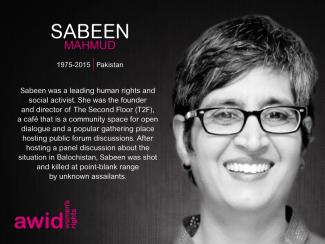
Just like women have learned to avoid dark streets for their safety, women journalists are forced to avoid reporting certain stories as a result of online harassment.
Harassment is not part of the job description and should be called out and challenged at every turn to ensure these important voices are not silenced.
This tribute to journalists was made on behalf of IFEX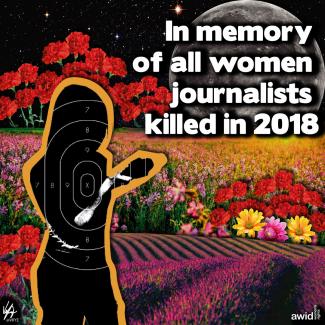
Apprenez-en davantage sur les prochains événements CSW69 co-organisés par l'AWID ci-dessous
AWID began in 1982 and has grown and transformed since then into a truly global organization.
Read From WID to GAD to Women's Rights: The First 20 Years of AWID
Este proyecto se desarrolla en colaboración con: