Contenido relacionado
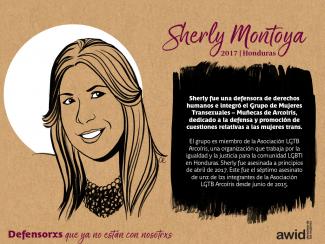
Organización Mundial Contra la Tortura: Honduras: Asesinato de Sherly Montoya, integrante del Grupo de Mujeres Transexuales “Muñecas de Arcoíris”

WHRDs are self-identified women and lesbian, bisexual, transgender, queer and intersex (LBTQI) people and others who defend rights and are subject to gender-specific risks and threats due to their human rights work and/or as a direct consequence of their gender identity or sexual orientation.
WHRDs are subject to systematic violence and discrimination due to their identities and unyielding struggles for rights, equality and justice.
The WHRD Program collaborates with international and regional partners as well as the AWID membership to raise awareness about these risks and threats, advocate for feminist and holistic measures of protection and safety, and actively promote a culture of self-care and collective well being in our movements.
WHRDs are exposed to the same types of risks that all other defenders who defend human rights, communities, and the environment face. However, they are also exposed to gender-based violence and gender-specific risks because they challenge existing gender norms within their communities and societies.
We work collaboratively with international and regional networks and our membership
We aim to contribute to a safer world for WHRDs, their families and communities. We believe that action for rights and justice should not put WHRDs at risk; it should be appreciated and celebrated.
Promoting collaboration and coordination among human rights and women’s rights organizations at the international level to strengthen responses concerning safety and wellbeing of WHRDs.
Supporting regional networks of WHRDs and their organizations, such as the Mesoamerican Initiative for WHRDs and the WHRD Middle East and North Africa Coalition, in promoting and strengthening collective action for protection - emphasizing the establishment of solidarity and protection networks, the promotion of self-care, and advocacy and mobilization for the safety of WHRDs;
Increasing the visibility and recognition of WHRDs and their struggles, as well as the risks that they encounter by documenting the attacks that they face, and researching, producing, and disseminating information on their struggles, strategies, and challenges:
Mobilizing urgent responses of international solidarity for WHRDs at risk through our international and regional networks, and our active membership.
Contenido relacionado
Organización Mundial Contra la Tortura: Honduras: Asesinato de Sherly Montoya, integrante del Grupo de Mujeres Transexuales “Muñecas de Arcoíris”
Segundo Diálogo de Alto Nivel sobre la Financiación para el Desarrollo
Las naciones ‘en desarrollo’ exhortaron a que se tuvieran en cuenta los desafíos globales así como las necesidades y posibilidades locales en la interacción con diferentes grupos (mujeres, jóvenes, personas con discapacidad, etc.) para abordar las temáticas identificadas en el Consenso de Monterrey.
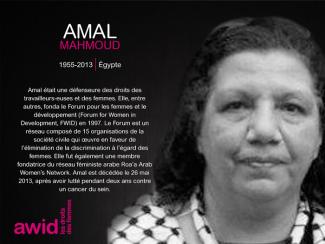
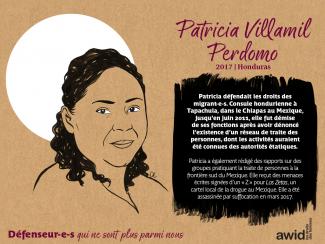
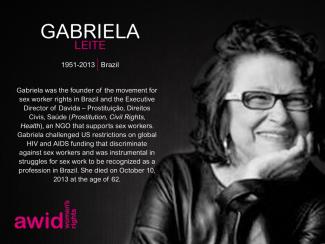
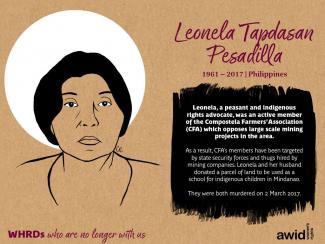
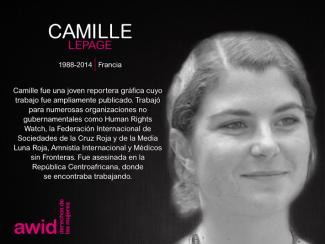
6 Women Human Rights Defenders (WHRDs) across Western and Southeastern Europe have in their lifetime researched, campaigned, participated in and advanced peace and women’s rights movements be it through political and social activism or through dance. We are grateful for the legacy they have left. Please join AWID in honoring these women, their activism and legacy by sharing the memes below with your colleagues, networks and friends and by using the hashtags #WHRDTribute and #16Days.
Please click on each image below to see a larger version and download as a file


Да, мы хотим получить ваш ответ, независимо от того, сколько раз (один, два или три) вы получали финансирование в период между 2021 и 2023 годами.
Explore these projects put together by AWID teams to promote feminist advocacy and perspectives.
Le cinquième Dialogue de haut niveau sur le financement du développement, organisé les 7 et 8 décembre 2011, a marqué le début des discussions relatives au programme de développement de l’après-2015 et aux liens entre ce programme et le financement du développement. La conférence a accordé une attention particulière à la question de l’accroissement de l’aide au financement des OMD. Dans ses observations finales, le Secrétaire général a appelé les membres à commencer à réfléchir sur le cadre de développement de l’après-2015.
A framework for your research will guide throughout your research process, and the framing document you develop can also serve as a concept note to advisors and partners, and a funding proposal to potential donors.
Before conducting any research:
- Set the goals of your research
- List the key questions you want your research to answer
- Write out the type of data you will need to obtain and review to answer your key questions
- Define the final products you will produce with your research
Your research framing may evolve over time as you refine your questions and gather new information. However, building an initial research framing will allow you to work from a solid foundation.
To create a strong foundation for your WITM research, it is important to clarify what you hope to accomplish.
For example, one goal of AWID’s WITM global research was to provide rigorous data to prove what we already knew anecdotally: that women’s rights organizations are discrepantly underfunded. With this data, we felt we would be better positioned to influence funders in their decision-making.
Your goals could be to:
Frame your research process with key questions that only your research can answer and limit those questions to a specific time frame (e.g. past five years, past year, etc.).
Consider the following points:
Choosing a specific timeframe for your research can result in more precise findings than working with an open-ended timeframe. Also, deciding whether you will repeat this research at regular intervals will allow you to set up data collection benchmarks for easy replication and comparison over time.
These were the key questions that guided AWID’s WITM research process:
Now that you determined your key questions, you can determine what kind of data will help you answer your key questions. This will allow you to plan the rest of your schedule for your WITM research.
For example, will you conduct a survey that covers an extensive portion of your priority population? Will you analyze the applications that funders are receiving from a certain region? Will you also conduct interviews (recommended)? By determining the types of data you need, you can reach out to external parties who will provide this data early on, and plot out your full schedule accordingly. Some suggested sources of data could be:
Diverse data sets are a great way to create robust and rich analysis.
The data from AWID’s 2011 Global Survey formed the backbone of our analysis in Watering the Leaves, Starving the Roots report. However, we also collected data from interviews and interactions with several actors in the field, ranging from donors to activists and women’s rights organizations.
In addition to allowing you to set your schedule, creating an initial plan of what products you will develop will also allow you to work out what resources you need.
For example, will you only produce a long research report or will you also create infographics, brochures and presentations? Depending on your products, you may need to hire a design firm, plan events and so on.
These products will also be the tools you use to achieve your goals, so it is important to keep those goals in mind. For example, is your WITM research exclusively intended as an advocacy tool to influence funders? In that case, your products should allow you to engage with funders at a deep level.
Some sample products:
Framing your research to cover goals, key questions, types of data, and final products will allow you to create a well-planned schedule, prepare your resources in advance, and plan a realistic budget.
This will make interactions with external partners easier and allow you to be nimble when unexpected setbacks occur.

• 1 month
• 1 or more Research person(s)
• AWID Research Framing: sample 1
• AWID Research Framing: sample 2
Pedimos estes dados para facilitar a revisão das respostas, para evitar respostas duplicadas e para poder entrar em contacto com o seu grupo caso não tenha conseguido completar o inquérito e/ou tenha dúvidas ou perguntas adicionais. Para mais informações sobre como utilizamos as informações pessoais que recolhemos através do nosso trabalho, clique aqui.
Hakima Abbas, AWID
"Estamos utilizando las herramientas que tenemos para compartir nuestra resistencia, nuestras estrategias y continuar edificando nuestro poder para actuar y crear nuevos mundos valientes y justos"
Additional consultation sessions on the Draft Outcome Document
Desk research can be done throughout your research. It can assist you with framing, help you to choose survey questions and provide insights to your results.
In this section
- Giving context
- Building on existing knowledge
- Potential sources for desk research
1. Donors’ websites and annual reports
2. Online sources of information
Conducting desk research throughout your research process can assist you with framing, help you to choose survey questions and provide contextual clarity or interesting insights to your survey results, such as comparing similarities and differences between your survey results and information produced by civil society and donors.
Perhaps you notice trends in your survey data and want to understand them.
For example, your survey data may reveal that organization budgets are shrinking, but it cannot tell you why this is happening. Reviewing publications can give you context on potential reasons behind such trends.
Desk research also ensures you are building your research on the existing knowledge regarding your topic, confirming the validity and relevance of your findings.
They may be complimentary or contradictory to existing knowledge, but they must speak to existing data on the topic.
To ensure comprehensive research of the entire funding landscape related to your topic, look at a diverse set of funding sectors.
You can consider:
- Women’s Funds
- Private and Public Foundations
- International Non-Governmental Organizations (INGOs)
- Bilateral and Multilateral Agencies
- Private Sector Actors
- Individual Philanthropists
- Crowdfunders
Include any other relevant sectors to this research.
For example, you may decide that it is also important to research local non-governmental organizations (NGOs).
These are direct sources of information about what funders are actually doing and generally contain information on policies and budgets. Researching this before interviewing donors can result in more focused questions and a stronger interview.

• 1-2 months
• 1 or more research person(s)
7. Synthesize your research findings
وسيكون التحقيق مفتوحًا حتى 31 أغسطس 2024. الرجاء تكملته خلال هذا الوقت للتأكد بأن تشمل ردودكم/ن في التحليل.
Tonya Haynes, CAISO
Angelique V. Nixon, CAISO


Súmate al Women’s Working Group on Financing for Development [Grupo de Trabajo de Mujeres sobre Financiación para el Desarrollo, WWG on FfD en inglés] y entérate de cuáles son sus aportes al proceso de la FpD (también puedes enviar un mensaje electrónico a: wwgonffd@gmail.com).
Únete al Grupo de las OSC en la Conferencia Internacional sobre la FpD (en inglés) o envía un mensaje electrónico a addiscoordinatinggroup@gmail.com pidiendo sumarte: https://groups.google.com/forum/#!forum/global-social-economy).
Otros enlaces importantes para mantenerse informada/o: