
None On Record

Young Feminist Activism

Organizing creatively, facing an increasing threat

Young feminist activists play a critical role in women’s rights organizations and movements worldwide by bringing up new issues that feminists face today. Their strength, creativity and adaptability are vital to the sustainability of feminist organizing.

At the same time, they face specific impediments to their activism such as limited access to funding and support, lack of capacity-building opportunities, and a significant increase of attacks on young women human rights defenders. This creates a lack of visibility that makes more difficult their inclusion and effective participation within women’s rights movements.

A multigenerational approach

AWID’s young feminist activism program was created to make sure the voices of young women are heard and reflected in feminist discourse. We want to ensure that young feminists have better access to funding, capacity-building opportunities and international processes. In addition to supporting young feminists directly, we are also working with women’s rights activists of all ages on practical models and strategies for effective multigenerational organizing.

Our Actions

We want young feminist activists to play a role in decision-making affecting their rights by:

  • Fostering community and sharing information through the Young Feminist Wire. Recognizing the importance of online media for the work of young feminists, our team launched the Young Feminist Wire in May 2010 to share information, build capacity through online webinars and e-discussions, and encourage community building.

  • Researching and building knowledge on young feminist activism, to increase the visibility and impact of young feminist activism within and across women’s rights movements and other key actors such as donors.

  • Promoting more effective multigenerational organizing, exploring better ways to work together.

  • Supporting young feminists to engage in global development processes such as those within the United Nations

  • Collaboration across all of AWID’s priority areas, including the Forum, to ensure young feminists’ key contributions, perspectives, needs and activism are reflected in debates, policies and programs affecting them.

Related Content

Snippet2 - WCFM Regional focus: - EN

globe icon

Regional focus:

Filter for funders that support initiatives in your geographical area.

Rosa Candida Mayorga Muñoz

Rosa Cándida Mayorga Muñoz fue una trabajadora social guatemalteca, líder sindical y defensora de los derechos laborales. La llamaban cariñosamente «Rosita».

En la década de 1980, Rosa se convirtió en la primera mujer integrante del Comité Ejecutivo del Sindicato de Trabajadores del Instituto Nacional de Electrificación (STINDE), un sindicato al que se había incorporado originalmente para defender los derechos laborales de las mujeres. Para ella, esto significaba luchar por la igualdad de oportunidades en una empresa en la que muchas mujeres enfrentaban un sistema discriminatorio y violento creado por las autoridades de la compañía. Rosa también había sufrido acoso sexual en su lugar de trabajo, tanto por parte de sus compañeros de trabajo, como de los funcionarios. Sin embargo, no era alguien a quien se pudiera acallar.

Rosa continuó con su pelea y fue parte del esfuerzo por configurar la lucha en una forma más específica, la del «Pacto colectivo de condiciones de trabajo INDE -STINDE». Este pacto fue pionero: el primero en tipificar el concepto de acoso (sexual) en Guatemala. Sirve como referencia para la legislación guatemalteca en temas laborales, y es un estímulo para otros sindicatos.

«No tenía herramientas de lucha más que sus propios ideales... Muchas veces fue intimidada, hostigada para dejar por un lado la lucha, pero su valentía a enfrentar generaba la imagen de la esperanza para los sindicalistas de bases. Rosita se trazó una imagen de respeto, no solo dentro de su sindicato, sino ante las autoridades de la institución, ante el movimiento de mujeres; fue reconocida, como pionera, del movimiento de mujeres sindicalistas, en un espacio que había sido más desarrollado por hombres.» - Maritza Velasquez, ATRAHDOM

Rosa falleció el 4 de abril de 2018, a la edad de 77 años.
Simone Jagger

Biography

Simone a 20 ans d’expérience dans le soutien à la gestion et l’administration dans des organisations à but non lucratif, en particulier dans l’enseignement médical post universitaire et la formation aux Technologies de l'Information et de la Communication. Elle possède des qualifications en soutien à la gestion et en études parajuridiques. Elle est basée en Afrique du Sud, aime voyager et agit en tant que généalogiste amatrice.

Position
Assistante Exécutive
Add to stories
Off

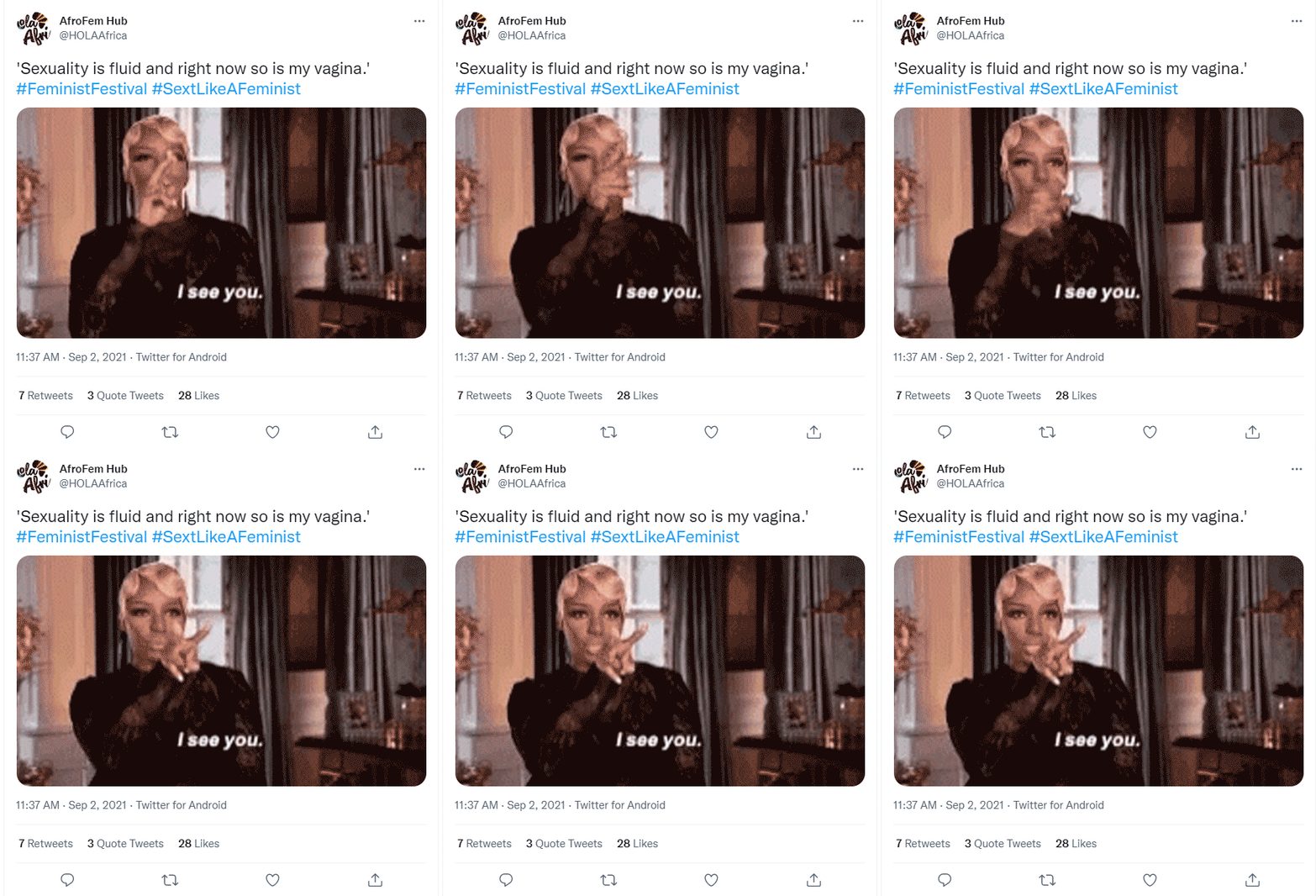
#2 - Sexting like a feminist Tweets Snippet AR

ما الضير في وصف مُتقَن للمشهديّة؟

للجنسانيّة تدفّقات متعدّدة ومتبدّلة كحال الغمد الملتهب بين فخذَيّ

Snippet - Take the quiz

Take the Quiz!

"Where is the money for feminist organizing?"

How much do you know about feminist resourcing? 📊 Take AWID's "Where is the Money for Feminist Organizing?" quiz to test your knowledge:


Take the quiz onlineDownload and print it


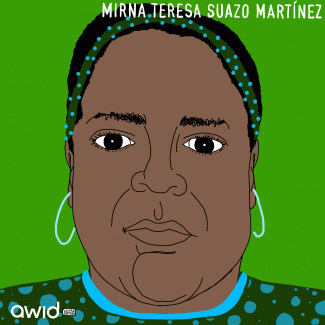
Mirna Teresa Suazo Martínez

Mirna Teresa Suazo Martínez faisait partie de la communauté garifuna (afro-descendante et autochtone) Masca et vivait sur la côte nord des Caraïbes du Honduras. Elle était leader de sa communauté et fervente défenseure du territoire autochtone, une terre qui a été violée le jour où l'Institut national agraire du Honduras a accordé des licences territoriales à des personnes extérieures à la communauté. 

Ce fait déplorable a été à l'origine de harcèlements, d'abus et de violences répétés contre Masca, où les intérêts économiques de différents groupes se sont heurtés à ceux des forces armées et des autorités honduriennes. Selon l'Organisation fraternelle noire du Honduras (OFRANEH), la stratégie de ces groupes consiste à expulser et exterminer la population autochtone. 

« Masca, la communauté garifuna située près de la vallée du Cuyamel, se trouve dans la zone d’influence de l’une des villes présumées modèles, une situation qui a déclenché des pressions territoriales le long de la côte garifuna. » - OFRANEH, 8 septembre 2019

Mirna Teresa, présidente du conseil d'administration de la communauté de Masca à Omoa, avait elle aussi fermement rejeté la construction de deux centrales hydroélectriques sur la rivière Masca, qui porte le même nom que sa communauté.

« La communauté garífuna attribue l'aggravation de la situation dans leur région à son opposition à l'exploitation touristique, à la monoculture de palmiers africains et au trafic de drogue, tandis qu'elle cherche parallèlement à construire une vie alternative au travers de la culture de la noix de coco et d'autres produits d'autoconsommation ». - Voces Feministas, 10 septembre 2019 

Mirna Teresa a été assassinée le 8 septembre 2019 dans son restaurant « Champa los Gemelos ». 

Elle est l'une des six femmes défenseures garifunas à avoir été assassinées rien qu'entre septembre et octobre 2019. Selon l'OFRANEH, les autorités n'ont pas mené d'enquête sur ces crimes.

« En ce qui concerne les communautés garífuna, une grande partie des homicides sont liés au régime foncier et à la gestion des terres. Cependant, les querelles entre les organisations criminelles ont abouti à des meurtres, à l’instar de ceux ayant eu lieu récemment à Santa Rosa de Aguán ». - OFRANEH, 8 septembre 2019

Nana Abuelsoud

Biography

Nana is a feminist organizer and a reproductive rights and population policy researcher based in Egypt. She is a member of Realizing Sexual and Reproductive Justice (RESURJ), a member of the Advisory Board of the A Project in Lebanon, and a member of the Community Committee of Mama Cash. Nana holds an MSc in Public Health from KIT Institute and Vrije University in Amsterdam. In her work, she follows and contextualizes national population policies while building evidence that addresses modern eugenics, regressive international aid, and authoritarianism. Previously, she was part of the Geneva Foundation for Medical Education and Research, the Egyptian Initiative for Personal Rights, and Ikhtyar Feminist Collective in Cairo.

Add to stories
Off

Upasana Agarwal

Upasana Agarwal

Upasana est un·e illustrateurice et artiste non binaire basé·e à Kolkata, en Inde. Son travail explore l'identité et les récits personnels en partant d’un vestige visuel ou d’une preuve des contextes avec lesquels iel travaille. Iel est particulièrement attiré·e par les motifs qui, selon Upasana, communiquent des vérités complexes sur le passé, le présent et l'avenir.  Quand Upasana n'est pas en train de dessiner, iel organise et dirige un centre d'art communautaire queer et trans dans la ville.

Visiter l’exposition

WITM - Refreshed Intro Text - ES

🚨Nuevo informe disponible en inglés🚨

¿Dónde está el dinero? Un llamado basado en evidencia a dotar de recursos a las organizaciones feministas

Este nuevo informe revela las realidades de los recursos de las organizaciones feministas y por los derechos de las mujeres en una época de turbulencias políticas y económicas sin precedentes. A partir de un análisis de más de una década desde el último informe de AWID ¿Dónde está el dinero? (Regando las hojas, dejando morir las raíces), se hace un balance de las conquistas, las brechas y las amenazas crecientes en el panorama del financiamiento.

En el informe se celebra el poder las iniciativas de los movimientos para configurar la dotación de recursos en sus propios términos y, a la vez, se da la voz de alarma sobre los recortes masivos de las ayudas, el declive de la filantropía y el aumento de las reacciones adversas. 

Se hace un llamado a los donantes para que inviertan copiosamente en las organizaciones feministas, pues estas son la infraestructura esencial para la justicia y la liberación. También se invita a los movimientos a reinventar modelos audaces y autodefinidos para una dotación de recursos fundada en el cuidado, la solidaridad y el poder colectivo.

¡Descarga el informe! (en inglés)

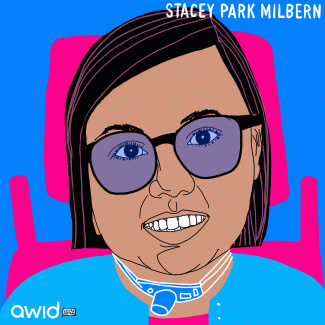
Stacey Park Milbern

“I do not know a lot about spirituality or what happens when we die, but my crip queer Korean life makes me believe that our earthly bodyminds is but a fraction, and not considering our ancestors is electing only to see a glimpse of who we are.” - Stacey Park Milbern

Stacey Park Milbern was a self-identifying queer disabled woman of colour and a trailblazer. A long-standing and respected organizer and leader in the disability rights and justice movement, she also advocated for the rights of many different communities, not just her own. Stacey’s activism had mighty roots in her experience at the intersections of gender, disability, sexuality and race.

Stacey, along with some friends, co-created the Disability Justice Culture Club, a group working to support various and especially vulnerable communities, including helping homeless people gain access to resources during the COVID-19 pandemic. 

She was also a co-producer of an impact campaign for Netflix’s documentary “Crip Camp”, a board member of the WITH Foundation, and led organizations at local, state and national levels. Stacey wrote beautifully and powerfully:

“My ancestors are people torn apart from loves by war and displacement. It’s because of them I know the power of building home with whatever you have, wherever you are, whoever you are with. My ancestors are queers who lived in the American South. It’s because of them I understand the importance of relationships, place and living life big, even if it is dangerous. All of my ancestors know longing. Longing is often our connecting place...” - Stacey Park Milbern

She was born in Seoul, Korea and grew up in North Carolina, later  continuing her journey in the San Francisco Bay Area. Stacey passed away of complications from surgery on her 33rd birthday on 19 May 2020. 


Read an essay by Stacey Park Milbern
Listen to an interview with Stacey Park Milbern
#StaceyTaughtUs: Record your story for the Disability Visibility Project

Tributes:

“She was, a lot of people would say, a leader. She kind of encompassed all of it. You know, sometimes there's like a lead from the front, lead from the middle, lead from the back. And she was just somehow able to do all of that.” - Andraéa LaVant, disability rights activist

“What a blow to lose Stacey when our communities need her leadership more than ever, and at a time when her strength, insight, and grit were receiving increased recognition outside of disability circles, giving her a greater platform to advance her life’s work...We will not have the gift of learning where her charismatic leadership would have taken us. But let there be no doubt: What Stacey gave us, in a relatively short time, will continue benefiting others for years to come.” - Disability Rights Education and Defense Fund (DREDF)

How did AWID get started?

AWID began in 1982 and has grown and transformed since then into a truly global organization.

Find out more:

Read From WID to GAD to Women's Rights: The First 20 Years of AWID

Interesting References

Explore these projects put together by AWID teams to promote feminist advocacy and perspectives.

Snippet - COP30 - The People's Summit - ES

La Cumbre de los Pueblos

La cumbre por el clima organizada por y para los movimientos.

📅 12 - 16 de noviembre de 2025
📍 Universidad Federal de Pará, Belém

Más información aquí

¿En qué temas trabaja AWID?

AWID trabaja para lograr la justicia de género y la realización de los derechos de las mujeres de todo el mundo.

Trabajamos para fortalecer las voces y el impacto de lxs activistas, organizaciones y movimientos por los derechos de las mujeres.

Las áreas prioritarias de AWID se relacionan con temas estrechamente vinculados con tendencias globales dominantes. Estos temas reflejan los crecientes desafíos que afectan negativamente a los derechos de las mujeres en todo el mundo.

  • Justicia Económica
  • Recursos para los Derechos de las Mujeres
  • Desafiando los Fundamentalismos Religiosos
  • Defensoras de los Derechos Humanos
  • Activismo Joven Feminista

Más información sobre las áreas prioritarias de AWID

Snippet Welcome Message_Fest (ES)

Mensaje de Bienvenida

Hakima Abbas, AWID

"Estamos utilizando las herramientas que tenemos para compartir nuestra resistencia, nuestras estrategias y continuar edificando nuestro poder para actuar y crear nuevos mundos valientes y justos"

ver video (inglés)

Snippet - COP30 - Resistance Hubs Section Title - FR

Pôles de résistance pour la justice climatique