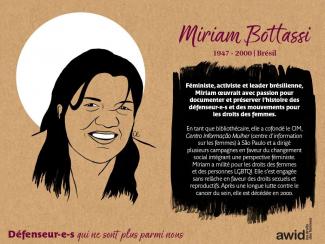
Miriam Bottassi
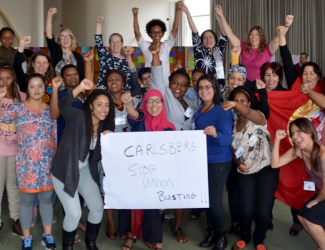
Women human rights defenders (WHRDs) worldwide defend their lands, livelihoods and communities from extractive industries and corporate power. They stand against powerful economic and political interests driving land theft, displacement of communities, loss of livelihoods, and environmental degradation.
Extractivism is an economic and political model of development that commodifies nature and prioritizes profit over human rights and the environment. Rooted in colonial history, it reinforces social and economic inequalities locally and globally. Often, Black, rural and Indigenous women are the most affected by extractivism, and are largely excluded from decision-making. Defying these patriarchal and neo-colonial forces, women rise in defense of rights, lands, people and nature.
WHRDs confronting extractive industries experience a range of risks, threats and violations, including criminalization, stigmatization, violence and intimidation. Their stories reveal a strong aspect of gendered and sexualized violence. Perpetrators include state and local authorities, corporations, police, military, paramilitary and private security forces, and at times their own communities.
AWID and the Women Human Rights Defenders International Coalition (WHRD-IC) are pleased to announce “Women Human Rights Defenders Confronting Extractivism and Corporate Power”; a cross-regional research project documenting the lived experiences of WHRDs from Asia, Africa and Latin America.
"Women Human Rights Defenders confronting extractive industries: an overview of critical risks and Human Rights obligations" is a policy report with a gender perspective. It analyses forms of violations and types of perpetrators, quotes relevant human rights obligations and includes policy recommendations to states, corporations, civil society and donors.
"Weaving resistance through action: Strategies of Women Human Rights Defenders confronting extractive industries" is a practical guide outlining creative and deliberate forms of action, successful tactics and inspiring stories of resistance.
The video “Defending people and planet: Women confronting extractive industries” puts courageous WHRDs from Africa, Asia, and Latin America in the spotlight. They share their struggles for land and life, and speak to the risks and challenges they face in their activism.
Challenging corporate power: Struggles for women’s rights, economic and gender justice is a research paper outlining the impacts of corporate power and offering insights into strategies of resistance.
AWID acknowledges with gratitude the invaluable input of every Woman Human Rights Defender who participated in this project. This project was made possible thanks to your willingness to generously and openly share your experiences and learnings. Your courage, creativity and resilience is an inspiration for us all. Thank you!
Brenda Salas Neves es une estratega feminista queer nacide y criade en los Andes del Sur. Elle trabaja en la organización para el cambio de narrativas y movilizar recursos para apoyar los movimientos de justicia racial y climática en todo el mundo. Ha producido proyectos mediáticos para potenciar el poder de la población migrante y alzarse contra la intervención militar estadounidense en toda América Latina, con Deep Dish TV y el Comité de Solidaridad con Centroamérica de Portland. Elle es une orgullose integrante del Proyecto Audre Lorde y egresade del movimiento de los United World Colleges (UWC).
 La Cubierta
|
 La Poderosa
|
 La Hiedra
|
 El Aullido
|
Producción y emprendimiento |
 Artisana
|
Sauf si vous avez des problèmes d’accessibilité et/ou que vous répondez aux questions de l’enquête dans une autre langue, nous vous encourageons fortement à utiliser KOBO pour une collecte et une analyse standardisées des données WITM.
Rachel es una profesional financiera con más de dos décadas de experiencia. Ha supervisado negocios y proyectos financieros para entidades privadas y públicas, organizaciones sin fines de lucro y organizaciones internacionales no gubernamentales. Es una contadora pública con una maestría global en administración de empresas, e integra el instituto sudafricano de contadores públicos. En su tiempo libre, Rachel diseña arte tipográfico, y disfruta de viajar y de pasar tiempo con familia y amigues con una botella de vino.
Yes, we invite you to share more on issues that are important to you by responding to the open question(s) at the end of the survey.
Nous Sommes la Solution est un mouvement de femmes rurales pour la souveraineté alimentaire en Afrique de l'Ouest. Fondée à l'origine comme une campagne contre l'agriculture hyper-industrialisée, Nous Sommes la Solution est devenue un mouvement de plus de 500 associations de femmes rurales du Burkina Faso, du Sénégal, du Ghana, de la Gambie, de la Guinée Bissau, du Mali et de la Guinée.
Ensemble, ce mouvement dirigé par des femmes construit et renforce la souveraineté alimentaire et semencière en Afrique de l'Ouest. Elles nourrissent les communautés, renforcent les économies locales, amplifient les connaissances des agricultrices et atténuent les effets dévastateurs du changement climatique grâce aux pratiques de l'agroécologie. Elles organisent également des ateliers, des forums et des émissions de radio communautaires pour partager leurs messages, leurs connaissances traditionnelles et leurs pratiques agroécologiques dans les communautés rurales.
En collaboration avec des universités et des centres de recherche publics, Nous Sommes la Solution travaille à la restauration des variétés indigènes traditionnelles de riz (un aliment de base en Afrique de l'Ouest) et à la promotion d'économies alimentaires locales basées sur des principes agroécologiques pour influencer l'élaboration des politiques nationales, tout en soutenant les femmes dans la création d'associations agricoles et leur accès à la propriété et à la gestion collectives des terres agricoles.

Los datos se procesarán para fines estadísticos y así arrojar luz sobre el estado de la dotación de recursos para los movimientos feministas de todo el mundo, y solo se exhibirán de forma desglosada. AWID no divulgará información acerca de ninguna organización en particular ni publicará información que permita identificar a una organización por su ubicación o características sin el consentimiento acreditado de dicha organización.
The main focus of our work is global. We also work closely with members and other women’s rights organizations and allies at the local, national and regional levels so that their realities inform our work.

Non. L’enquête s’appuie sur les 20 années de mobilisation de l’AWID dans l’objectif d’obtenir davantage de financement de meilleure qualité pour des changements sociaux menés par des féministes. Cette enquête est la troisième édition de la recherche Où est l’argent pour l’organisation des mouvements féministes? Notre objectif est de mener une enquête WITM tous les 3 ans.