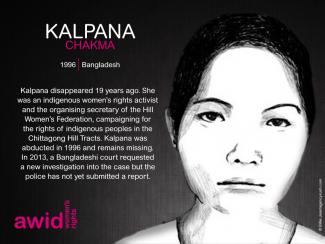
Kalpana Chakma
Over the past few years, a troubling new trend at the international human rights level is being observed, where discourses on ‘protecting the family’ are being employed to defend violations committed against family members, to bolster and justify impunity, and to restrict equal rights within and to family life.
The campaign to "Protect the Family" is driven by ultra-conservative efforts to impose "traditional" and patriarchal interpretations of the family, and to move rights out of the hands of family members and into the institution of ‘the family’.
Since 2014, a group of states have been operating as a bloc in human rights spaces under the name “Group of Friends of the Family”, and resolutions on “Protection of the Family” have been successfully passed every year since 2014.
This agenda has spread beyond the Human Rights Council. We have seen regressive language on “the family” being introduced at the Commission on the Status of Women, and attempts made to introduce it in negotiations on the Sustainable Development Goals.
AWID works with partners and allies to jointly resist “Protection of the Family” and other regressive agendas, and to uphold the universality of human rights.
In response to the increased influence of regressive actors in human rights spaces, AWID joined allies to form the Observatory on the Universality of Rights (OURs). OURs is a collaborative project that monitors, analyzes, and shares information on anti-rights initiatives like “Protection of the Family”.
Rights at Risk, the first OURs report, charts a map of the actors making up the global anti-rights lobby, identifies their key discourses and strategies, and the effect they are having on our human rights.
The report outlines “Protection of the Family” as an agenda that has fostered collaboration across a broad range of regressive actors at the UN. It describes it as: “a strategic framework that houses “multiple patriarchal and anti-rights positions, where the framework, in turn, aims to justify and institutionalize these positions.”
Actualmente, una compleja red de actores anti-derechos, en constante evolución, está ejerciendo cada vez más influencia tanto en los espacios internacionales y regionales, como en las políticas nacionales. Los actores anti-derechos están ingresando en los espacios multilaterales (donde múltiples países se reúnen para la colaboración internacional), con el fin de transformarlos y socavarlos desde adentro. Emplean una variedad de discursos persuasivos para ganar legitimidad, a menudo cooptando el lenguaje de los derechos y la justicia para ocultar sus verdaderas agendas.
Este informe es el segundo de una serie de reportes sobre las tendencias en derechos humanos, producido por el Observatorio de la Universalidad de los Derechos (OURs, por sus siglas en inglés). Además del análisis sobre actores anti-derechos clave y sus discursos, estrategias e impactos, el informe presenta breves narrativas inspiradoras de acción feminista y ejercicios de construcción de conocimiento para ayudar a fortalecer nuestra resistencia colectiva.
El efecto sobre nuestros derechos ya ha sido grave, pero esto no ha terminado todavía. Todxs podemos hacer nuestra parte para resistir las agendas anti-derechos y reclamar nuestros derechos.
¡Únete hoy mismo al llamado a la acción colectiva!
Don't know where to start? Let's try understanding the filters.
Maritza Quiroz Leiva fue una activista social afrocolombiana, líder comunitaria y defensora de los derechos humanos de las mujeres. Como una de las 7,7 millones de colombianxs desplazadxs internamente por 50 años de conflicto armado, Maritza dedicó su trabajo de incidencia a apoyar los derechos de otras personas, en particular dentro de la comunidad afrocolombiana, que sufrían similares desplazamientos y violaciones de derechos.
Maritza era líder adjunta del Comité de Víctimas de Santa Marta, y una voz importante para quienes buscaban justicia en su comunidad, exigiendo reparaciones por las torturas, los secuestros, los desplazamientos y la violencia sexual que experimentaban las víctimas durante el conflicto armado. También trabajó activamente en el movimiento nacional por la redistribución de la tierra y la justicia agraria.
El 5 de enero de 2019 Maritza fue asesinada por dos individuos armados que irrumpieron en su casa. Tenía 60 años.
Maritza se sumó así a lxs otrxs cinco activistas y líderes sociales colombianxs que fueron asesinadxs durante la primera semana de 2019. En Colombia, ese año fueron asesinadxs un total de 107 defensorxs de derechos humanos.

How does a movement start?
we get expelled by ghosts from a house, a family, and a nation
we arrive fatigued to a space (sometimes an actual address) but mainly to a state of being
preceded by a fallen star
perhaps our arrival isn’t accompanied by fatigue,
maybe accompanied by fear
perhaps our arrival isn’t accompanied by fear
maybe accompanied by anger
from issues that keep on repeating themselves:
a stab in the heart (read heartache)
a bullet in the back (read betrayal)
forced disappearances
bodies sentenced by marriage, disfiguration, and chronic fatigue
yet when we arrive, we gather, whisper, speak and weep.
This is how our movements begin when we arrive at each other
We become seeds,
This is how our movements start when we plant each other
Becoming flowers, sometimes just thorns, sometimes fruits,
we are each other’s oasis
to sing for the battles
to make remedies
to place the faces of our lovers, the shape of their smiles, the sound of their laughter
the secret of turning silences into language
the detailed instructions of witches
our movement is: for all of us
when we arrive as seeds with the purpose of flowering.
Sara AbuGhazal
www.badiya.blog
AWID does not provide group discounts, but we do provide registration discounts to members. (Click here to learn more about becoming a member)
Les antidroits ont adopté une double stratégie : outre leurs attaques ouvertes sur le système multilatéral, ils et elles sapent les droits humains depuis l’intérieur. Leur implication vise à prendre le contrôle des processus, instaurer des normes régressives et fragiliser la redevabilité.
If your funding institution is already a part of the Database and you would like to contact us to update your record, or if you would like to leave some feedback for us, please use the form above.
Roxana Reyes Rivas, était une philosophe, féministe, lesbienne, poétesse, politicienne et activiste pour les droits des personnes LGBT et des femmes du Costa Rica. Auteure à la plume acérée et à l’humour incisif, elle était irrésistiblement drôle. Née en 1960 et élevée à San Ramón dans la province d’Alajuela, qui était encore une localité rurale à l’époque, elle a toute sa vie refusé d’adhérer aux attentes envers « les femmes ».
Avec le groupe de lesbiennes costariciennes El Reguero, Roxana a organisé pendant plus de dix ans des festivals lesbiens, de joyeux espaces de formation où se rassembler à une époque où le gouvernement du Costa Rica et la société persécutaient et pénalisaient l’existence des lesbiennes. Ces festivals lesbiens étaient, pour des centaines de femmes, le seul endroit où elles pouvaient être elles-mêmes et se regrouper avec leurs semblables.
Roxana aimait répéter que la formation de partis politiques comptait parmi ses passe-temps. « Il est important que les gens comprennent qu’il y a d’autres manières de faire de la politique, et que de nombreuses questions doivent être résolues collectivement. » Elle fut également l’une des fondatrices des partis Nueva Liga Feminista et VAMOS, centrés sur les droits humains.
« La philosophie est faite pour bousculer, pour aider les gens à se poser des questions. Une philosophe qui n’irrite personne ne fait pas son travail. » Pendant 30 ans, Roxana a enseigné la philosophie dans plusieurs universités publiques du Costa Rica. Des générations d’étudiant·e·ss ont suivi ses directives et réfléchi aux dilemmes éthiques que posent la science et les technologies.
L’outil de prédilection de Roxana était l’humour. Elle a créé le prix de l’ignorance La Citrouille étincelante, qu’elle décernait à des personnalités publiques sur ses réseaux sociaux, tournant en dérision leurs expressions et déclarations anti-droits.
Roxana a été emportée par un cancer agressif fin 2019, avant qu’elle ne puisse publier son recueil de poèmes, qu’elle aurait voulu être le cadeau de départ de l’esprit créatif d’une féministe qui a toujours élevé sa voix contre l’injustice.

Lorsque des milliers de féministes se réunissent, nous créons une grande force de solidarité qui a le pouvoir de changer le monde. Le Forum de l’AWID sera pour nous un moment de repos et de guérison ensemble, de connexion au-delà des frontières et de découverte de nouvelles orientations stratégiques courageuses.
La date et le lieu seront annoncés l'année prochaine, dès que possible. Nous sommes ravi.es et nous savons que vous le serez aussi. Restez à l'écoute!
Assurez-vous de nous suivre sur les médias sociaux et de vous inscrire à notre liste de diffusion pour rester informé!
Reconocemos que el viaje involucra muchos desafíos y por eso brindaremos más información y detalles sobre cómo llegar a Bangkok cuando abramos el proceso de inscripción a principios del próximo año.
Want to join the growing numbers of people saying “enough” to the infiltration of the UN by anti-rights actors?
In contrast, over $1 billion went to three anti-rights groups 2021-2022, with funding for anti-gender networks still rising.1
1 Global Philanthropy Project, 2024
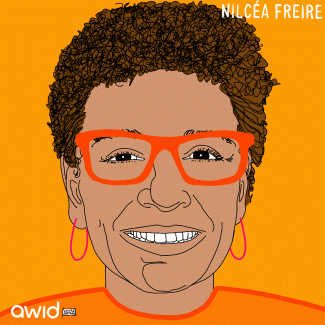
Nilcéa Freire was a Brazilian feminist activist, politician and academic. A persevering advocate for women’s rights and those of underrepresented minorities in the country, her life and work carried a long history of struggles and victories.
"While resisting we have to keep pushing for progress, and what we can achieve at this time, in my view, will be through the stupendous organization of young white women, and especially black women, in all of the state capitals and large cities of Brazil." - Nilcéa Freire
In 1999 she became the first woman to occupy the position of Dean at the State University of Rio de Janeiro. Here, she spearheaded the implementation of the first affirmative action policy for students graduating from public schools, requiring reserved places specifically for low-income black students in a public university. This system was adopted in dozens of other public universities.
Some years later, Nilcéa headed the Special Secretariat of Policies for Women in the government of former president Luiz Inácio Lula da Silva. In this capacity, she led the first National Women’s Conference. Over 12,000 women from across the country participated and the result of this collective work was embodied in the National Plan for Policies for Women.
Her commitment to women, Afro-Brazilians and indigenous peoples was also strongly reflected in her work to promote their rights through initiatives of the Brazil Ford Foundation office where she was a regional director.
The feminist activist Manoela Miklos recounted Nilcéa to be "a woman without equal".
At the age of 66, Nilcéa passed away in Rio de Janeiro on 29 December 2019 of cancer.
"Without words for the news of the death of dear Nilcea Freire. It is too sad to know that she left so early. She was always part of the ranks of those who do not settle for the injustices of the world. She was the Minister of Women, an activist, always active in the feminist cause. Much missed!” - Jandira Feghali, Federal Deputy
Watch Brazilian feminist Nilcea Freire on why we need to show solidarity with Brazil
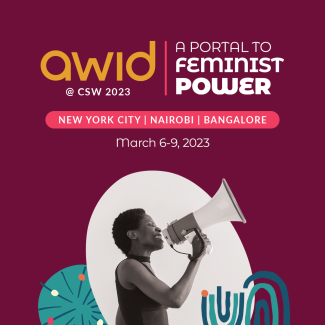
Imagine opening a door which takes you into a conversation with feminist activists in other continents. This portal will transcend the barriers of UN CSW by pushing beyond language barriers, unaffordable travel, unequal protection from COVID19, and racist visa regimes.
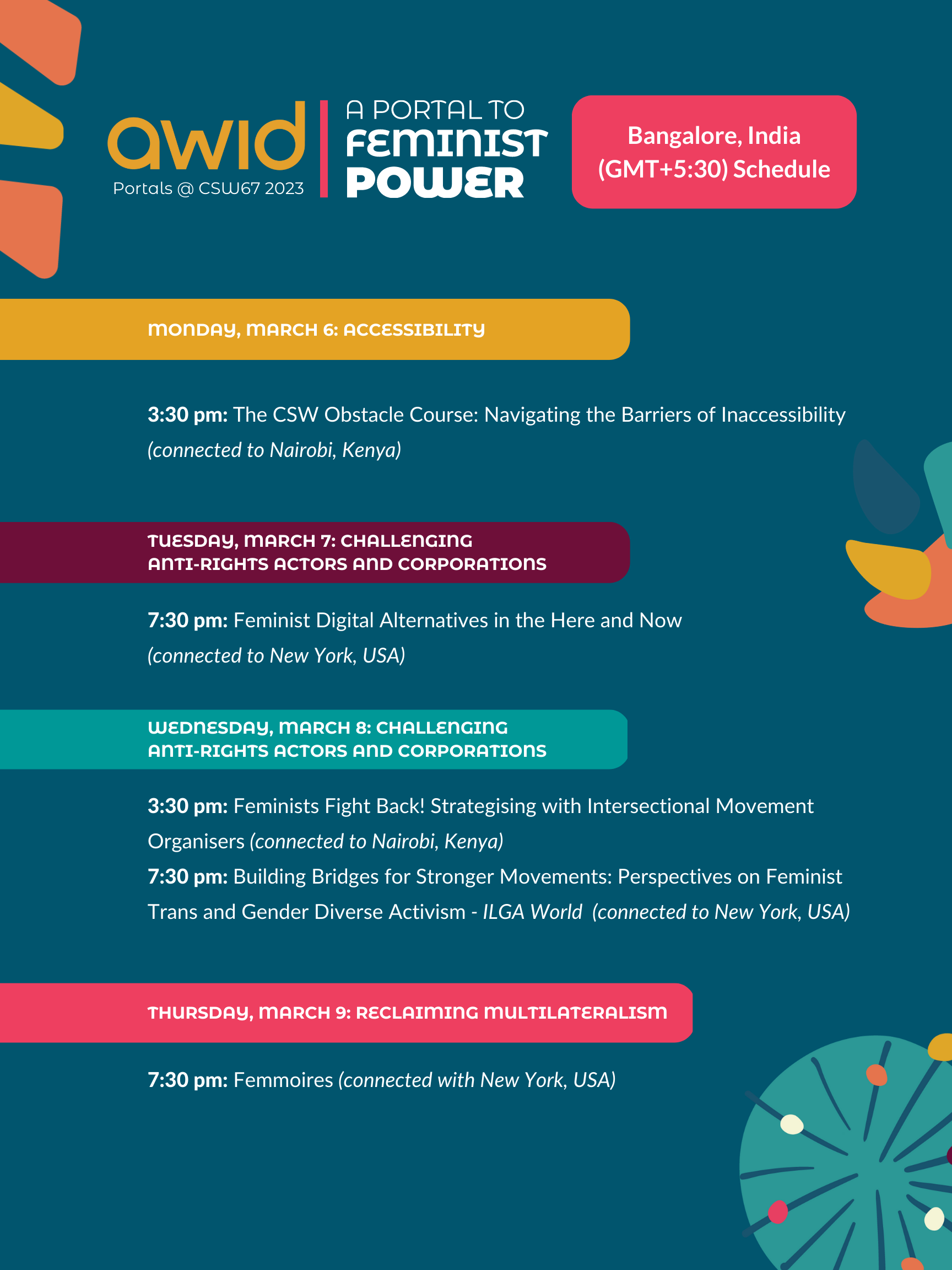
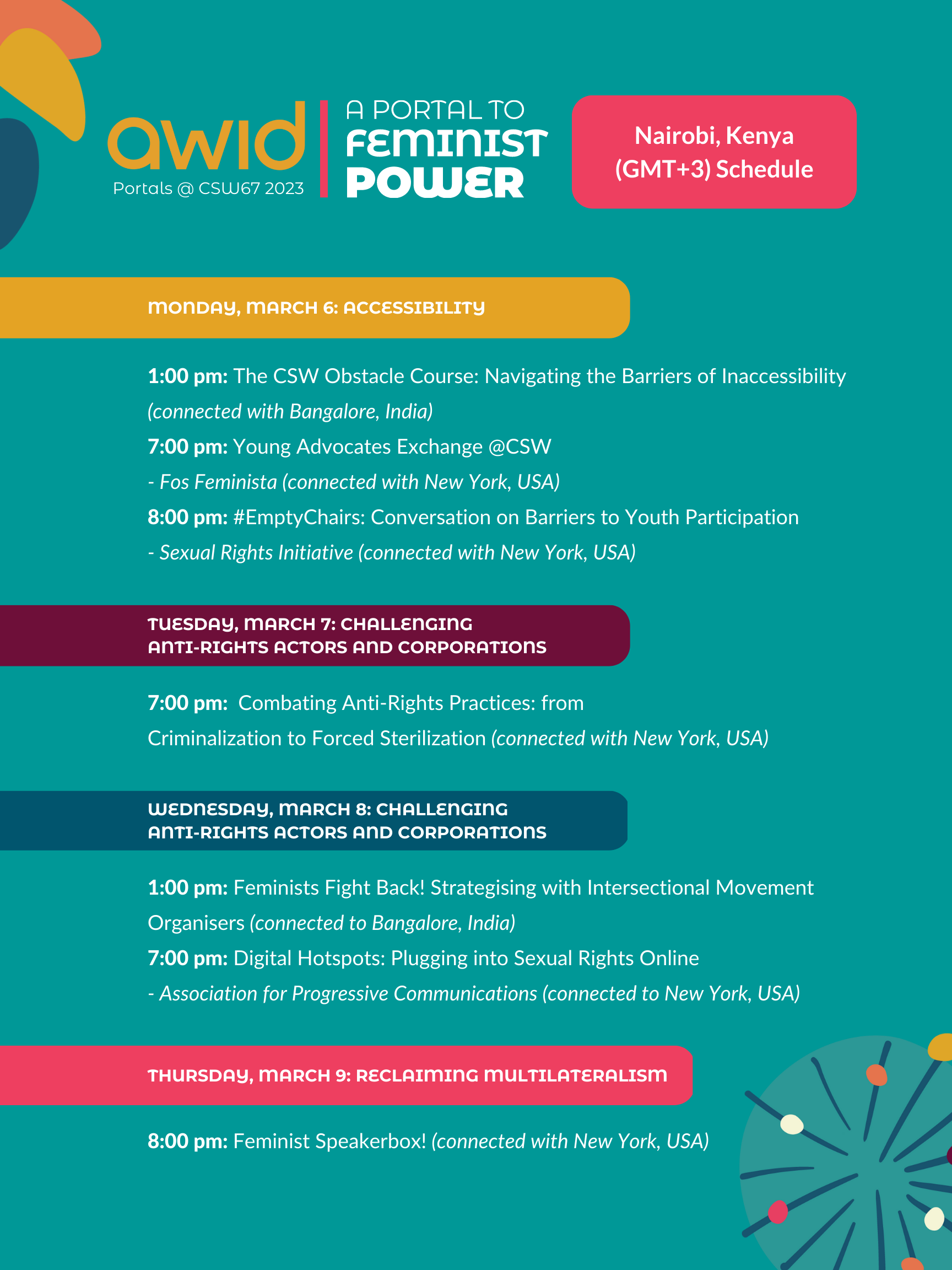
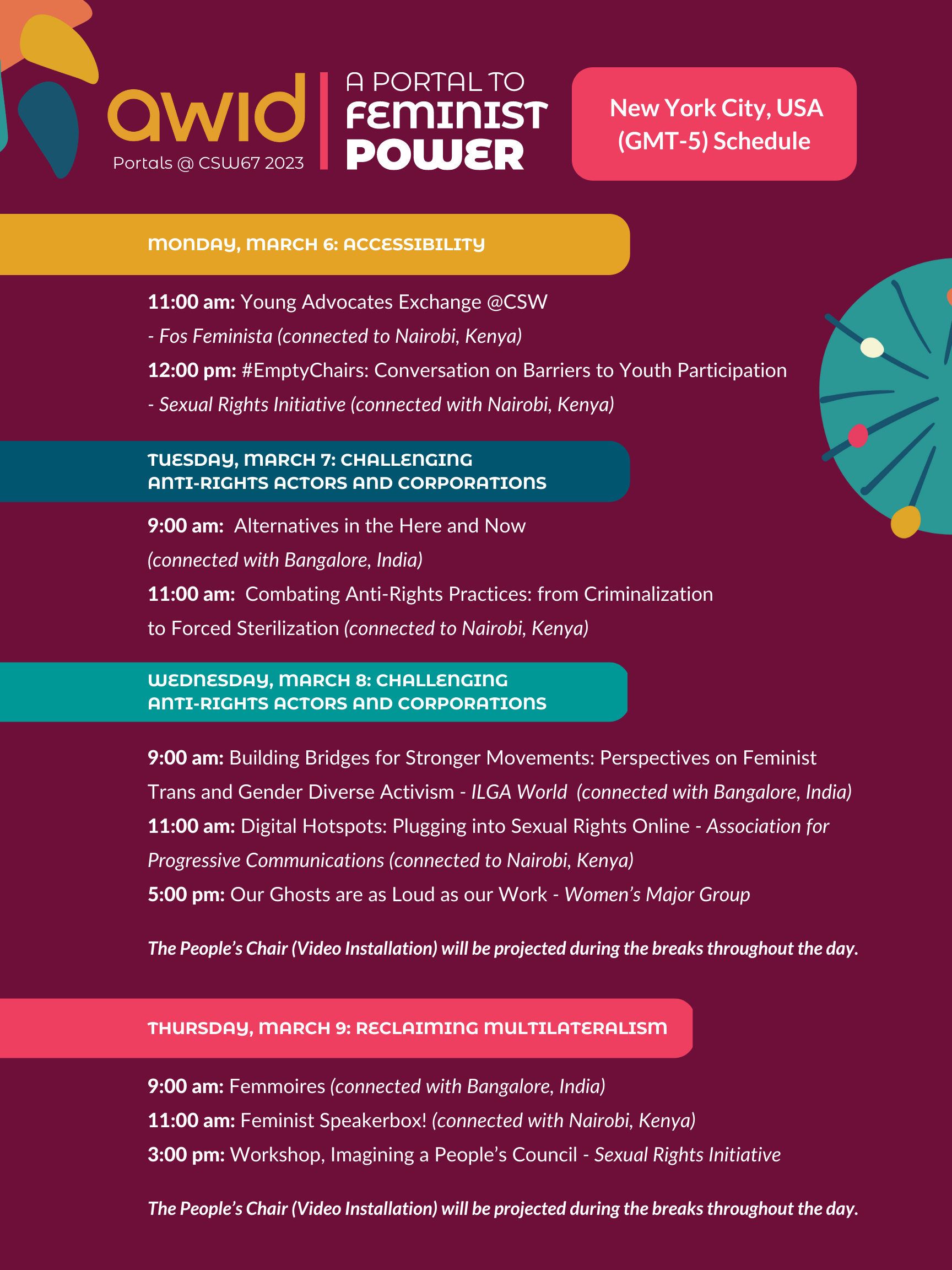
This week, we’re putting a virtual spin on CSW by connecting and amplifying feminist activists' voices, to challenge the discriminatory barriers that limit participation and influence. By setting up connecting “portals” in New York City, Nairobi & Bangalore, we'll host a physical-virtual hybrid space for feminists to connect their struggles and build collective power.
Day 1: March 6 - Accessibility
Day 2: March 7- Challenging Anti-Rights Actors And Corporations
Day 3: March 8 - Challenging Anti-Rights Actors And Corporations
Day 4: March 9- Reclaiming Multilateralism
Download full program here (PDF)
Bangalore Schedule (PNG) Nairobi Schedule (PNG) New York City Schedule (PNG)