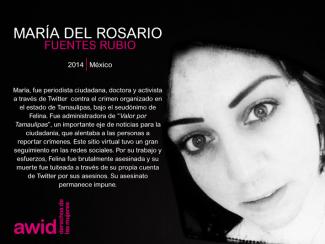
Maria del Rosario Fuentes Rubio
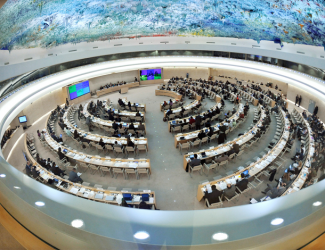
The Human Rights Council (HRC) is the key intergovernmental body within the United Nations system responsible for the promotion and protection of all human rights around the globe. It holds three regular sessions a year: in March, June and September. The Office of the UN High Commissioner for Human Rights (OHCHR) is the secretariat for the HRC.
Debating and passing resolutions on global human rights issues and human rights situations in particular countries
Examining complaints from victims of human rights violations or activist organizations on behalf of victims of human rights violations
Appointing independent experts (known as “Special Procedures”) to review human rights violations in specific countries and examine and further global human rights issues
Engaging in discussions with experts and governments on human rights issues
Assessing the human rights records of all UN Member States every four and a half years through the Universal Periodic Review
AWID works with feminist, progressive and human rights partners to share key knowledge, convene civil society dialogues and events, and influence negotiations and outcomes of the session.
Marta is a queer, transfeminist non-binary activist-researcher from ex-Yugoslavia, currently based in Barcelona. They work as a transnational movement organizer, a feminist economist and a weaver of systemic alternatives. They are the co-founder and one of the coordinators of the Global Tapestry of Alternatives, a global process that seeks to identify, document and connect alternatives on local, regional and global levels. Locally, they are engaged in anti-racist, transfeminist, queer, migrant organizing. They also hold a doctoral degree in Environmental Science and Technology from the Autonomous University of Barcelona, dedicated to decolonial feminist perspectives of a pluriverse of systemic alternatives and the creation of feminist alternative systems based on care and the sustainability of life. During their free time, they enjoy boxing, playing the guitar and the drums as part of a samba band, photography, hiking, cooking for loved ones and spoiling their two cats.
Metzineres


The survey is available in: Arabic, English, French, Portuguese, Russian and Spanish!
Elina es una joven feminista afrodominicana, que trabaja con enfoque interseccional. Es abogada de derechos humanos y está comprometida a usar su voz y sus capacidades para construir un mundo más justo, empático e inclusivo. Ingresó a la facultad de derecho a los 16 años, segura de que iba a obtener herramientas para entender y promover la justicia social. Luego de obtener el título de Juris Doctor [Doctora en Jurisprudencia] en la República Dominicana, cursó una maestría en Derecho Internacional Público y Derechos Humanos en el Reino Unido, como becaria Chevening. Fue la única mujer latinoamericana-caribeña en su clase y se graduó con honores.
Elina ha trabajado en la intersección de derechos humanos, género, migración y política en el gobierno, en colectivos de base y en organizaciones internacionales. Colaboró en el litigio de casos sobre violencia de género ante la Corte Interamericana de Derechos Humanos. Como integrante del Panel Consultivo de Jóvenes de UNFPA, contribuyó al fortalecimiento de los derechos sexuales y reproductivos en la República Dominicana. Fue una de las personas que lideraron la primera campaña de Amnistía Internacional sobre derechos de lxs trabajadorxs sexuales en las Américas, desarrollando una fuerte asociación con las organizaciones de trabajadorxs sexuales, y utilizando la posición de Amnistía para potenciar las voces de quienes defienden los derechos humanos de las mujeres y de lxs trabajadorxs sexuales. Elina es parte del Foro Feminista Magaly Pineda y la Global Shapers Community [Comunidad Global Shapers]. Habla español, francés e inglés.
Gracias a su diversificada trayectoria, Elina trae sólidas capacidades de gobernanza y de planificación estratégica, una experiencia sustancial en las Naciones Unidas y en mecanismos regionales de derechos humanos, además de su profunda determinación para que AWID siga siendo una organización inclusiva para todas las mujeres, especialmente, las feministas jóvenes y caribeñas. Con estas propuestas, se suma a una hermandad global de feministas fantásticas, desde donde podrá seguir cultivando su liderazgo feminista y nunca más se sentirá sola en su camino.
|
383 personas. |
La encuesta mundial ¿Dónde está el dinero? es un pilar fundamental de la tercera edición de nuestra investigación orientada a la acción: ¿Dónde está el dinero para las organizaciones feministas? (abreviadamente, ¿Dónde está el dinero? y WITM). Los resultados de la encuesta se desarrollarán y analizarán en mayor profundidad mediante conversaciones exhaustivas con activistas y donantes, y se contrastarán con otros análisis e investigaciones disponibles acerca del estado del financiamiento para las organizaciones feministas y por la igualdad de género en todo el mundo.
El informe completo ¿Dónde está el dinero para las organizaciones feministas? se publicará en 2026.
 Para conocer más información acerca de cómo AWID ha arrojado luz sobre el dinero destinado en favor y en contra de los movimientos feministas, consulta nuestra historia ¿Dónde está el dinero? y nuestros informes anteriores aquí.
Jessica est une artiste-activiste queer de Toronto, au Canada, mais qui vit actuellement en Bulgarie. Elle a plus de 15 ans d'expérience dans la riposte au VIH, travaillant aux intersections du genre et du VIH auprès de populations clés (travailleurs·ses du sexe, femmes consommatrices de drogues, communautés LGBTQI, personnes incarcérées et, bien sûr, personnes vivant avec le VIH). Jessica aime créer du mouvement et réfléchir/entreprendre/élaborer des stratégies sur des interventions basées sur les arts. L'un des projets amusants qu'elle a lancé en 2013 était LOVE POSITIVE WOMEN (Femmes positives à l’amour), qui implique plus de 125 groupes et organisations communautaires du monde entier, du 1er au 14 février, pour célébrer les femmes vivant avec le VIH dans leurs communautés.
 La Cubierta
|
 La Poderosa
|
 La Hiedra
|
 El Aullido
|

Producción y emprendimiento |
 Artisana
|
The key objective of the WITM survey is to shine light on the financial status of diverse feminist, women’s rights, gender justice, LBTQI+ and allied movements globally. Based on this, we hope to further strengthen the case for moving more and better money, as well as shift power, to feminist movements.
Related content
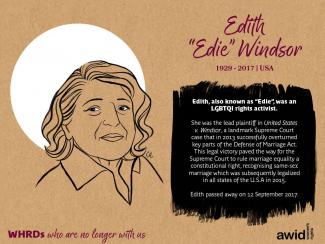
The Guardian: Edith Windsor, icon of gay rights movement, dies aged 88
Rolling Stone: Edith Windsor, Same-Sex Marriage Activist, Dead at 88
BBC: Edie Windsor: Gay rights trailblazer dies aged 88
The New Yorker: Postscript: Edith Windsor, 1929-2017
The Guardian: Goodbye, Edie Windsor. Thank you for never giving up
Love and Justice: Edith Windsor talks with Ariel Levy - The New Yorker Festival - The New Yorker (Video)
Remembering Edie Windsor (Video)
Leila is a transnational feminist leader, strategist, and advisor with over 25 years of organizing, advocacy and philanthropic experience advancing human rights, gender equality, and sexual and reproductive rights and justice. She was born in Algeria and educated in the U.S., France, and Morocco; over her professional career, she has lived and worked in forty countries across Africa, Europe, Latin America and Asia. Leila currently serves as a Senior International Fellow at the Asfari Institute for Civil Society and Citizenship at the American University of Beirut in Lebanon and as Senior Strategist for various feminist movements and organizations as well as the the Urgent Action Fund-Africa and Trust Africa on an initiative on Reimagining Feminist and Pan-African Philanthropies.
From 2017-2023, Leila held the position as Vice-President of Programs at Global Fund for Women where she oversaw its strategic grantmaking, movement-strengthening, global advocacy and philanthropic collaborations. At GFW, she doubled its grantmaking to over $17 million, launched its feminist and gender-based movements and crises work, created an adolescent girls program led by a girls’ advisory council and led its philanthropic advocacy work. Prior to that she served on the senior leadership team of Ipas from 2002 to 2016 where she published extensively on abortion rights and justice, lead global advocacy efforts and partnered with feminist groups working on self-management, community strategies and stigma reduction around bodily integrity and sexual and reproductive rights.
Leila is currently researching shifts in the philanthropic sector including recognizing non-institutional practices of giving resources in the Global South and efforts to decolonize practices in the Global North. She has written extensively on the political nature of veiling across North Africa and the Middle East, abortion practices in majority Muslim contexts and feminist approaches to sexual and reproductive health, rights and justice.
Leila holds an MPH in public health and a MA in Middle Eastern and North African Studies, studied Islamic law in Morocco and pursued doctoral studies in sociology in France. She studied Arabic and speaks French and English fluently. She is a mother of two feminist young women, an avid scuba diver, mountain bike rider, skier, and outdoor enthusiast.